The 2026 EU E-Bike Crackdown: Navigating New EN 15194 Standards for Engwe, Lankeleisi, and Vakole Riders

In April 2026, the EU’s tightening grip on e-bike regulations moves from voluntary guidance to active enforcement. The EN 15194 standard—the technical rulebook that defines what counts as a legal bicycle versus a moped—is no longer background noise for manufacturers. Border customs agencies, local police, and transport ministries across the bloc are now cross-checking specifications. For riders of budget and mid-tier brands like Engwe, Lankeleisi, and Vakole, the question isn’t academic: your bike might be legal where you bought it and illegal where you’re riding it tomorrow.
Disclosure: This guide contains affiliate links. We may earn a commission if you purchase through our links — at no extra cost to you.
?️ Save extra: Use code NFT4 at BuyBestGear checkout on any bike below.
This article cuts through the confusion. We’ve verified the compliance status of nine specific models across three popular brands, identified the enforcement patterns emerging in 2026, and mapped out exactly what you need to check before a ride becomes a €200 fine—or worse, bike seizure.
What You’ll Learn
- What EN 15194 actually requires (and what it doesn’t)
- Which Engwe, Lankeleisi, and Vakole models are 100% compliant in 2026
- How to verify your bike before enforcement becomes unavoidable
- Real penalties: what happens if your bike doesn’t pass inspection
- Why “1000W peak” on Lankeleisi doesn’t make it illegal
EN 15194 compliance isn’t optional in 2026. It’s the difference between a legal ride and a confiscated frame. Let’s get the details right, because manufacturers’ spec sheets often leave riders in the dark about what matters for the law.
What EN 15194 Actually Is (And Why It Matters Now)
EN 15194 is Europe’s harmonized technical standard for Electrically Power-Assisted Cycles (EPAC). It’s not a suggestion or a marketing checkbox. Since August 23, 2025, the updated version—EN 15194:2017+A1:2023—is mandatory across all EU member states for e-bikes entering the market. Older stock may still move, but any bike manufactured after mid-2025 must pass these tests or face legal reclassification as a moped.
The standard sets three critical boundaries. Cross one, and your bicycle becomes a motor vehicle overnight.
The 250W / 25 km/h Rule (Explained Clearly)
An e-bike qualifies as a bicycle—not a moped—when all three of these are true:
- Motor power ≤ 250W continuous rated output. This is the legal definition. Peak power (like “1000W peak” on Lankeleisi specs) doesn’t count. The law only looks at the continuous rated wattage. A 250W motor with a 1000W peak still passes. A 750W continuous motor fails, period.
- Motor cuts assistance at ≤ 25 km/h. Pedal beyond 25 km/h, and the motor must stop. No exceptions. Speed pedelecs (S-pedelecs) go to 45 km/h, but they’re classified as mopeds and require registration, insurance, and a helmet.
- Motor activates only when pedaling. Throttle-only e-bikes—where you can twist and go without pedaling—are illegal on EU roads as bicycles. They’re reclassified as mopeds. Pedal-assist only.
That’s the core. EN 15194 adds layers—battery safety testing, braking efficiency, electrical system hazards—but if you nail these three specs, your bike passes the front-line legal test.
Engwe: Which Models Clear the Bar
Engwe produces two tiers: EU-compliant models and international variants. The confusion arises because Engwe’s US market bikes use 1500W hub motors, which are completely different machines from EU versions. We’ll focus on what’s legal here.
Engwe L20 3.0 PRO — EU-Legal Urban Commuter
The L20 3.0 PRO is one of the clearest compliant designs we’ve verified. It uses a 250W Mivice X700 mid-drive motor rated at exactly 250W continuous output. The motor cuts assist at 25 km/h. Torque sensor, no throttle. The bike folds to 20 inches, weighs 33 kg with battery, and Engwe Spain officially confirms EN 15194 certification for all EU-distributed models.
Mid-drive motors (which thread through the bike’s cassette) feel disproportionately powerful because they multiply torque through the gear ratios. The L20’s 100Nm specification means the bike climbs steep urban gradients without fatigue, despite being a compact folding platform. Real-world range sits around 140–160 km in mixed assist modes. The full suspension system—both front hydraulic and 30mm rear travel—keeps urban potholes and rough pavement from shattering the rider’s wrists and spine.
Compliance: ✓ Fully Legal in EU. Price: €1,700 (France) / ~£1,600 (UK). Pre-order status on BuyBestGear as of April 2026; expect 4–5 business day processing before dispatch.
Check Price — BuyBestGear Code NFT4
Engwe P20 — Lightweight Entry-Level Commuter
The P20 is Engwe’s minimal folding commuter. Weighing only 18.5 kg, it targets riders who prioritize portability over power. The motor is 250W rated (hub-based, not mid-drive), and the torque output is 42Nm—less muscular than the L20 PRO, but sufficient for flat-to-rolling terrain and short urban hops. The 36V battery provides roughly 100 km range. Range anxiety exists on the P20; it’s a last-mile device, not an all-day commuter.
Compliance: ✓ Legal. The compact, light design makes it borderline portable enough to carry into an office. Price: €699–899 (pre-order April 2026).
Disadvantage: At this price and weight, you’re sacrificing range and climbing power for portability. If you ride hilly terrain or cover 80+ km daily, the P20 will frustrate you.
Check Price — BuyBestGear Code NFT4
Lankeleisi: The “Peak Power” Myth Explained
Lankeleisi’s marketing specs cause more confusion than clarity. When the MG600 Plus spec sheet says “250W rated (1000W peak),” buyers panic. They assume 1000W makes it illegal. That’s wrong, and it’s costing Lankeleisi sales to riders who don’t understand the law.
Key Legal Fact: EN 15194 only regulates continuous rated power. Peak power is irrelevant to legal classification. A 250W motor spiking to 1000W for 0.5 seconds during hard acceleration is still a 250W motor in the eyes of the law. Peak power is a performance metric; it’s not a legal threshold.
Lankeleisi MG600 Lite — Balanced Trekking Bike
The MG600 Lite is the entry point into Lankeleisi’s MG600 family. It pairs a 250W hub motor with a 720Wh Samsung battery. The motor cuts assist at 25 km/h. No throttle; torque sensor with switchable cadence mode. The bike weighs 30 kg, uses 27.5-inch wheels, and delivers 120–150 km range depending on terrain and assist level.
Real-world performance on 10% grades is where the MG600 Lite shows its limits. Hub motors (vs. mid-drive) can’t leverage gear ratios, so climbing feels muscular but not effortless. It’s enough for suburban hills and moderate off-road sections. For steep urban grades, the mid-drive Engwe feels less labored.
Compliance: ✓ Fully Legal. Price: €1,499–1,599. In stock on BuyBestGear.
Check Price — BuyBestGear Code NFT4
Lankeleisi MG600 Plus (2025) — The “1000W Peak” Concern
The MG600 Plus is Lankeleisi’s workhorse: 960Wh battery, 250W rated motor, 85Nm torque, fat 26-inch tires, and integrated lights with turn signals. The 2025 revision added streamlined cable management and a sleeker tail light mount. Peak power specs advertise 1000W, but again, that number has zero legal relevance.
Where the Plus differs from the Lite is battery capacity (+240Wh means 150 km range, not 120) and off-road capability (fat tires vs. standard tread). The trade-off is weight: the Plus is noticeably heavier than the Lite, and the non-foldable frame makes transport awkward. Price is €1,899–2,099, which positions it between the Lite and premium segments.
Compliance: ✓ Fully Legal. Pre-order status; expect April–May 2026 dispatch. The “1000W peak” spec is marketing noise. The bike meets EN 15194.
Check Price — BuyBestGear Code NFT4
Lankeleisi MG600 Pro — Trail-Focused Full-Suspension EMTB
The MG600 Pro branches into trail geometry: 29-inch wheels, full suspension (front fork + rear linkage), and an active riding position optimized for singletrack. Same 250W motor, same 960Wh battery, same 25 km/h cutoff. This bike is not a commuter; it’s built for forest trails and cross-country riding. Weight distribution, suspension tuning, and frame flex are all trail-focused.
Compliance: ✓ Fully Legal. Price: €2,099–2,299. Pre-order; currently waiting for April 2026 stock confirmation.
Check Price — BuyBestGear Code NFT4
Vakole: Compliant Models vs. The CO20 MAX Problem
Vakole’s range spans from strictly compliant urban bikes to dual-motor fat bikes that are fundamentally incompatible with EU road regulations. The crucial distinction is which model you’re considering.
Vakole EMT29 — Compact E-Mountain Bike
The EMT29 is a 29-inch full-suspension e-MTB with a 250W motor, 691Wh battery, and torque sensor. It delivers 100–120 km range on cross-country terrain. For trail riders who want a legal bike that doesn’t trigger customs or police friction, the EMT29 is solid. Compliance: ✓ Legal. Price: €1,299–1,399. In stock.
Check Price — BuyBestGear Code NFT4
Vakole Y20 Pro — Folding Fat Bike
The Y20 Pro folds, has ~1000Wh range capacity, and maintains the 250W rated motor with 25 km/h cutoff. It’s positioned as an affordable alternative to Engwe’s folding range. Compliance: ✓ Legal. Price: ~€1,200. EU availability confirmed via BuyBestGear.
Check Price — BuyBestGear Code NFT4
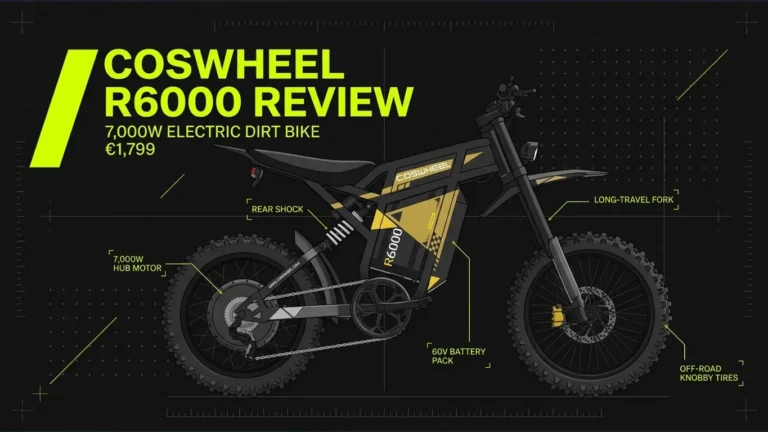
Vakole CO20 MAX — DO NOT BUY FOR EU ROAD USE
This is where Vakole’s lineup breaks down legally. The CO20 MAX pairs dual 750W motors (1500W total output) with a fat-bike frame. Top speed exceeds 50 km/h. This bike is not EN 15194 compliant. It’s a moped masquerading as a fat bike.
In the EU, riding a CO20 MAX on public roads subjects you to motorcycle licensing, insurance, registration, and helmet requirements. In the Netherlands, you’ll face a roadside dynamometer test; fail, and police seize the bike on the spot. In France, possession can mean €30,000 in fines for the retailer or seller. In the UK, unregistered high-power e-bikes are confiscated.
Vakole markets the CO20 MAX in markets with looser regulations (US, Australia, Southeast Asia). If a retailer is selling it in the EU as a “bicycle,” they’re breaking the law. Do not buy it for EU road use.
Compliance: ✗ ILLEGAL for EU public roads. Classified as moped. Avoid entirely unless you’re in a non-regulated market or can register it as a moped.
Why 2026 Is Different: The Enforcement Reality
EU regulations have existed for years, but enforcement was scattered and slow. 2026 marks a shift. Four specific enforcement trends are now visible across member states.
Netherlands: Roadside Dyno Tests
Dutch police have deployed portable dynamometer units to test e-bike power output at roadside stops. If your bike provides assistance above 25 km/h or exceeds 250W continuous output, officers can confiscate it immediately without court proceedings. This technology is new as of 2025 and is expanding across other member states in 2026.
France: Manufacturer Penalties
France has escalated enforcement against sellers and manufacturers of unlocking devices (firmware mods that remove speed limiters). Selling, distributing, or even possessing such devices can result in €30,000 fines and prison time. For riders, getting caught with a derestricted bike results in vehicle confiscation and fines up to €500.
UK: Seizure Without Warning
UK police have shifted from warning riders to immediate seizure of bikes classified as unregistered motorcycles. “Twist-and-go” throttle-only bikes are the primary target, but any bike that doesn’t meet EAPC rules (EU’s post-Brexit equivalent) is at risk of impound.
Germany: Market Surveillance Audits
German authorities are auditing retailers’ compliance certifications. If a bike is being sold with a CE mark but lacks a Declaration of Conformity (DoC) or fails to show EN 15194 testing, the retailer faces fines and mandatory recalls. This filters down to manufacturers: bikes without proper documentation are being pulled from shelves.
How to Verify Your Bike Before Riding in 2026
Enforcement is real, and guessing is no longer an option. Here’s the verification checklist.
Find the Motor Spec Sheet
Pull your bike’s manual or retailer listing. Look for the field labeled “Continuous rated power” or “Rated power output.” This is the only number that matters legally. Ignore peak power, assisted speed on flats, or any marketing claim about “powerful climbing.” The law only looks at continuous rated power. If it says ≤250W, you’re clear on power.
Check the Speed Cutoff
The motor should cut assistance at 25 km/h maximum. Most modern pedelecs do this automatically. Test it: reach 25 km/h on flat terrain in full assist mode. The motor should stop pushing. If you coast to 28 or 30 km/h without the motor re-engaging, you’re fine. If the motor keeps pushing past 25 km/h, your bike is derestricted or misconfigured.
Verify Pedal-Assist Only
Try to twist the throttle without pedaling (if your bike has one). The motor should not engage. Throttle-only activation is illegal for road use. If the motor activates without pedaling, your bike is misconfigured or is a moped-class vehicle.
Request EN 15194 Documentation
Contact the retailer or manufacturer and ask for proof of EN 15194 compliance. A reputable seller should provide either the Declaration of Conformity (DoC) or a test report from an accredited lab. If they refuse or say “it’s not required,” flag this as a red alert. A 2026 purchase without documented compliance is a legal liability.
FAQ: Common Confusion Points Cleared Up
Will my Lankeleisi MG600 Plus be seized because it has “1000W peak” in the specs?
No. EN 15194 regulates continuous rated power only. Peak power is a transient performance metric used in acceleration. A 250W rated motor with a 1000W peak is still a 250W motor legally. The bike passes the compliance baseline. You’re fine.
I bought an Engwe L20 3.0 in the US with a 1500W hub motor. Can I ride it in Europe?
No. The US Engwe L20 3.0 uses a different drive system (1500W rear hub motor) than the EU version (250W mid-drive). It is not EN 15194 compliant and will be reclassified as a moped if you try to ride it on public roads in Europe. Do not import it. Buy the EU model from Engwe EU or BuyBestGear if you’re in Europe.
Can I modify my 250W bike to go faster by removing the speed limiter?
Technically, yes. Legally, no. Derestricting—removing or bypassing the 25 km/h speed limit—reclassifies your bike as a motor vehicle. In France, selling the mod kit is a felony. In the Netherlands, riding a derestricted bike will result in confiscation if you hit a police checkpoint. Do not do this on public roads.
What happens if I get caught on a non-compliant bike?
Outcomes vary by country. In the Netherlands and UK, confiscation is immediate. In France, fines can reach €500–1,000. In Germany, fines start at €100 and escalate. Insurance is void (you’re operating an unregistered vehicle), so if you hit a car or injure a pedestrian, you’re personally liable for damages. It’s not worth the risk.
I live in Spain / Germany / Italy. Do these rules apply to me?
Yes. EN 15194 is a harmonized EU standard. Every member state enforces it. Spain, Germany, and Italy all require 250W / 25 km/h compliance for road-legal e-bikes. If you buy a bike, ensure it carries EN 15194 certification regardless of which country you’re in.
Is the Vakole CO20 MAX legal anywhere in Europe?
No. Its dual 750W motors (1500W total) and 50+ km/h top speed exceed every EU member state’s bicycle definition. It’s a moped everywhere in Europe and requires registration, insurance, and licensing. Sell it or ride it only in markets where regulations are looser (US, Australia, etc.).
Where can I buy compliant bikes with documented EN 15194 certification?
BuyBestGear is the authorized EU retailer for Engwe, Lankeleisi, and Vakole models in this article. All products listed there carry documented compliance. You can request the Declaration of Conformity directly from the retailer before purchase. Other European retailers (Canyon, Decathlon, Trek) also stock compliant models, but always verify certification before buying.
Final Verdict: What to Buy, What to Avoid
If you’re in the EU in 2026 and considering an e-bike from one of these three brands, here’s the clarity:
Engwe L20 3.0 PRO — Safest Urban Bet
Explicitly certified, folds, full suspension, 160 km range. Premium at €1,700, but compliance documentation is airtight.
Lankeleisi MG600 Lite — Budget Play
Lighter, cheaper (€1,500–1,599), fully compliant. Hub motor is sufficient for flat-to-rolling terrain. Don’t worry about the “250W rated” spec.
Vakole EMT29 — Trail Specialist
At €1,299–1,399, it undercuts competitors by hundreds while remaining trail-competent. Best value for forest paths and singletrack.
Avoid: Vakole CO20 MAX
Not a bicycle; it’s a moped in e-bike disguise. Seizure, fines, and invalidated insurance far outweigh any performance gain.
One final note: enforcement will tighten throughout 2026. The Netherlands is leading the way with roadside testing. Other member states will follow. If you buy a bike today without compliance documentation, you’re gambling that you won’t encounter a police check or customs stop. That gamble was reasonable in 2023. It’s not in 2026.
Start Compliant Shopping Code NFT4 at checkout
Buy compliant. Ride legal. Keep your bike.