
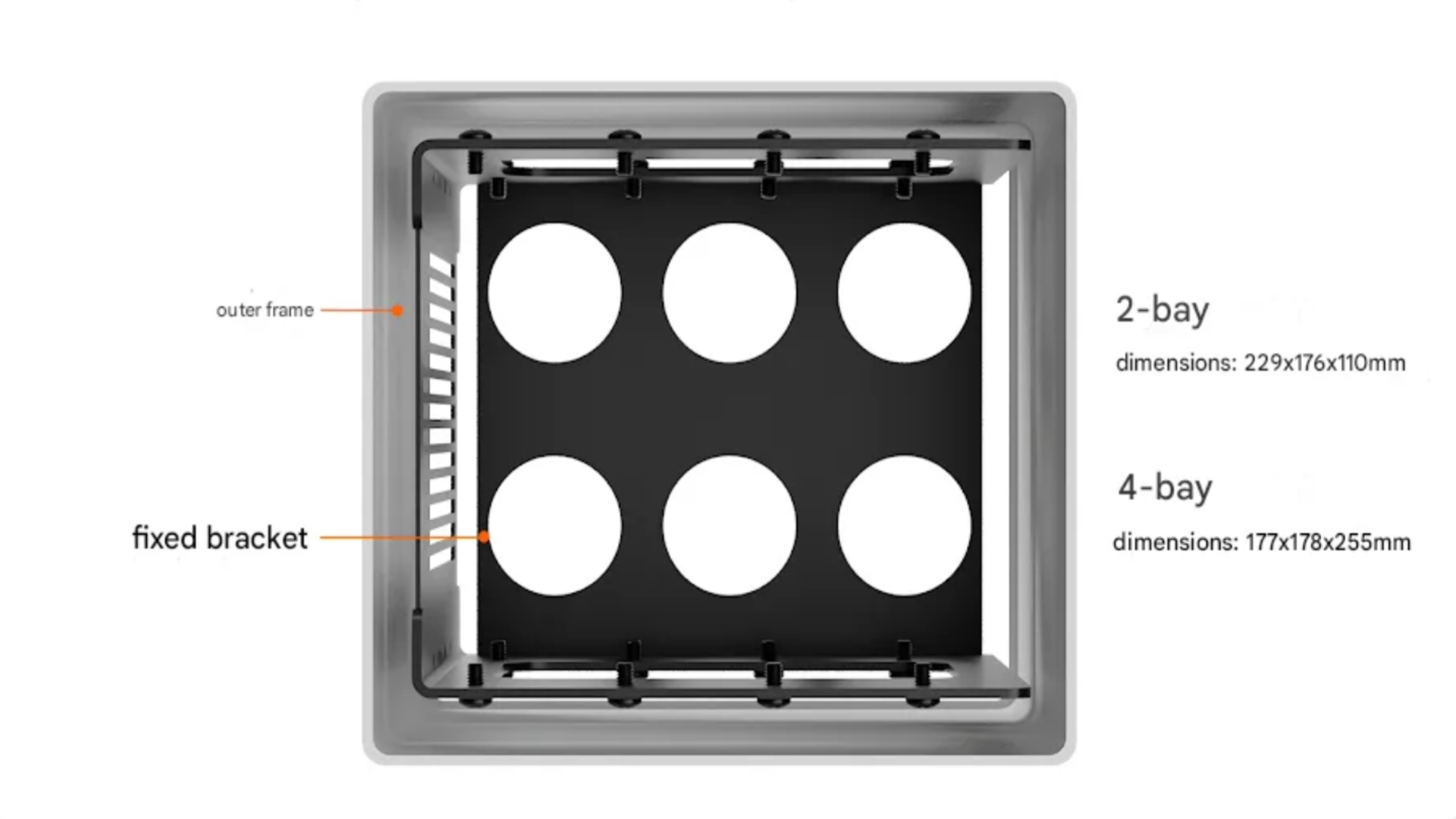
- Beelink ME Pro offers two and four bay hard drive configurations for increased flexibility
- The four-bay ME Pro has a minimal footprint and supports up to 120 TB
- The chassis uses a unibody construction, eliminating the need for the traditional frame and mount.
Beelink is preparing a compact NAS series that aims to reduce the size of multi-bay storage systems without reducing usable disk space.
A teaser has been released WeiboOriginally revealed in Chinese, the company plans two versions of the ME Pro, one with two hard drive bays and another with four hard drive bays.
The smallest model would measure 166 x 121 x 122 mm, while the largest four-bay unit would measure 166 x 166 x 146 mm.
Beelink Four-Bay ME Pro promises a capacity of 120 TB
The dimensions of these models are significantly smaller than traditional cabinets, which take up much more space on your desk or shelf.
Beelink notes that typical two-bay systems already take up more space, and many four-bay options increase significantly in height and depth.
Size matters here, as compact cases often struggle to balance internal volume, airflow and drive placement.
However, Beelink says the upcoming models will still be smaller than competitors that rely on larger designs to accommodate more hard drive slots.
The contrast is most striking on the four-bay ME Pro, which is typically around 255mm larger than the competition.
Beelink keeps the system closer to a four-liter size, an unusual level of compactness for a device that can hold enough drives to reach around 120 TB with today’s high-capacity hard drives.
The ME Pro continues the company’s evolution from the previous ME mini PC that introduced it to the storage segment.
From the trailer, it appears the device uses a unibody structure that eliminates the traditional stand and support frame, freeing up internal space in a compact chassis.
The company expects the unibody concept to reduce overall volume by half compared to previous models.
The non-Pro version uses an Intel N200 and only accepts NVMe SSDs, so the latter model may take a different approach given the move to high-end drive configurations.
The ME Pro marks an interesting shift in Beelink’s storage strategy, but some details remain under wraps.
The company has not confirmed the processor, supported SSD options or the type of networking hardware on the final models.
These factors determine the system’s performance as a true NAS rather than a simple multi-bay enclosure.
Another outstanding issue remains software support, as the choice of operating system, update strategy, and management tools affect long-term usability more than the actual design of the bag itself.
Until Beelink resolves these fundamentals, the ME Pro will find itself in an exciting but incomplete situation.