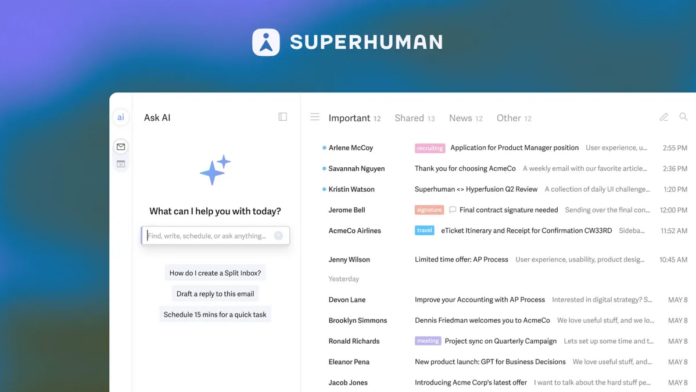
Grammarly, best known for its writing assistant software, announced Wednesday that it is changing its name to Superhuman as it focuses on a broader range of AI productivity tools.
Founded in 2009, Grammarly has built a user base of more than 40 million people and has grown in recent years with workplace platform Coda and email service Superhuman Mail. With its new identity, Superhuman aims to become a comprehensive AI-powered productivity platform that runs silently in the background of your daily work, according to the company’s announcement. The new Superhuman brand is an effort to create an “AI-native” platform designed to work with all the tools you already use, combining features from each brand into one bundled subscription.
The rebrand also includes the launch of a new product called Superhuman Go, an artificial intelligence assistant that can work across multiple applications and workflows.
“Superhuman represents a fundamental shift in how we think about artificial intelligence in the workplace,” said Shishir Mehrotra, CEO of Superhuman. “The name Superhuman reflects our belief that artificial intelligence should augment human capabilities, not replace them or force humans to adapt to their limitations.”
What you need to know about Superhuman Go
Superhuman Go is designed to help users complete everyday tasks by automatically retrieving relevant information and performing small actions through connected tools. For example, you can retrieve account information from a CRM when writing an email, summarizing notes from previous meetings, or sending a bug report to development teams.
The Assistant links to more than 100 apps, including Google Workspace, Microsoft Outlook, Jira, and Confluence. It uses so-called ‘agents’, small AI modules that are trained to perform specific tasks, such as aggregating or retrieving data.
Noam Lovinsky, Chief Product Officer, said the goal is to reduce friction rather than add new management tools.
“While other AI tools ask you to change the way you work, Go learns how you work and meets you there,” he said. “That’s the difference between an AI tool that you have to think about and an AI partner that actively works with you.”
Superhuman suite and agent platform.
The most comprehensive Superhuman suite now includes the writing features of Grammarly, Coda’s collaborative workspace, and the inbox tools of Superhuman Mail. Combined with Go, the suite aims to create a more unified experience for writing, communication and project management.
Superhuman is also launching an Agent Store with a range of integrated AI agents developed by partners. Early partners include Common Room, Fireflies, Latimer, Parallel, Radical Candor, Quizlet and Speechify. The company plans to expand this suite with an Agent SDK, which is currently in closed beta for developers and will allow third parties to create their own connected agents.
The Superhuman suite is now available to paying users and includes the new Go Assistant and a network of AI agents available in the company’s Chrome and Edge extensions. Mac and Windows versions are in the works, and all Go features can be tested for free until February 1, 2026.
The launch and expansion of Superhuman comes amid a broader wave of productive AI tools that combine writing, research and communication into a single workspace. For example, Google’s NotebookLM turns uploaded documents and printouts into summaries and study guides, while OpenAI and Google have introduced ways to use generative AI to create slideshows and the like. Presentations. This comes at a time of growing interest in productivity tools for work life, such as using “agents” for planning, cooking, training, travel and more.

