There is a self-cleaning cycle that circulates fresh water through the system. This will probably require you to empty the dirty water tank and refill the clean one during the cycle, but otherwise it is effective at removing dirt from the roller.
Dyson has also added hot air drying here – it’s loud but again effective. Even after the dirtiest cleaning task, my roller looked like new.
Aside from a few minor complaints, I was impressed with this cleaner. Whether it’s worth the asking price is another matter – I’ve tested some of the best wet and dry vacuums on the market, and unfortunately there’s not much here that’s truly exceptional.
This is the short version; Read on for my full Dyson Clean+Wash hygiene review.
Dyson Clean+Wash hygiene test: price and availability
- List price: £429.99
- Available: Now available in the UK, US and Australia
- Market launch: December 2025
The Dyson Clean+Wash Hygiene launched in the UK in December 2025 with a list price of £429.99. It’s due to be available in the US and Australia in 2026, but I don’t have any details or pricing yet – based on UK prices it could be around $600/AU$850.
It falls into the premium category of a hard floor cleaner, and while the build quality is excellent and a lot of thought has obviously been put into the design, I don’t think it’s enough to justify the price. For that much money, I would expect a suction option and special features like dirt detection, automatic adjustment, and even foam/steam functions.
- Value for money rating: 3 out of 5
Hygiene specifications for Dyson Clean+Wash
Dyson Clean+Wash hygiene test: design
- Streamlined and relatively light, can lay flat
- The waste is stored in the bottom head and separated into solids and liquids
- Self-cleaning function and hot air drying on the dock
The Dyson Clean+Wash Hygiene is a lightweight hard floor cleaner with a handful of cool design features. Given this brand’s heritage, it’s surprising that there’s no suction here: instead, it uses moisture and movement to remove dirt from hard floors.
The roller rotates at high speed and is continuously supplied with fresh water while dirty material is stripped off. It can pick up mixed solid and liquid spills and, to some extent, dust and other dry residues (although it’s not as effective here as a regular stick vacuum).
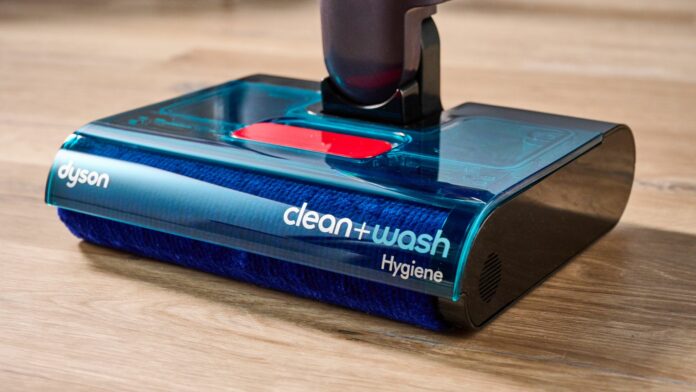
The roller is densely packed with fiber to make it as absorbent as possible, and Dyson has added stiff bristles that protrude slightly to provide extra scrubbing power. There is also an anti-tangle comb behind the roller to prevent the hair from getting tangled.
On one side the roller reaches up to the edge of the floor head, but on the other side there is a good bit of housing. If necessary, the roller can be removed for rinsing.
One of the areas where Dyson shines in its floor care range is maneuverability, but I didn’t find the Clean+Wash Hygiene to be as maneuverable as I expected. Don’t get me wrong, it’s far from bulky – its design is streamlined and rotates smoothly, but it feels a little less nimble than something like the Dyson WashG1.
I was impressed that it could lay completely flat on the ground until the whole thing was only 4.5 inches tall. A small wheel on the back of the handle makes maneuvering easier in this mode.
The dirty water compartment is integrated into the floor head itself – similar to the cleaning head of the Dyson V15s Detect Submarine. The idea is that there is no hose to clog because the dirt has nowhere to go. The liquid ends up in a waste water tank and the solid waste is filtered into a separate container.
Both compartments can be removed as a whole, but separating and then reassembling them is a little tricky compared to other wet and dry vacuums I’ve tested… not to mention more complicated.
There are three hydration modes to choose from and a Boost mode to add additional water to combat dried-on dirt. Dyson proudly claims that the 750ml fresh water tank covers an area of 350m² and leaves a sheen of moisture so fine that your floors will be dry in 60 seconds.
There are no other special modes, such as: B. automatic parameter adjustment.
A major improvement in Clean+Wash hygiene over the WashG1 is that Dyson has introduced hot air drying on the dock. So after cleaning, you run a self-cleaning cycle where fresh water runs over the roller. It is then dried with blasts of hot air (185°F/85°C), so you don’t have to struggle to take it out and leave it to dry in one place.
- Design rating: 4 out of 5
Dyson Clean+Wash hygiene test: performance
- Efficient and relatively quiet cleaning of spilled liquids and solids
- The floor head drips a little and the self-clean cycle uses a lot of water
- Mop drying rather loud but effective
I started by stocking up on clean water and started cleaning the entire floor. The roller soaked up pretty quickly without wetting it first and left a very light, even watery sheen on my vinyl floor. It’s easy to switch modes and the screen shows the remaining cleaning time, so the battery never runs out unexpectedly.
Since there is no suction, operation is relatively quiet and the running times are long. The Clean+Wash Hygiene can last up to 45 minutes per charge.
cleaning
To further assess its capabilities, I tested how the Dyson Clean+Wash Hygiene tackled a range of tricky cleaning challenges. I started with soy sauce mixed with oatmeal. In Med mode, it vacuumed up all the oatmeal in one back-and-forth pass – impressive considering there’s no suction here.
Then I decided it was time to bring out the big guns. I spread maple syrup, crunchy peanut butter and Marmite (a super sticky, gooey spread) on a vinyl floor. This time it was a bit difficult.
I activated boost mode and it took about 20 seconds to clear the mess. This is a correct result – this test is intentionally very sensitive. In addition, no sticky residue was left behind.
Like all wet and dry cleaners I know, this machine is only suitable for perfectly flat floors. It can’t handle uneven surfaces like tiles, nor can it get into the cracks between the tiles – although it does a better job than some thanks to the roller’s bristles.
interview
After my cleaning session, it was time to clean up the trash. Although I see the logic of separating liquids and solid waste and recognize the potential benefits of long-term maintenance, the emptying process seems longer than usual to me.
In contrast to the WashG1, you cannot reach into the dirty water tank to clean. The design of the tank also makes it very difficult to tell when it is filling, even though it will notify you on the screen.
I also found that the floor head had a tendency to leak or leak dirty water when handled. No wet-dry vacuum is perfect in this regard, but this Dyson machine seems particularly bad, perhaps because the waste compartments are relatively complex in design and contain many separate elements.
Then I started a self-cleaning cycle. First, the system is flushed with fresh water to remove stubborn dirt.
Almost immediately the machine stopped and asked me to fill the tank with clean water. After restarting it stopped again and asked me to empty the dirty water.
I would recommend doing both before running a self-cleaning cycle and again afterwards to avoid annoying interference. The process uses more than half a tank of fresh water and will therefore almost certainly be necessary.
Once the rinse is complete, the dock begins drying the roller with hot air. This part is also surprisingly loud, even though it only lasts about half an hour. (Other machines I’ve used take longer to dry but are much quieter, and some advanced models give you the choice of short, loud drying or long, quiet drying.) Next, I examined the roller and found that it was almost completely dry and had no significant dirt on it.
- Performance rating: 4 out of 5
Dyson Clean+Wash Hygiene: Dashboard
This is how I tested the Dyson Clean+Wash Hygiene
I used the Dyson Clean+Wash Hygiene on my hard floors for a few weeks. Aside from daily use, I ran a series of special cleaning tests to see how it reacted to different types of messes, including spills and solid substances, as well as sticky and slimy substances. I compared my results with other hard floor cleaners and evaluated whether this model offers good value for money.
Find out more about how we test
- First revision in January 2026
