Snapdragon 8 Elite Gen 5 vs Apple A19 Pro: The Real 2026 Verdict
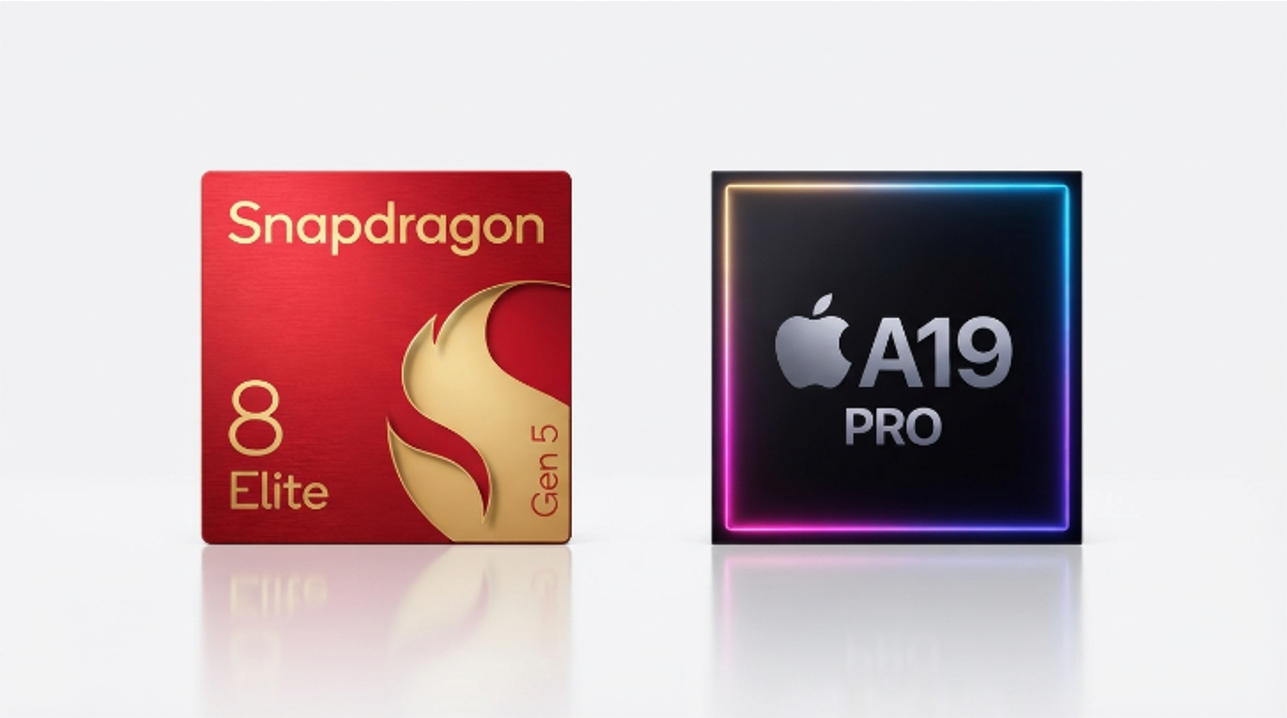
The Snapdragon 8 Elite Gen 5 vs Apple A19 Pro debate looked simple for about a week last September. Then the benchmarks rolled in, then the thermal tests rolled in behind them, and the story got messier — in the good way. One chip wins almost every synthetic score by a wide margin. The other wins the moment you run that same score twice in a row.
I’ve been tracking both platforms since Qualcomm’s Snapdragon Summit reveal in Maui last September, through the Snapdragon 8 Elite performance we already knew from the prior generation, and into the pile of independent throttling tests that came out over the following months. What follows isn’t a spec-sheet regurgitation. It’s what the numbers actually do when a phone gets warm in your hand.
Qualcomm’s 3nm flagship — the raw-benchmark leader, if the phone around it can keep it cool.
- 8-core Oryon Gen 3 CPU, up to 4.6GHz — a full two extra cores over the A19 Pro, and it shows in multi-core work
- ~3.7–4.0 million AnTuTu 11 — roughly 50% higher than the A19 Pro on the same test suite
- Adreno 840 GPU, 1,536 shaders — double the shader count of Apple’s 6-core GPU
- Throttles to ~58% of peak CPU output after 15 minutes — the cost of chasing that ceiling
Apple’s 3nm iPhone 17 Pro chip — fewer cores, lower AnTuTu, but the steadier chip once things warm up.
- 6-core CPU (2P + 4E), up to 4.26GHz — matches or beats Snapdragon single-core in most Geekbench runs
- Vapor chamber cooling in the iPhone 17 Pro — Apple’s first, and it’s doing real work here
- 16-core Neural Engine, Neural Accelerators per GPU core — built for on-device AI, not benchmark charts
- Held steadier frame pacing in Where Winds Meet — beating a liquid-cooled Android flagship at its own game
Here’s the short version: the Snapdragon 8 Elite Gen 5 wins on paper, by a lot. It loses some of that lead the second a phone has to hold that performance for more than a few minutes — which is most of what a phone actually does. The A19 Pro trails on raw numbers but degrades far less. Neither fact cancels the other out, and that’s the whole article.
Head-to-Head Comparison
Both chips are built on a 3nm process. Past that, they diverge fast — core count, GPU architecture, even which benchmark you trust. AnTuTu and Geekbench don’t agree with each other here, and that disagreement is itself the story.
| Spec | Snapdragon 8 Elite Gen 5 | Apple A19 Pro |
|---|---|---|
| Process node | 3nm (TSMC N3P) | 3nm (TSMC, second-gen) |
| CPU configuration | 8-core: 2 Prime @ 4.6GHz + 6 Performance @ 3.62GHz | 6-core: 2 Performance @ 4.26GHz + 4 Efficiency |
| GPU | Adreno 840, 1,536 shaders, hardware ray tracing | Apple A19 Pro GPU, 6-core, 768 shaders, hardware ray tracing |
| Peak GPU throughput | ~3,686 GFLOPS | ~2,488 GFLOPS |
| Memory | LPDDR5X, up to 24GB supported | LPDDR5X, 12GB in iPhone 17 Pro Max |
| Memory bandwidth | ~84.8 GB/s | ~75.8 GB/s |
| Geekbench 6 single-core (device avg.) | ~3,600–3,900 | ~3,800–3,900 |
| Geekbench 6 multi-core (device avg.) | ~10,800–12,400 | ~9,100–10,600 |
| AnTuTu 11 total (device avg.) | ~3.7–4.0 million | ~2.4–2.5 million |
| 15-minute CPU throttling floor | ~58% of peak (iQOO 15, per Beebom testing) | Not independently stress-tested to the same standard in available data — positioned as more conservative in comparative sustained-load tests |
| Neural engine claim | Hexagon NPU, 37% faster than prior gen (Qualcomm) | 16-core Neural Engine, 4x peak Neural Accelerator compute vs A18 Pro (Apple) |
| 5G modem | Snapdragon X85, up to 12.5 Gbps down | Paired with Apple’s in-house N1 wireless chip (Wi-Fi 7, Bluetooth 6) |
Look at that AnTuTu gap for a second. Fifty percent isn’t a rounding error, it’s the kind of number that would normally settle an argument. Except Geekbench single-core — arguably the more useful real-world proxy, since most phone tasks are single-thread bound — puts the two chips within a percentage point of each other in most device-level tests. That’s the first sign this isn’t a clean sweep for anyone.
Snapdragon 8 Elite Gen 5: Strengths & Limitations
Architecture and Build
Qualcomm’s third-generation Oryon core is the headline change. Two Prime cores clocked at 4.6GHz, six Performance cores at 3.62GHz, all built on TSMC’s N3P node. Qualcomm’s own claim — 20% more CPU performance and 35% better efficiency over last year’s Snapdragon 8 Elite — checks out in short-burst testing. What Qualcomm didn’t put in the press deck is what happens after burst three.
Performance and Thermals
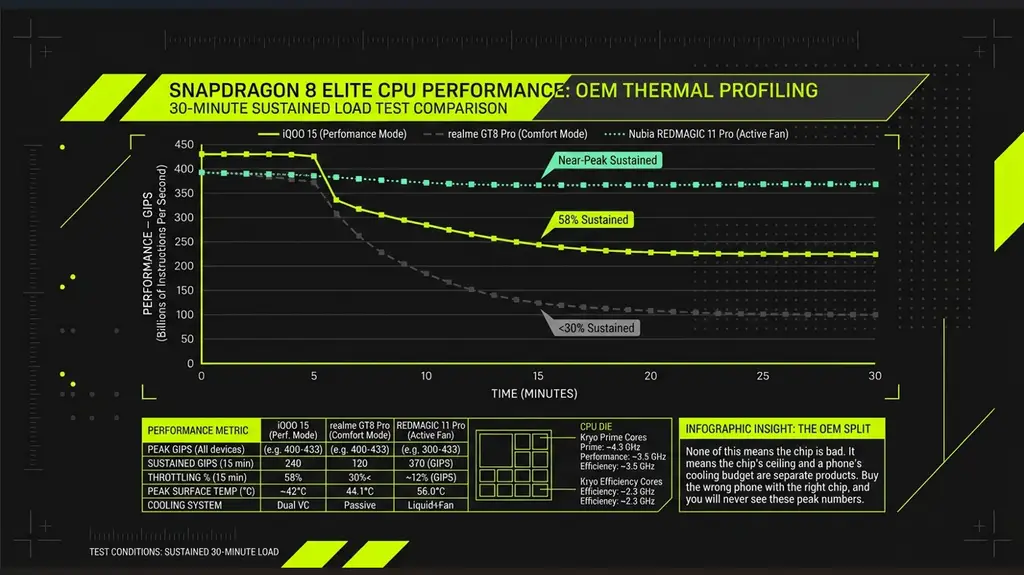
This is where it gets uncomfortable. In a 15-minute CPU throttling test on the iQOO 15, the Snapdragon 8 Elite Gen 5 held its peak clock for about three minutes before dropping to roughly 60% of maximum, settling around 58% for the rest of the run. On the realme GT8 Pro, a phone tuned for comfort rather than benchmark records, testers measured performance dropping below 30% of peak just to keep surface temperature at a still-warm 44.1°C. The Nubia REDMAGIC 11 Pro — a gaming phone with liquid cooling and an active fan — needed to hit 56°C to sustain near-peak output, which is not a temperature most people want resting against their palm during a train commute.
None of this means the chip is bad. It means the chip’s ceiling and a phone’s cooling budget are now two separate products, and OEMs are making very different bets on which one to prioritize. Buy the wrong phone with the right chip and you’ll never see the numbers on this page.
Value
The Snapdragon 8 Elite Gen 5 ships across a wider price spread than the A19 Pro ever will, because it’s licensed into everything from the Galaxy S26 Ultra down to mid-tier gaming phones running the same silicon in a “for Galaxy” or standard trim. That’s a real advantage if you want flagship-class multi-core throughput without an iPhone’s starting price. It also means the specific phone you buy matters more than the chip name on the spec sheet — the Snapdragon-versus-Exynos regional split we’ve covered before is a small taste of how much variance one chip family can carry.
Who Should Buy
Buy into the Snapdragon 8 Elite Gen 5 if you play graphically demanding Android games on a phone with active cooling — a REDMAGIC, an ROG Phone, or a Galaxy S26 Ultra you’re willing to let get warm during a long session. This is the wrong chip to chase if all you care about is a phone that stays cool during a video call and a browser tab; a mid-range Snapdragon or the base A19 will do that job with less drama.
Apple A19 Pro: Strengths & Limitations
Architecture and Build
Six cores instead of eight, but Apple’s first vapor chamber cooling system in an iPhone Pro changes what those six cores can actually do over time. The heat-forged aluminum unibody plus vapor chamber is a genuine departure from the titanium-and-glass approach of the iPhone 16 Pro, and Apple’s own claim of 40% better sustained performance under prolonged stress lines up with what independent testers have found — the chip pulls back earlier than Snapdragon’s, but it pulls back less, and it does it more predictably.
Performance and Thermals
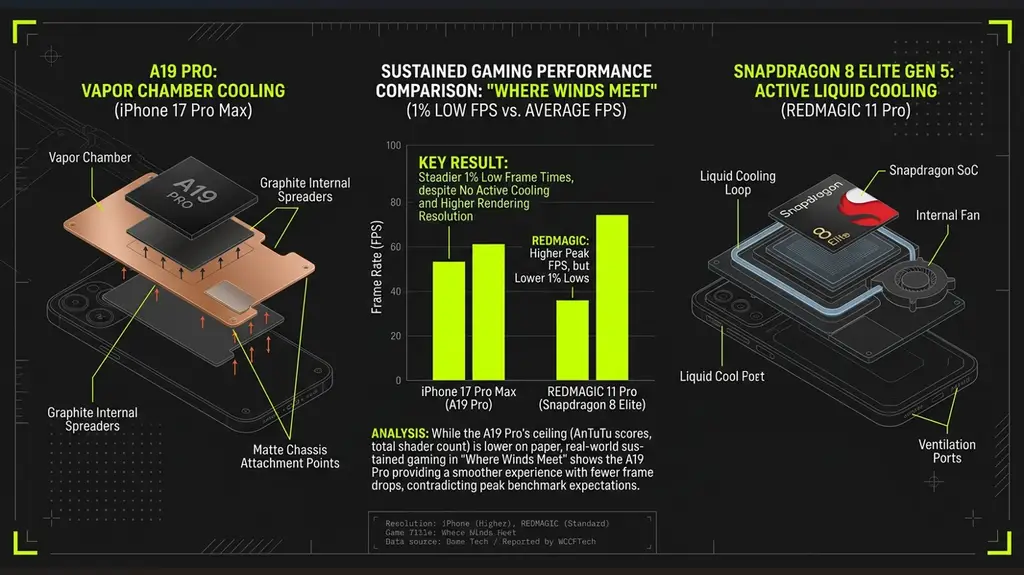
One counterintuitive result stands out, and it came from an actual game rather than a synthetic loop. In an early comparison of Where Winds Meet — tested by Dame Tech and reported by WCCFTech — the iPhone 17 Pro Max’s A19 Pro delivered steadier 1% low frame times than the REDMAGIC 11 Pro’s liquid-cooled Snapdragon 8 Elite Gen 5, at a higher rendering resolution besides. A phone with worse benchmark numbers and no active cooling beat a phone built specifically to showcase peak silicon performance. That’s not a knock on Qualcomm’s engineering so much as a reminder that AnTuTu doesn’t play video games.
The honest limitation here: the A19 Pro’s ceiling is lower. It will not hit Snapdragon’s AnTuTu numbers, full stop, and its 6-core GPU has fewer shaders on paper than the Adreno 840. If your workload genuinely saturates a chip for sustained, GPU-bound tasks — heavy on-device video export, for instance — Apple’s numbers won’t win that specific fight either.
Value
There’s no separate market for “just the A19 Pro” — you buy it bundled with the iPhone 17 Pro or Pro Max, at Apple’s price, full stop. That’s a real constraint against Qualcomm’s multi-tier licensing model, and it’s part of a broader trend worth watching: flagship phone prices have been climbing across the board, and Apple’s silicon exclusivity means you can’t shop around for a cheaper A19 Pro phone the way you can shop around for a cheaper Snapdragon one.
Who Should Buy
The A19 Pro makes sense if you play mobile games in short-to-medium sessions and care more about consistent frame pacing than a leaderboard number, or if on-device AI features matter more to you than raw throughput — Apple built the Neural Accelerators for exactly that. Skip it if benchmark bragging rights or maximum theoretical GPU output are the actual point of the purchase; that’s Qualcomm’s game to win, not Apple’s.
Category Context: The Chips Already Replacing Both of These
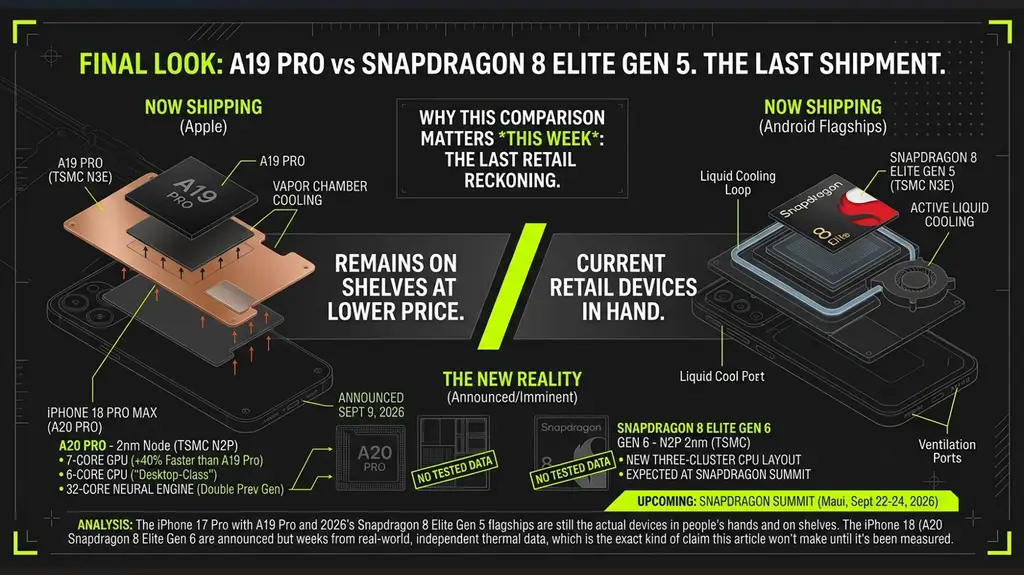
Here’s the part that makes writing this comparison right now a little strange: Apple already moved on. The company announced the iPhone 18 Pro and iPhone 18 Pro Max on September 9, 2026, with the A20 Pro chip — Apple’s first on TSMC’s 2nm node, with a 7-core GPU Apple claims is up to 40% faster than the A19 Pro’s, a 6-core CPU with “desktop-class” performance cores, and a 32-core Neural Engine, double the previous generation’s. Qualcomm isn’t far behind. The Snapdragon 8 Elite Gen 6 is expected at the Snapdragon Summit running September 22–24, 2026, in Maui, reportedly on TSMC’s N2P 2nm process with a new three-cluster CPU layout.
So why does the Snapdragon 8 Elite Gen 5 vs Apple A19 Pro comparison still matter this week? Because both chips are still what’s actually shipping and selling. The iPhone 17 Pro remains on shelves at a lower price than the 18 Pro, the Galaxy S26 Ultra and most of 2026’s Android flagships launched on the Gen 5 rather than a chip that’s still weeks from retail devices, and neither successor has independent thermal testing yet — which is exactly the kind of claim this article won’t make until it’s been measured, not just announced.
Final Verdict
Decision matrix, stripped down: if the number on the box is what matters to you — AnTuTu score, GPU shader count, multi-core Geekbench — the Snapdragon 8 Elite Gen 5 wins, and it isn’t especially close. If what matters is what the phone still does after twenty minutes of the thing you actually bought it for, the A19 Pro’s smaller, more conservative design is doing something the raw spec sheet doesn’t capture.
Snapdragon 8 Elite Gen 5 best for: Android gamers with a cooling-forward phone, anyone who wants flagship multi-core power at more than one price tier, developers benchmarking against the widest possible device pool.
Apple A19 Pro best for: users who game in short sessions and care about frame consistency over peak numbers, anyone leaning on on-device AI features day to day, buyers who’d rather not think about thermal management at all.
FAQ
Which is faster, the Snapdragon 8 Elite Gen 5 or the Apple A19 Pro?
It depends what “faster” means to you. Single-core Geekbench scores put the two chips within about 1-3% of each other across most tested devices. On multi-core and AnTuTu, the Snapdragon 8 Elite Gen 5 leads by a wide margin — often 20-50% depending on the specific device and test run.
Does the Snapdragon 8 Elite Gen 5 overheat?
It runs hot under sustained load. Independent 15-minute stress tests recorded the chip throttling to roughly 58% of peak CPU performance on the iQOO 15, and surface temperatures reaching 56°C on the liquid-cooled Nubia REDMAGIC 11 Pro during extended GPU stress. Phones with lighter cooling throttle even harder to stay comfortable to hold.
Is the A19 Pro in the iPhone 17 or just the iPhone 17 Pro?
The A19 Pro is exclusive to the iPhone 17 Pro and iPhone 17 Pro Max. The standard iPhone 17 uses the regular A19 chip with a 5-core GPU and no vapor chamber cooling — a meaningfully different chip despite the similar name.
Should I wait for the A20 Pro or Snapdragon 8 Elite Gen 6 instead?
If a purchase decision isn’t urgent, yes — both successors are landing within days of this comparison, with the A20 Pro already announced on a 2nm process and the Snapdragon 8 Elite Gen 6 expected at Snapdragon Summit on September 22-24, 2026. If you need a phone now, the A19 Pro and Snapdragon 8 Elite Gen 5 remain the best-tested, most widely available options, and prices on iPhone 17 Pro and current Android flagships are likely to soften once the new chips ship.
Which phones use the Snapdragon 8 Elite Gen 5?
The Samsung Galaxy S26 series (in a “for Galaxy” variant), OnePlus 15, Xiaomi 17 Pro, iQOO 15, realme GT8 Pro, and Nubia REDMAGIC 11 Pro all shipped on the Snapdragon 8 Elite Gen 5, alongside most other 2025-2026 Android flagships outside China’s Exynos-holdout devices.
The Bottom Line
Neither chip is the objectively better one. That’s not a cop-out, it’s the actual finding after pulling apart five benchmark databases and half a dozen thermal tests: Qualcomm built for the number on the results screen, Apple built for the twentieth minute of use. Pick based on which of those two things you’ll actually be doing with the phone — and if you can wait a few weeks, the A20 Pro and Snapdragon 8 Elite Gen 6 are about to make this whole conversation look quaint anyway.
Related Stories

WWDC 2026 Apple Keynote: What Apple Actually Needs to Deliver on June 8

Oura Ring vs AI Sleep Trackers: Which Gives Better Recovery Data?