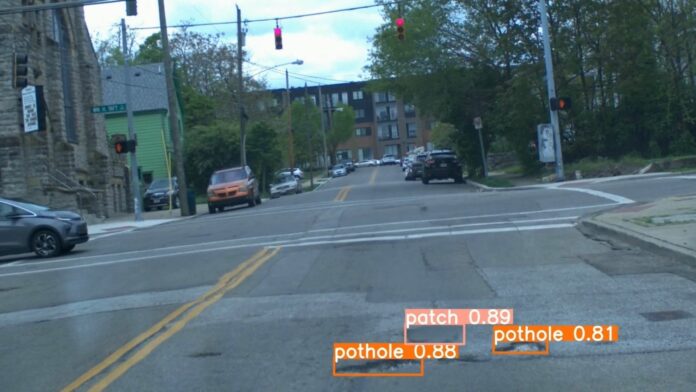
No matter where you live, potholes and bad roads can ruin any trip or excursion. With consequences ranging from bumpy driving and damage to suspension components to a complete accident, potholes are a real headache for drivers, cyclists and local authorities. Fortunately, Honda and Mercedes-Benz are trying to solve the problem in two different ways.
Honda recently partnered with DriveOhio, the Ohio Department of Transportation’s (ODOT) smart mobility center, for a pilot project it hopes can help speed up road repairs by harnessing the power of real-time data generated by vehicles that can detect and report road defects.
The project, also working with the University of Cincinnati, was created to evaluate the feasibility of an automated road condition management and reporting system, using Honda test vehicles equipped with advanced imaging sensors and LiDAR.
These vehicles then monitored approximately 3,000 miles of roads in central and southeastern Ohio, scanning the road surface for worn or obstructed traffic signs, damaged guardrails and barriers, inadequate road markings, and potholes, as well as their size and location.
One of the technology partners was i-Probe Inc., which currently supplies sensor technology to OEMs and automakers. Daisuke Oshima, the company’s president and CEO, explained that while sensors in production vehicles are primarily designed for driving and safety, their ability to “continuously collect data during daily driving creates unique value at scale.”
During the pilot program, the massive amount of data was processed using cutting-edge AI models, transferred to a Honda cloud platform for analysis, and integrated into the Parsons iNET Asset Guardian system, which could then optimize workflows to “improve the efficiency of field maintenance operations.”
According to Honda and DriveOhio, results showed the technology had a 99% accuracy rate for damaged or blocked panels, 93% for damaged railings, and an average accuracy of 89% for potholes.
Additionally, the project demonstrated that automated road condition detection by leveraging existing sensor technology and sharing data with local government agencies has the potential to save the Ohio Department of Transportation more than $4.5 million per year by reducing reliance on manual inspection time, optimizing maintenance schedules, and avoiding costly and delayed repairs through proactive inspection.
These savings could then be reinvested into fixing problems easily and efficiently, which is good news for pothole haters everywhere.
Mercedes-Benz takes a more proactive approach in this regard
The German brand recently gave its top-of-the-range S-Class one of the most comprehensive mid-life updates ever, equipping the luxury sedan with new design features and technologies, an example of which is the elimination of potholes.
All new S-Class models will be equipped with the “Airmatic” air suspension and an optional E-Active Body Control system. When the two are combined, the vehicle constantly sends information about the road surface to the Mercedes Intelligent Cloud.
You can distinguish between shorter, steeper potholes and speed bumps. Once detected, it transmits this information to other Mercedes-Benz vehicles using Car-to-X technology, allowing the suspension to automatically adjust to reduce the impact of a bump or pothole the next time the vehicle travels the road.
Of course, it’s not the permanent solution Honda is looking for, but it certainly results in a smoother, more comfortable ride for anyone who can afford to commute in the S-Class on a daily basis.
