Citrix NetScaler Zero-Day Patch: What Admins Must Do Now
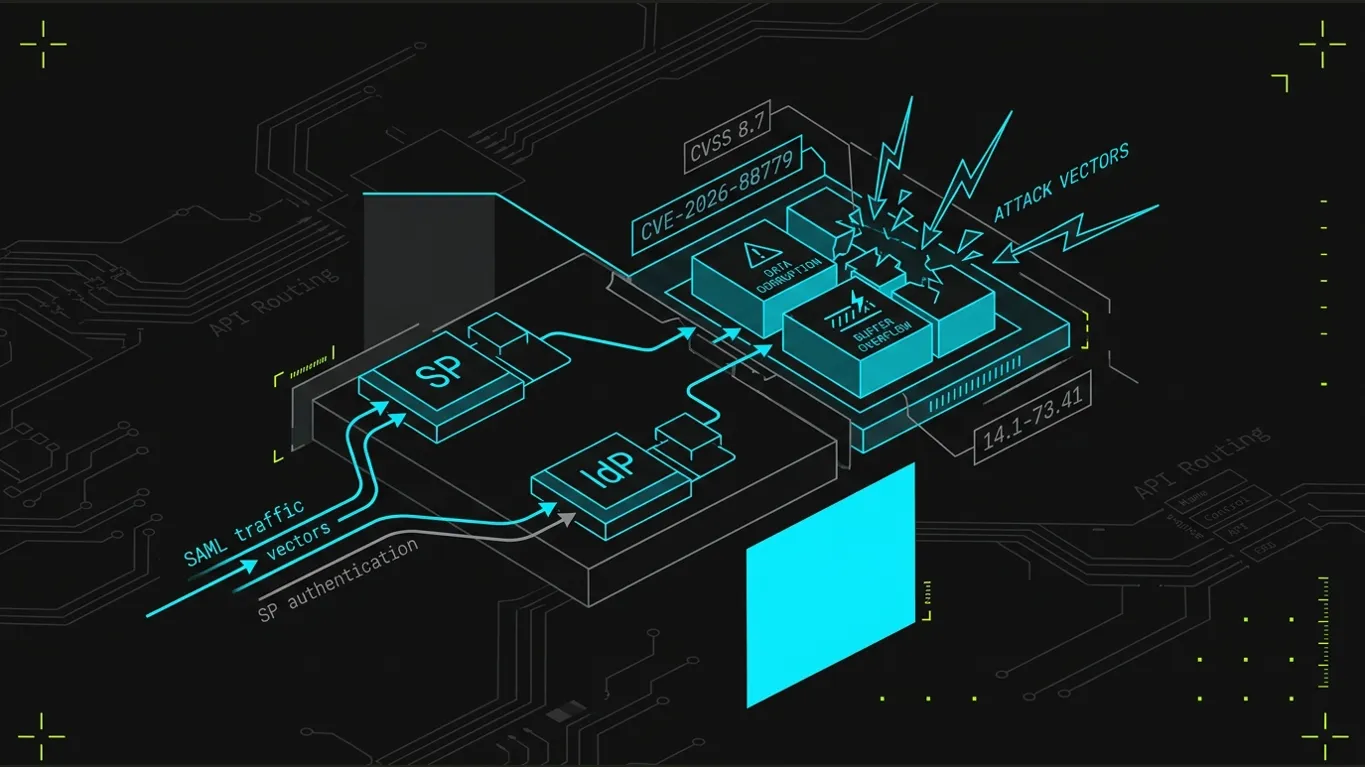
A new Citrix NetScaler zero-day is now an urgent patching issue for organizations using SAML authentication. CVE-2026-88779 is already being exploited, and Citrix says it can knock affected NetScaler appliances offline.
The flaw carries a CVSS v4.0 score of 8.7. It affects customer-managed NetScaler ADC and NetScaler Gateway systems when SAML is configured, so this is mainly an IT infrastructure story rather than a consumer device alert.
- CVE-2026-88779 is actively exploited against SAML-enabled NetScaler deployments.
- Fixed builds are 14.1-73.41 and 13.1-64.28, plus separate FIPS and NDcPP fixes.
- Citrix-managed cloud services are updated by Cloud Software Group.
- RCE concerns remain unconfirmed; Citrix currently describes the CVE as denial of service.
What happened with CVE-2026-88779
Citrix published security bulletin CTX697174 on October 3, 2026, after observing targeted attacks against unmitigated deployments. The bulletin describes a memory overflow in NetScaler ADC and NetScaler Gateway that can lead to denial of service.
The problem is configuration-dependent. A vulnerable appliance must be acting as a SAML service provider or SAML identity provider, usually alongside Gateway or AAA functionality.
CISA added CVE-2026-88779 to its Known Exploited Vulnerabilities catalog on October 4. The agency set October 7, 2026, as the remediation deadline for affected federal civilian agencies.
This flaw arrived days after Citrix patched CVE-2026-88771 and CVE-2026-88772. Those earlier flaws involved remote code execution, so administrators who patched last week still need to check again.
Why a memory overflow can still be a big outage
A memory overflow means software handles data outside the safe bounds of a memory buffer. In this case, Citrix says that failure can turn a reachable SAML authentication path into a denial-of-service condition.
That matters because NetScaler often sits between remote workers and internal applications. If the appliance repeatedly fails, users can lose gateway access or single sign-on even when the protected applications remain healthy.
The attack does not require a user to approve a prompt. Citrix’s CVSS vector also lists no required privileges or user interaction, which is why an exposed SAML endpoint deserves fast attention.
So the risk is operational as much as technical. A small business may notice the issue first as employees suddenly being unable to reach internal tools.
Who is exposed, and who is not
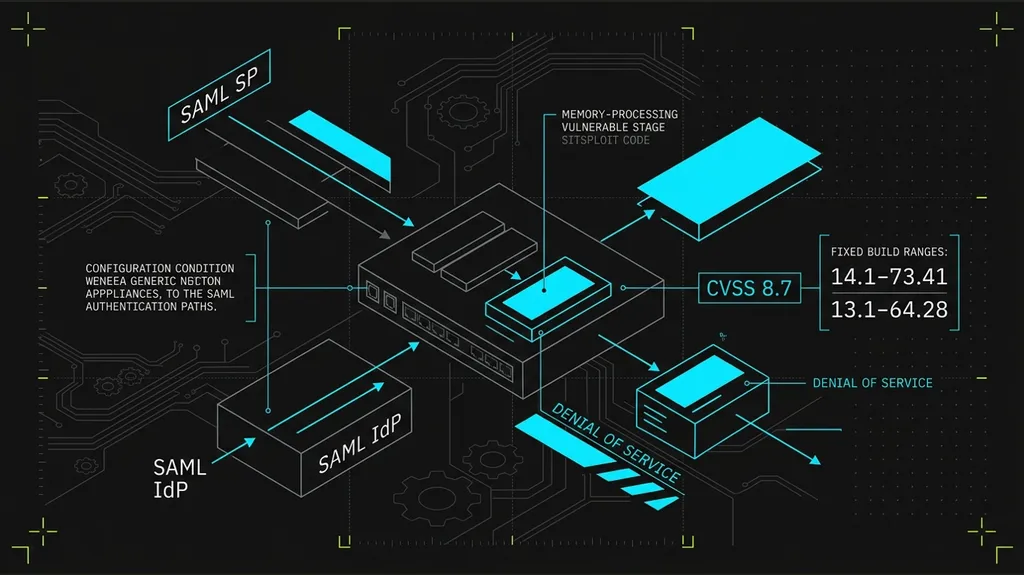
CVE-2026-88779 targets customer-managed NetScaler ADC and NetScaler Gateway appliances. The affected software lines are 14.1 before 14.1-73.41 and 13.1 before 13.1-64.28 when the SAML precondition is present.
FIPS deployments have separate fixed builds. NetScaler ADC 14.1-FIPS needs 14.1-73.41 FIPS or later, while 13.1-FIPS and 13.1-NDcPP need 13.1-37.282 or later.
Secure Private Access Hybrid deployments using NetScaler instances are also covered. By contrast, Citrix-managed cloud services and Citrix-managed Adaptive Authentication are handled by Cloud Software Group and are not covered by this customer-managed appliance bulletin.
How to check your NetScaler build and SAML setup
Start with the software build, then check the SAML configuration. Citrix’s own documentation confirms that the CLI command show ns version displays the current software version.
Next, inspect the configuration for add authentication samlAction or add authentication samlIdPProfile. The first identifies a SAML service provider setup, while the second identifies a SAML identity provider setup.
Finding one of those entries on a vulnerable build means the appliance meets the published precondition. It does not, by itself, prove that the appliance was compromised.
NetScaler Console can also identify affected instances through its CVE Detection workflow. Citrix says administrators can search for CVE-2026-88779 and start an upgrade workflow from the impacted-instance list.
DoS or remote code execution?
Citrix’s confirmed position is denial of service. The vendor says repeated triggering can leave the service unavailable, and its analysis found no impact on the integrity of customer data.
Still, the incident has produced troubling observations. Administrators reported crafted authentication requests containing shell commands, while security researcher Kevin Beaumont said a patched honeypot was running a downloaded malware binary.
Those reports deserve attention, but they do not prove that CVE-2026-88779 itself provides remote code execution. The activity could involve another flaw, a bypass, or an interaction with the broader NetScaler attacks.
watchTowr reproduced CVE-2026-88779 and later told SecurityWeek that it assessed the vulnerability as a crash-only denial-of-service bug. Tenable also reported on October 4 that no public proof of concept for this CVE was known then.
I would treat the uncertainty as an incident-response reason, not a reason to delay the patch. A rebooting or unexpectedly crashing SAML gateway should be investigated even after the update.
What to do first
First, identify every customer-managed NetScaler ADC and Gateway instance, including systems maintained by an MSP. Record each branch, build number, SAML configuration, and recent reboot history.
Next, move affected 14.1 appliances to 14.1-73.41 or later. Move affected 13.1 appliances to 13.1-64.28 or later, and use the matching FIPS or NDcPP build where required.
Citrix provides an interim mitigation through Global Deny List signatures. For standard non-FIPS systems, the vendor says this option applies to appliances on 14.1 builds from 14.1-73.37 through the fixed build, or 13.1 builds from 13.1-64.23 through the fixed build, when managed through NetScaler Console.
Citrix says the relevant signature set should show version 24 or newer. Administrators can also inspect stat denylist global AAA_REQUEST and review the rule counters and Last Hit Time to confirm activity is being recorded.
The mitigation is a stopgap, not a replacement for the fixed build. Citrix’s bulletin remains the controlling source for the supported versions and configuration conditions.
What changed after the September NetScaler fixes
The previous wave of NetScaler bugs was already serious. Citrix disclosed eight vulnerabilities on September 27, including CVE-2026-88771 and CVE-2026-88772, with fixes for standard 14.1 and 13.1 deployments.
But CVE-2026-88779 is independent of that earlier bulletin. The new SAML flaw means an appliance can be fully patched for the September issues and still require another upgrade.
This is why version numbers matter more than the phrase “fully patched.” Ask for the exact build, then compare it with the CVE-2026-88779 advisory.
Why the latest patch still matters
The awkward part is that some teams may already believe they are finished. The September 27 fixes for CVE-2026-88771 through CVE-2026-88778 moved standard branches to 14.1-73.37 or 13.1-64.23, but those builds are not enough for CVE-2026-88779 when SAML is enabled.
That creates a narrow but important patch gap. A company that upgraded last week can still have an exposed appliance today if it uses the required SAML configuration.
For small businesses, the first question is not technical. It is ownership: does your company, MSP, or hosting provider operate a customer-managed NetScaler?
If the answer is yes, ask for the exact build and SAML status rather than accepting a generic “we patched Citrix.” That simple check closes the most obvious ambiguity in this incident.
What small businesses should watch for
A NetScaler gateway sits at the edge of a business network, so an outage can affect remote access and single sign-on at the same time. For a small company, that can quickly become a staff-access problem rather than a narrow security event.
Watch for repeated appliance restarts, authentication failures, unexplained crashes of the authentication service, or unusual requests reaching SAML endpoints. Those signals do not prove exploitation, but they warrant a closer look during an active campaign.
Preserve logs and support bundles before making destructive changes when compromise is suspected. Citrix says its IoC scan is an initial assessment tool, not a substitute for forensic investigation.
A clean IoC result also does not prove that an appliance was never compromised. If there is independent evidence of malicious activity, keep the incident-response process running instead of treating a successful patch as cleanup.
Frequently Asked Questions
01 Does CVE-2026-88779 affect every NetScaler?
02 How do I check whether NetScaler uses SAML?
03 Is CVE-2026-88779 confirmed as remote code execution?
What to watch next
The immediate deadline is October 7, 2026, but the investigation is likely to continue after that date. The key question is whether the suspicious post-patch activity becomes technically linked to CVE-2026-88779 or proves to be a separate attack path.
For now, the defensible position is clear: patch affected customer-managed NetScaler systems, verify the SAML condition, use Citrix’s interim mitigation when needed, and investigate signs of compromise.
Read the Citrix security bulletin for the authoritative affected-build list and remediation guidance. The CISA KEV entry is the key government record for active exploitation.