Microsoft Rewards Explained: How Points Work and What They’re Actually Worth

The premise sounds engineered to make you suspicious. A loyalty program run by one of the world’s largest technology companies that pays you in gift cards for searching the web — with no subscription, no catch, and no credit card required. That skepticism is reasonable. What Microsoft Rewards actually is sits somewhere between a genuine financial perk and a cleverly designed behavior-change engine, and understanding exactly which side of that line it lands on requires getting specific about numbers.
- Each Microsoft Rewards point is worth between $0.00076 and $0.001 — meaning you need roughly 5,000 points to redeem a $5 gift card, and that rate improves slightly at higher redemption volumes.
- Level 1 members can earn points on up to 10 PC searches per day; Level 2 members are capped at 30 per day and also unlock mobile search earning — a confirmed doubling of daily potential from search alone.
- As of October 2025, Xbox Game Pass Ultimate subscribers can earn up to 100,000 points per year through gameplay — up from 58,000 the previous year — making the Xbox path the highest-volume earning route in the program.
- Contrary to widespread belief, most account bans are triggered by automated search scripts, VPN usage, or cross-region redemption attempts — not arbitrary throttling of legitimate users.
- Points expire if your account earns or redeems nothing for 12 consecutive months, per official Microsoft support documentation.
Last updated: 2026-03-30 · Sources linked inline
Microsoft Rewards is a free loyalty program tied to your Microsoft account. You accumulate points by searching with Bing, browsing in Edge, engaging with daily quizzes on the Rewards dashboard, shopping at the Microsoft Store, and playing games through Xbox. Those points are then redeemable for digital gift cards, sweepstakes entries, or charitable donations. The program launched originally as Bing Rewards in 2010, expanded into its current form under the Microsoft Rewards name, and has since been integrated across the entire Microsoft product ecosystem.
Contents
Microsoft Rewards Explained: The Short Version
The Points System
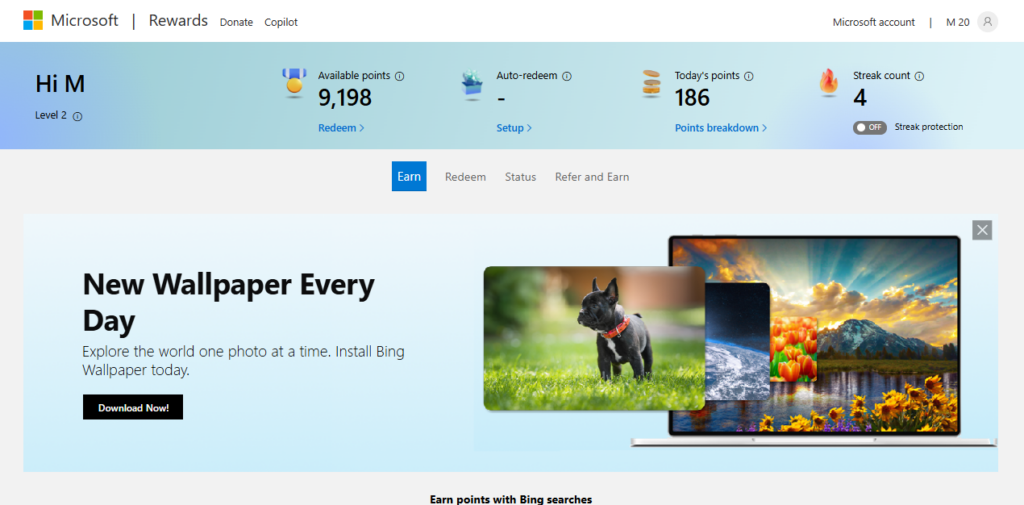
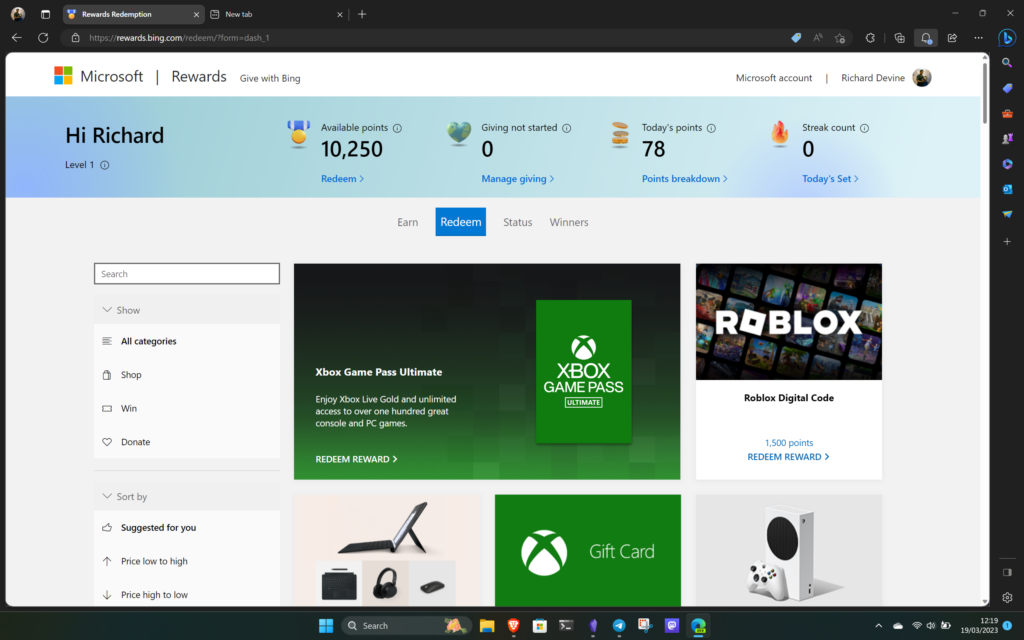
Every action inside the Microsoft Rewards ecosystem produces a fixed number of points. A single Bing search on PC earns 5 points. Completing a daily quiz might yield 30 to 50 points. Buying a game at the Microsoft Store at Level 2 earns 10 points for every dollar spent. According to Microsoft’s Edge Learning Center, 1,000 points translates to roughly $1 in redemption value — or more precisely, $0.00076 to $0.001 per point depending on what you redeem and your account level. That figure sets the ceiling. You are not beating it through clever optimization.
What You Can Do With Points
The official Microsoft Rewards catalog organizes redemptions by minimum point thresholds: sweepstakes entries from 200 points, nonprofit donations from 1,000, Microsoft Store and Xbox gift cards from 1,600, and third-party retailer gift cards (Amazon, Starbucks, Target, and others — availability varies by region) from 5,000 points. A $5 gift card at major retailers costs 5,000 points. A $100 gift card runs approximately 91,000 points, which is a marginally better per-point rate but still within the $0.001 ceiling.
The Two Membership Levels
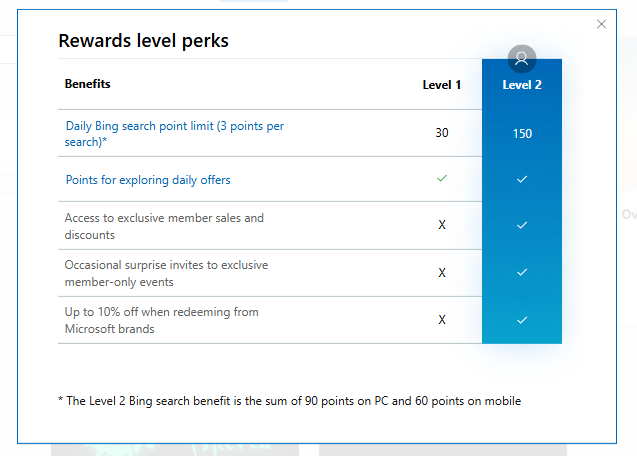
The program runs on two tiers. Level 1 is automatic — anyone with a Microsoft account who visits the dashboard is enrolled. Level 2 requires earning at least 500 points per month, which a consistent Bing user can hit in under three weeks. Level 2 unlocks mobile search earning (an additional 5 points per search), raises the daily PC search cap from 10 to 30 searches, increases the Microsoft Store multiplier from 1 point per dollar to 10, and grants access to exclusive redemption discounts on Microsoft-branded gift cards.
How Microsoft Rewards Actually Works
The Earning Mechanics — and Where the Cap Bites
The daily search cap is the number most guides quietly omit. At Level 1, points accrue on a maximum of 10 PC searches per day. At Level 2, the cap rises to 30 daily PC searches. At 5 points per search, a Level 1 user caps out at 50 points per day from search; a Level 2 user peaks at 150 points per day from PC search plus an additional 150 from mobile (30 mobile searches at 5 points each). Add the daily quiz and trivia points — which typically total 40 to 60 points — and a Level 2 user doing everything correctly can realistically accumulate 300 to 360 points per day from routine activity.
Over a full month, that ceiling sits around 9,000 to 10,000 points — consistent with what Pure Xbox reported in May 2025 based on community feedback across their Xbox readership. At $0.001 per point, that translates to approximately $9 to $10 per month for a committed Level 2 user who hits the cap daily without missing a day. A Level 1 user who completes only PC searches and daily quizzes might accumulate 2,000 to 2,500 points per month, enough for a sweepstakes entry several times over but short of the 5,000-point threshold for a third-party gift card.
What Most Explanations Skip: The Xbox Layer
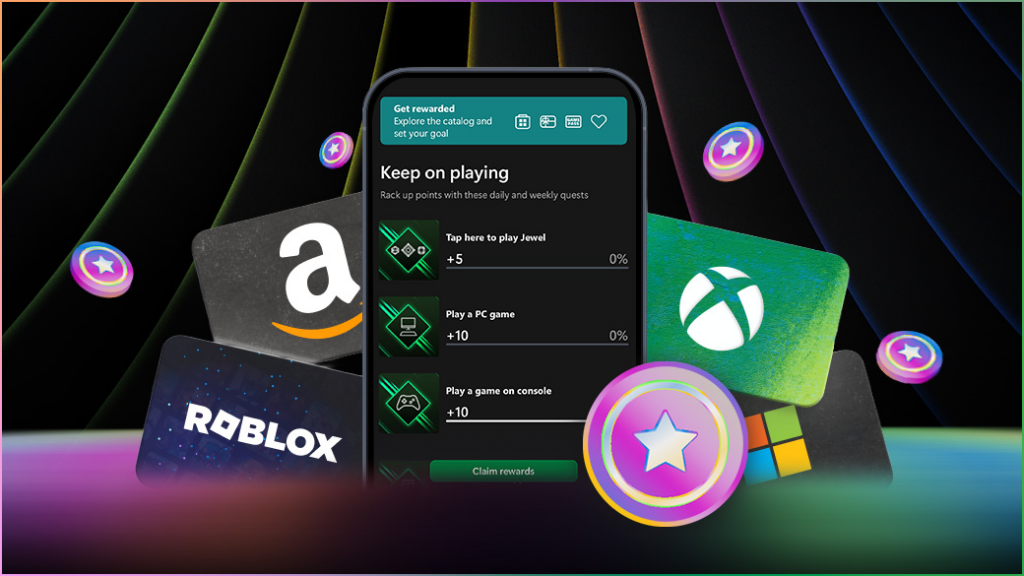
The Xbox Game Pass integration is where the earning math shifts decisively. As of October 2025, according to Xbox’s official Rewards page, Game Pass Ultimate subscribers can earn up to 100,000 points per year through gameplay, quests, and store purchases — up from 58,000 the prior year. Premium and Ultimate members earn 2× and 4× points respectively on qualifying Microsoft Store purchases. The Xbox auto-redeem feature converts accumulated points into monthly Xbox gift credit automatically, bypassing the manual redemption process entirely. For regular Xbox users, this path produces the most consistent value with the least friction.
That said, Xbox quest eligibility requires being 18 or older, a Microsoft account in a supported market, and minimum playtime for each quest. Subscriptions and gift card purchases at the store do not earn points, and a single item only qualifies for one Rewards offer at a time — details buried in the fine print that meaningfully limit earning for users who primarily buy subscriptions.
A Concrete Example
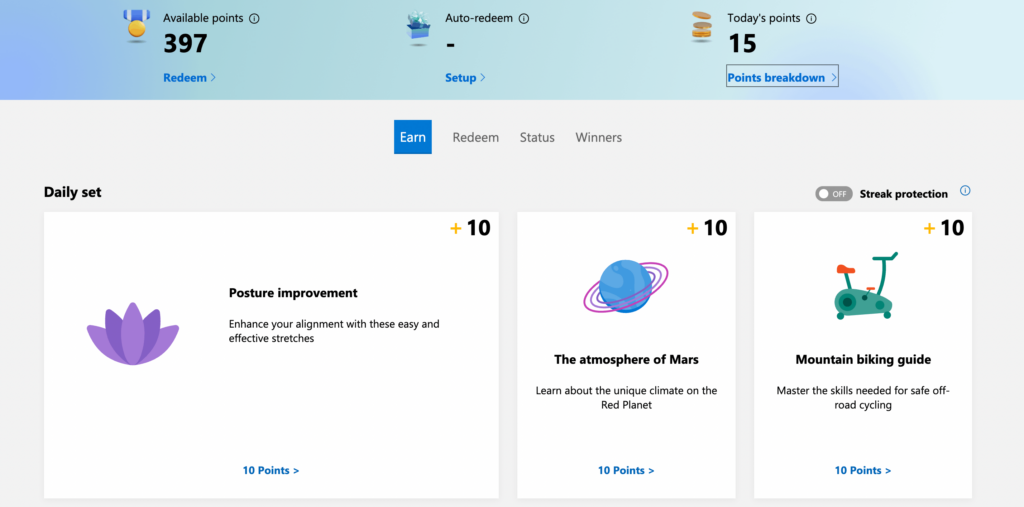
A Level 2 user who completes 30 PC searches, 30 mobile searches, and the daily quiz set every day for 60 days will accumulate approximately 18,000 to 20,000 points. That is enough to redeem a $10 Microsoft Store gift card (roughly 10,000 points) and still have a buffer. The same user who misses a week of quizzes but maintains searches lands at around 15,000 — still above the 5,000-point threshold for third-party gift cards. The math holds, provided the account stays active and does not hit a search cap violation.
Common Misconceptions About Microsoft Rewards
“Microsoft Rewards Is a Scam”
The program is legitimate. As an independent analysis published by MacMyths in March 2026 put it, the program is “neither a scam nor a side hustle, but a low-friction loyalty program.” Gift card redemptions deliver digitally, often within the same day. The program has operated continuously since 2010. Microsoft Corporation — one of the world’s largest publicly traded companies — operates it directly, with no intermediary platform involved.
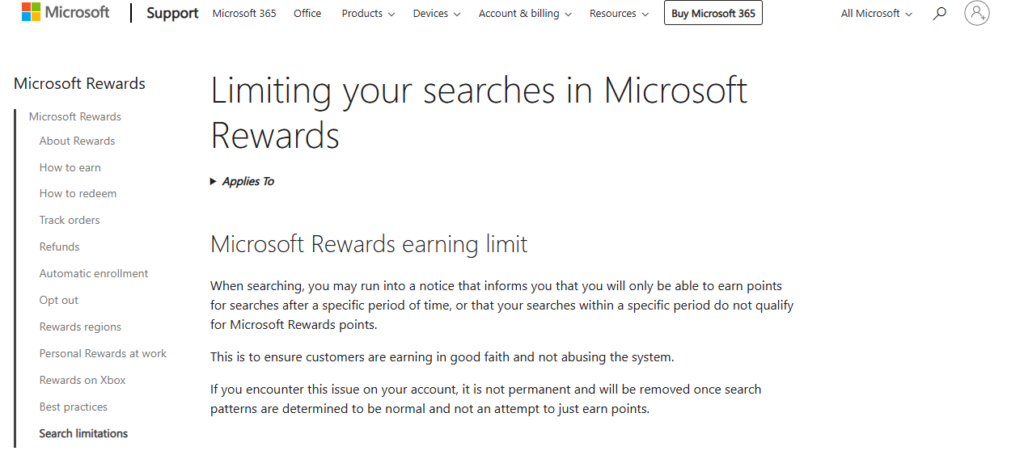
What feeds the scam narrative is the account ban pattern. Accounts do get flagged and restricted, sometimes with little explanation. But as MacMyths noted in their March 2026 analysis, documented ban causes — automated search scripts, VPN usage to exploit regional pricing differences, or exceeding the household limit of six accounts per phone number — align with the Microsoft support page on program best practices. The enforcement explanation Microsoft provides is frequently vague, which fuels legitimate frustration. But the underlying incentive structure — preserving advertiser trust by preventing artificial engagement — explains why the bans happen, even if individual communications are poor.
“You Can Earn Meaningful Passive Income Through Microsoft Rewards”
You cannot. The math does not support it. At the Level 2 monthly ceiling of approximately 10,000 points — reported by the Pure Xbox community in May 2025 — the maximum monthly value is around $10. That requires consistent daily engagement: 30 PC searches, 30 mobile searches, and the daily quiz set, every day, without missing. At any realistic conversion, the effective hourly rate for time spent actively optimizing the program runs below $2 per hour. This is a rebate on behavior you already exhibit, not a secondary income stream.
For users who simply have Bing set as their default search engine and check the quiz once a day, the value feels additive because no deliberate effort is added. For users who treat it as a hustle and spend 20 minutes daily gaming the system, the return does not justify the time. The program is worth joining. It is not worth obsessing over.
Real-World Applications
For Xbox and Game Pass Users
This is where Microsoft Rewards delivers its most consistent value. If you already hold an Xbox Game Pass Ultimate subscription and play regularly, the October 2025 cap increase to 100,000 points per year through gameplay means you can realistically accumulate enough points for $50 to $100 in Xbox credit annually — purely from gaming you were doing anyway. The auto-redeem feature deposits points into your Microsoft account balance monthly. There is no redemption queue to compete with, no third-party inventory to run out. If you own an Xbox Series X, enabling Microsoft Rewards on your console and keeping the Rewards hub checked weekly is one of the lowest-effort ways to extract recurring value from hardware you already own.
For Everyday Bing and Edge Users
Set Bing as your default search engine in Edge, log in with your Microsoft account, and visit the Rewards dashboard once a day to complete the quiz set. That routine — totaling perhaps four minutes daily — will accumulate 5,000 to 6,000 points per month at Level 2. Over three months, that reaches the threshold for a $10 to $15 third-party gift card. Whether switching to Bing from Google is an acceptable trade-off depends on how much you rely on Google’s search quality for professional or research use — Bing’s results for general queries are comparable, but for highly technical or niche research, the difference is still noticeable.
For Charitable Giving
The donation path is underutilized. Microsoft Rewards lets members convert points into cash donations to over one million nonprofits. The minimum is 1,000 points for a donation. For users who have no interest in gift cards but want to direct the value somewhere, this option converts idle points into real-world impact. Points sitting unused past 12 months expire anyway, per the official Microsoft Rewards redemption support page, making a periodic donation a better outcome than forfeiture.
Microsoft Rewards vs. Alternatives
| Dimension | Microsoft Rewards | Google Opinion Rewards |
|---|---|---|
| Primary earn method | Search, quizzes, Xbox gameplay, store purchases | Survey responses |
| Earning consistency | Daily cap — predictable but limited | Irregular — surveys vary in frequency |
| Point-to-cash rate | ~$0.001 per point | $0.10–$1.00 per survey |
| Redemption options | Gift cards, Xbox credit, donations, sweepstakes | Google Play credit only |
| Account ban risk | Moderate — flags automated or VPN activity | Low — surveys are inherently human-verified |
| Gaming ecosystem tie-in | Deep — Xbox quests, Game Pass integration | None |
| Monthly earning ceiling | ~$10 at Level 2 (search-only path) | Not established — depends on survey availability |
Key Differences: Microsoft Rewards is the stronger choice for users already embedded in the Microsoft ecosystem — particularly Xbox Game Pass subscribers, who gain disproportionate value from the gameplay earning path. Google Opinion Rewards suits Android users who want occasional Play Store credit without any daily habit commitment and who are comfortable with unpredictable survey frequency. Neither program is appropriate as a substitute for income. For users outside Microsoft’s primary supported markets, Google Opinion Rewards may offer better redemption availability, since Microsoft Rewards eligibility, reward catalog selection, and point-earning rates vary significantly by region — a limitation explicitly noted in Microsoft’s own terms.
What the Future Looks Like
The October 2025 Xbox cap increase — confirmed directly on Xbox’s official Rewards page — suggests Microsoft is actively investing in the gaming earning path rather than scaling it back. The simultaneous integration of Copilot and AI features across Edge and Bing also creates natural openings for new earning activities tied to AI-assisted search and browsing. Whether those become point-eligible interactions has not been announced as of March 2026, and Microsoft has not published a roadmap for the Rewards program.
The persistent friction point — account throttling and opaque ban enforcement — has not been addressed in any public statement from Microsoft. The pattern of users flagged for “automated behavior” without specific explanation has been consistent across the Microsoft Q&A forums and Trustpilot since at least 2024. Whether that changes depends on whether Microsoft prioritizes reducing false-positive enforcement — something that would cost them in advertiser-integrity terms if done carelessly. Until there is a transparent appeals mechanism with specific ban reasoning, that limitation remains real and unresolved.
Frequently Asked Questions
How do you earn Microsoft Rewards points?
Is Microsoft Rewards worth it?
How many points do you need for a gift card?
Do Microsoft Rewards points expire?
What is the difference between Microsoft Rewards Level 1 and Level 2?
Is Microsoft Rewards a scam?
The Bottom Line
Microsoft Rewards is what it says it is: a free loyalty program that converts existing Microsoft product usage into low-denomination gift cards and store credit. The math is public, the mechanics are documented, and the value ceiling is real. A committed Level 2 user accumulates roughly $9 to $10 per month; an Xbox Game Pass Ultimate subscriber following the October 2025 updated earning rules can realistically reach $50 to $100 annually in Xbox credit through gameplay alone. Those numbers are not spectacular, but they require no additional spending to achieve. Joining Microsoft Rewards takes under two minutes for anyone with an existing Microsoft account.
The program is not for users who want to maximize financial return on time invested, who rely on Google for professional research and are unwilling to switch, or who live in markets where reward availability is limited. It is also not for anyone who runs automated scripts, VPNs, or multi-account setups — enforcement exists, even if explanation often doesn’t. For the significant portion of PC users who already use Edge and Bing as defaults, and for Xbox subscribers who are gaming regularly anyway, the Rewards program is essentially free money sitting unclaimed. The only people who should ignore it entirely are those who have no Microsoft products in their daily workflow at all. If you want to explore the privacy trade-offs of Microsoft’s AI features more broadly, our analysis of Copilot Vision in Windows 11 covers what Microsoft collects and why it matters.