The Real Reason People Are Leaving iPhone for Android in 2026

Something shifted in February 2026. Apple released iOS 26.3 with a feature that would have been unthinkable five years ago: a built-in tool to help iPhone users switch to Android. Not a third-party workaround. Not a buried support document. A native Settings option labeled “Transfer to Android” that sits right there in General > Transfer or Reset iPhone.
The question isn’t whether people are switching. The question is why Apple is suddenly making it easier—and what that reveals about the smartphone market’s new physics.
- iOS 26.3’s “Transfer to Android” tool was mandated by EU Digital Markets Act compliance—not voluntary Apple innovation
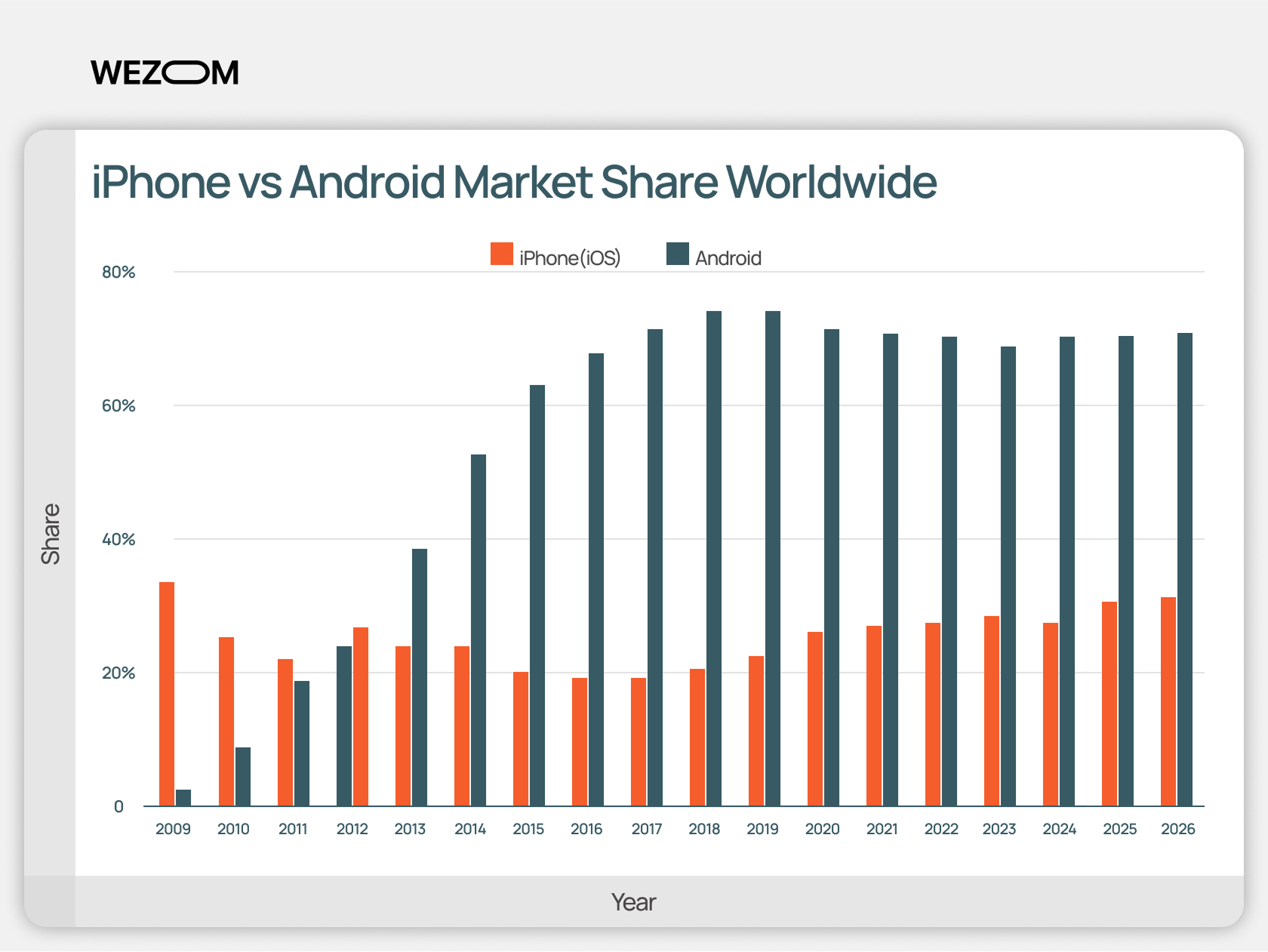
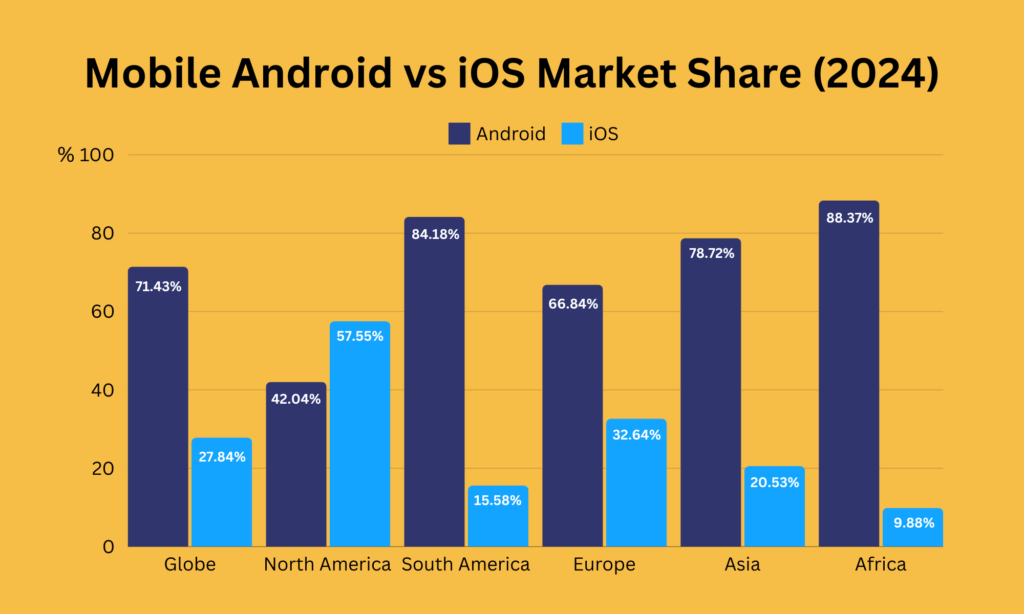
- Android holds 70.36% global market share vs iOS’s 29.25%, but iOS dominates US with 59.8%—creating regional switching dynamics
- Gen Z reassesses mobile plans every 3-6 months vs annual cycles for older demographics, accelerating platform fluidity
- The “ecosystem lock-in” myth is eroding: iMessage history remains trapped, but core data now transfers seamlessly
- Price pressure and AI feature gaps are the primary pull factors, not iOS deficiencies
Last updated: 2026-03-26 · Sources linked inline
Platform switching in 2026 is fundamentally different from previous years. According to OXIO’s 2026 Mobile Consumer Survey, 7 in 10 consumers now reassess their mobile plans at least once annually, with Gen Z reviewing options as frequently as every 3 to 6 months. This represents a behavioral shift: smartphones are no longer static commitments but dynamic service relationships subject to continuous evaluation. Price remains the primary trigger, with 58% citing bill increases as the leading reason they reconsider their provider.
The structural barriers that once made switching nearly impossible are collapsing. eSIM adoption has reached 44% of consumers, with 85% describing the experience as positive. Nearly half of consumers say instant eSIM activation would make them more likely to switch providers—a figure that rises to 64% among Millennials and 69% among Gen Z. Lower switching friction is reshaping mobile competition at the carrier level, and now, with iOS 26.3, it’s reshaping platform competition too.
Contents
Platform Switching Explained: The Short Version

Platform switching in 2026 is the movement of users between iOS and Android ecosystems, enabled by regulatory mandates and technical improvements that reduce “exit penalties.” According to StatCounter data from February 2026, Android holds 70.36% of the global smartphone market compared to iOS’s 29.25%. In raw numbers, that’s approximately 3.9 billion Android users versus 1.56 billion iPhone users worldwide. Yet in the United States, the dynamic inverts: iOS commands 59.8% market share versus Android’s 40%.
This geographic split creates two distinct switching narratives. In global markets, Android’s dominance is driven by price accessibility and hardware variety—from $200 Xiaomi devices to $1,800 Samsung foldables. In the US, iOS maintains cultural and economic premiums, with iPhone users earning an average of $53,251 annually compared to $37,040 for Android users according to 2026 demographic data. The switching flow is increasingly bidirectional: budget-conscious iPhone users moving to mid-range Android flagships, and power users seeking AI features or customization moving in the same direction.
Why the Switching Barriers Fell in 2026
The European Union’s Digital Markets Act (DMA), enforced since March 2024, designated Apple and Google as “gatekeepers” and mandated interoperability measures. The European Commission explicitly stated in December 2025 that Apple’s new data transfer tools were “the direct result of the DMA, which requires designated services to ensure effective data portability.” This regulatory pressure—not voluntary corporate goodwill—drove iOS 26.3’s “Transfer to Android” feature.
The technical implementation is straightforward: users place devices side by side, scan a QR code, and transfer apps, photos, messages, contacts, call history, calendars, and even eSIM phone numbers wirelessly. Health data, Bluetooth-paired devices, and locked notes remain excluded—deliberate limitations that preserve some ecosystem friction. The feature works worldwide, not just in Europe, because Apple’s compliance architecture is global.
How Platform Switching Actually Works in 2026
The mechanics of switching have evolved from manual data reconstruction to near-seamless migration. iOS 26.3’s transfer tool requires both devices to run current software, connect to Wi-Fi, and enable Bluetooth. The process initiates either during Android setup by scanning a QR code, or mid-cycle through Settings > General > Transfer or Reset iPhone > Transfer to Android. Transfer time varies from 15 minutes for light users to over an hour for photo-heavy libraries.
What actually transfers matters more than how. The supported data list reveals Apple’s strategic calculus: photos, videos, contacts, calendars, call history, messages, apps (free versions only), accessibility settings, wallpaper, and home screen layout all move. eSIM transfers work with supported carriers including AT&T, T-Mobile, Verizon in the US, and major carriers in Japan, Germany, France, and the UK. What doesn’t transfer—health data, Apple Watch pairings, locked notes—represents the remaining lock-in points Apple preserves.
The Economic Logic of Switching
Android’s value proposition has sharpened significantly. Mid-range Android flagships from Google Pixel, Samsung Galaxy A-series, and OnePlus now deliver 90% of premium iPhone performance at 50-60% of the cost. The Google Pixel 10 Pro offers a 48-megapixel camera, advanced AI tools, and MagSafe-compatible charging via “Pixel Snap”—directly addressing iPhone switcher concerns about accessory compatibility.
More significantly, Android manufacturers have closed the software support gap. Samsung and Google now offer seven years of OS updates for flagship devices, exceeding Apple’s informal six-year support window. The myth that Android phones “don’t last” has been empirically debunked: OnePlus, realme, vivo, and OPPO promise 1,600 charging cycles before battery capacity drops to 80%, compared to iPhone’s 1,000 cycles. Battery replacement costs 50-70% less on Android devices, and independent repair access is legally mandated in more jurisdictions.
Common Misconceptions About Leaving iPhone
Three persistent myths prevent rational platform evaluation. Each deserves examination with current data.
“Android Phones Don’t Get Updates”
This was accurate in 2015. It is not accurate in 2026. Samsung Galaxy S24 series and Google Pixel 8 series receive seven years of updates—matching or exceeding iPhone support. The fragmentation problem persists only at the budget tier, where Motorola and lesser-known brands still offer two-year commitments. The critical distinction: if you spend iPhone money on Android, you receive iPhone-equivalent or superior update longevity. The correlation is price-tier, not platform.
“iMessage Lock-in Is Inescapable”
The social pressure of “green bubbles” is real but technically surmountable. Google’s RCS (Rich Communication Services) implementation now delivers typing indicators, high-resolution media sharing, and end-to-end encryption across Android devices and, since late 2024, between Android and iOS when carriers support it. The iMessage history export problem remains—Apple provides no native tool to extract message archives—but forward-looking communication is increasingly platform-agnostic. For users whose social circles span both platforms, third-party apps like WhatsApp, Signal, and Telegram have already replaced SMS as the default.
“Ecosystem Investment Makes Switching Impossible”

This is the most durable myth—and the one iOS 26.3 most directly addresses. Apple Watch, AirPods, and HomeKit devices do create genuine switching costs. However, empirical research from early 2026 migration experiments reveals these costs are procedural, not technical. Users who systematically deregister from Apple services, export photos via Google Photos, and replace hardware incrementally report successful transitions within 30 days. The “exit penalty” is real but finite, and regulatory pressure is systematically reducing it.
Video: A 15-Year iPhone User Switches to Android
Real-World Impact: Who’s Actually Switching
The switching demographic defies simple characterization. OXIO’s 2026 survey reveals generational divergence: Millennials and Gen Z exit family plans between ages 19 and 22, nearly 15 years earlier than Boomers and Gen X. The driver is autonomy—45% of Gen Z cite wanting their own plan, and 44% want more control over features and usage. This independence impulse extends to platform choice.
Three distinct switching profiles emerge from 2026 data:
- Value Seekers: Users with iPhone 12 or older models facing battery degradation or storage constraints who discover that mid-range Android devices ($400-600) deliver superior specs to entry-level current iPhones ($800+). This group represents the largest switching volume.
- AI Early Adopters: Users prioritizing Google’s Gemini integration, Circle to Search, and real-time translation features that remain technically superior to Apple Intelligence’s current implementation. This group skews younger and more technically engaged.
- Customization Demanded: Users who have hit iOS’s customization ceiling—limited home screen layouts, restricted default app selection, and the absence of sideloading (in non-EU markets)—and seek Android’s open ecosystem.
The wrong fit for switching? Users deeply embedded in Apple’s services layer—Apple Fitness+ subscribers, heavy Apple TV+ watchers, or those with extensive HomeKit automation—face higher friction that may not justify the transition. Similarly, users whose social circles are entirely iMessage-dependent may find the “green bubble” stigma socially costly despite technical workarounds.
iPhone vs Android: The 2026 Comparison
| Dimension | iPhone (iOS) | Android |
|---|---|---|
| Global Market Share | 29.25% | 70.36% |
| US Market Share | 59.8% | 40.0% |
| Average User Income | $53,251 | $37,040 |
| Monthly App Spending | ~$11.20 | ~$1.70 |
| Software Support (Flagships) | ~6 years (informal) | 7 years (Samsung/Google) |
| AI Integration | Apple Intelligence (Siri) | Gemini (Google Assistant) |
| Hardware Price Range | $429–$1,599 | $100–$1,800+ |
| Customization Depth | Limited | Extensive |
| Ecosystem Lock-in | Strong (Watch, AirPods, HomeKit) | Weaker (cross-platform services) |
Key Differences: iPhone remains the correct choice for users prioritizing privacy-by-default, seamless cross-device integration with other Apple products, and guaranteed long-term software support without manufacturer variation. Android is the correct choice for users prioritizing hardware variety, price flexibility, AI feature advancement, and system customization. The “better” platform depends entirely on which of these vectors a user values most—and whether they’re willing to pay the Apple premium for ecosystem coherence.
What Happens Next: Platform Fluidity or New Lock-in?
The smartphone market is approaching an inflection point. Apple and Google are collaborating on switching tools not because they want to, but because the EU Digital Markets Act mandates data portability. This regulatory pressure is reducing “exit penalties”—the costs and friction that keep users locked in ecosystems.
Two futures are possible. In the first, platform fluidity becomes the norm: users switch between iOS and Android based on annual hardware improvements, price promotions, or feature needs, treating smartphones as the commodity appliances they objectively are. In the second, new lock-in mechanisms emerge—perhaps through AI assistant loyalty, cloud service entrenchment, or wearable ecosystem dependencies—that recreate the switching barriers iOS 26.3 just dismantled.
Current evidence supports the fluidity scenario. 74% of consumers switched brands in the past year across all product categories, and 80% now prioritize value for money over brand loyalty. In mobile specifically, eSIM adoption and simplified data transfer are reducing the technical barriers that once justified ecosystem commitment. The psychological barrier—familiarity, sunk cost, social pressure—remains, but it is eroding with each successful switch narrative shared on platforms like YouTube and Reddit.
What remains uncertain is whether Apple will continue to resist full interoperability. Health data, Apple Watch functionality, and iMessage history remain deliberately excluded from iOS 26.3’s transfer capabilities. These are not technical limitations—they are strategic moats. Whether regulators eventually mandate their bridging will determine if true platform fluidity arrives, or if the current opening is merely a regulated exception to continued ecosystem lock-in.
Frequently Asked Questions
Why is Apple making it easier to switch to Android in 2026?
Apple’s iOS 26.3 “Transfer to Android” feature is not voluntary innovation—it is regulatory compliance. The European Union’s Digital Markets Act, enforced since March 2024, designated Apple as a “gatekeeper” and mandated data portability to prevent ecosystem lock-in. The European Commission explicitly stated in December 2025 that these tools were “the direct result of the DMA.” While the feature rolls out globally, its origin is regulatory pressure, not corporate goodwill.
What data can be transferred from iPhone to Android with iOS 26.3?
iOS 26.3 supports transfer of photos, videos, contacts, calendars, call history, messages, apps (free versions downloaded from Google Play), accessibility settings, wallpaper, home screen layout, and eSIM phone numbers (with supported carriers). Notably excluded: Health app data, Bluetooth-paired device information, locked notes, and iMessage history archives. These exclusions represent Apple’s remaining lock-in points.
Is it worth switching from iPhone to Android in 2026?
The calculation depends on your priorities. Android offers superior price-to-performance ratios, faster AI feature deployment, deeper customization, and hardware variety including foldables. iPhone offers stronger privacy defaults, more consistent cross-device integration, and guaranteed software support timelines. Users with heavy Apple ecosystem investments (Apple Watch, HomeKit, Fitness+) face higher switching costs that may not justify the transition. Users with aging iPhones seeking value should evaluate mid-range Android flagships from Google, Samsung, or OnePlus.
What are the main reasons people leave iPhone for Android?
Primary drivers include: (1) Price—mid-range Android devices deliver flagship specs at 50-60% of iPhone costs; (2) AI features—Google’s Gemini integration leads Apple’s current implementation; (3) Customization—Android permits deeper system-level personalization; (4) Hardware variety—foldables, gaming phones, and camera-specialized devices unavailable from Apple; (5) Reduced switching friction—iOS 26.3 and eSIM adoption have lowered technical barriers. The “why now” is as important as the “why”: regulatory pressure and generational attitude shifts toward platform fluidity.
Does switching from iPhone to Android save money?
Generally, yes—over a 3-year ownership cycle. Android flagships cost 30-50% less upfront than comparable iPhones. Repair costs (screen replacement, battery swaps) are 50-70% lower. However, app repurchases may offset some savings if you owned paid iOS apps without Android equivalents. The largest savings accrue to users who would have purchased AppleCare+ and premium accessories, which Android manufacturers typically include or discount. For budget-conscious users, the value proposition is compelling; for ecosystem-embedded users, the calculation is more complex.
The Bottom Line
The real reason people are leaving iPhone for Android in 2026 is not that Android became radically better, or that iPhone became radically worse. It is that the barriers preventing rational platform choice are finally falling—and not by accident. Regulatory pressure from the EU Digital Markets Act forced Apple’s hand, reducing the “exit penalty” that kept users locked in ecosystems regardless of their best interests.
This creates a test for consumers. With switching friction reduced, the question becomes whether users will actually evaluate platforms on merits rather than inertia. The data suggests they will: Gen Z reassesses mobile choices every 3-6 months, 74% of consumers switched brands last year, and 80% now prioritize value over loyalty. The smartphone duopoly is not ending, but the assumption that users must pick one side and stay there is.
For iPhone users considering Android, the practical advice is simple: evaluate your ecosystem dependencies honestly. If you’re not deeply invested in Apple Watch, HomeKit, or Fitness+, the technical barriers to switching are now manageable. If you are, the remaining lock-in points—deliberately preserved by Apple—may still justify staying. The choice is finally yours to make, not Apple’s to trap.
Continue exploring mobile platform dynamics with our coverage of Google’s AI roadmap and the latest Samsung hardware developments.