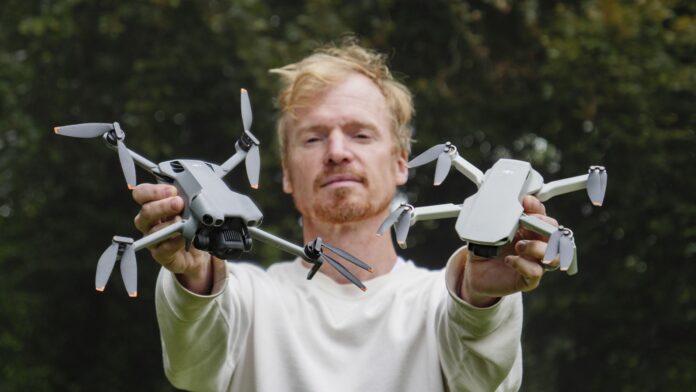
Expensive 249g drone with 1-inch sensor, rotating camera, 4K video up to 120 frames per second and slow motion recording, as well as omnidirectional object detection and subject tracking.
Budget drone under 250g with 1/2.3″ sensor, 4K video up to 30 frames per second, no object detection or subject tracking features.
DJI raised the bar for entry-level drones this week with the launch of the Mini 5 Pro. It’s the best sub-250g drone I’ve flown, with a top-notch camera and flight features.
With a larger 1-inch sensor and improved safety features and flight modes, it’s a solid step up from its successor, the Mini 4 Pro. The price is the same, too. So if you’re a first-time buyer, there’s no competition between these Mini Pro models.
If you compare the capabilities of DJI’s latest flagship mini drone to other current models, particularly the Mini 4K, it’s also a no-brainer for the Mini 5 Pro.
However, the Mini 5 Pro costs about three times as much as the Mini 4K, and when I tested the base model, I called it “your best first drone.”
Should I continue with these words now that the Mini 5 Pro is on the scene? What weight under 250g makes the most sense? Let’s explain the key points in more detail.
1. Price and availability
- DJI Mini 5 Pro starts at £689 / AU$1,119 (currently not available in US)
- DJI Mini 4K from $299 / £240 / AU$499
If you’re on a budget, the basic Mini 4K seems like the obvious choice, costing only about 35% of the price of the Mini 5 Pro.
Both models are available as a standard kit or as a Fly More Combo kit. The Mini 4K costs $299 / £269 / AU$499, while the Fly More Combo with RC-N1C controller costs $449 / £399 / AU$699 (it’s currently on sale at around 10-15% off).
Meanwhile, the Mini 5 Pro costs £689 / AU$1,119 on its own, or you can pay £869 / AU$1,419 for the Fly More Combo with RC-N3 controller or £979 / AU$1,699 for the Fly More Combo RC 2.
There’s no typo above regarding US pricing – if you’re in the US, you have no choice right now as the Mini 5 Pro, like other recent DJI products like the Mavic 4 Pro, is not available in the US DJI Store.
Is the Mini 4K the cheapest drone regardless of availability and therefore offers the best price-performance ratio? From experience I would say not necessarily.
I have a Mini 4K and it has had some serious problems because it lacks some security features that the Mini 5 Pro has; the more expensive drone will probably serve you for years and I think it’s worth the extra cost. Let’s see why…
2. Security features
- DJI Mini 5 Pro: Next-generation LiDAR and omnidirectional object detection
- DJI Mini 4K: Downward-facing sensors for takeoff and landing only
A big difference between the Mini 5 Pro and the Mini 4K is the flight safety features that one has and the other does not.
The Mini 5 Pro features omnidirectional object detection that detects nearby hazards and prevents the drone from colliding with them. I have done several flights with the “Pro” model and the object detection works very well, even while tracking the subject.
In addition, it now has front LiDAR, which improves the detection of the drone in low light conditions; This is an improvement over the Mini 4 Pro.
The Mini 4K, on the other hand, does not have that function: the only sensors it contains are oriented downwards and guarantee safe takeoff and landing.
I’ve been using the Mini 4K for a long time and it keeps crashing into branches and other obstacles. It has shown remarkable robustness to continue functioning, but I feel that the countdown to its useful life is ending.
The lack of safety features also affects my courage to drive the Mini 4K. I avoid getting too close to objects, which certainly affects where I fly and the dynamics of the videos I create.
On the contrary, with the Mini 5 Pro I have more confidence in flying and I enjoy flying more, and this is also noticeable in the videos I make. Speaking of videos…
3. Video recording
- DJI Mini 5 Pro: 1-inch sensor with 4K recording up to 120 fps, 1080p slow motion, D Log M color profile
- DJI Mini 4K: 1/2.3-inch sensor with 4K video at 30 frames per second, standard color profile only
Both drones record 4K videos, but that’s where the similarity ends. The Mini 5 Pro has a much larger 1-inch sensor for better video quality in daylight and low-light conditions, and the same goes for the Mini 4 Pro as well.
It also records video with a 10-bit color depth, which is 13 times more colors than the 8-bit color depth of the Mini 4K. There’s also a wider range of color profiles on the Mini 5 Pro: both have a standard color profile, while the Pro model also has the flat D Log M profile (which requires calibration but contains more highlight detail).
You also get a better range of frame rates with the Mini 5 Pro: it can record 10-bit 4K video at up to 60fps and also offers slow-motion recording at 120fps, which can be increased to 240fps if you drop the resolution to 1080p.
The Mini 4K only records 4K videos at up to 30 frames per second, while it can double that speed for 2.7K videos.
4. The camera
- DJI Mini 5 Pro: 3-axis gimbal and 225-degree pan rotation, 50MP still images
- DJI Mini 4K: 3-axis gimbal, 12 MP photos
Both drones feature a 3-axis mechanical gimbal to stabilize their respective cameras, allowing for a smooth live viewing and video recording experience. However, the Mini 5 Pro’s gimbal is the more versatile of the two, as it has a rotation range of 225 degrees.
By rotating the roller, you can switch between landscape and portrait orientation with the push of a button. This means taking vertical photos and videos for social media is much easier with the Mini 5 Pro.
For stills, the Mini 5 Pro can capture 50MP photos, while the Mini 4K is limited to 12MP. Both offer lower quality digital zoom, but with the Mini 5 Pro you can at least get better results by cropping larger photos if you need a more precise perspective.
5. Flight
- DJI Mini 5 Pro: 2788 mAh battery and flight time of 36 minutes, maximum speed of 19 m/s, transmission up to 20 km, ActiveTrack 360°, QuickShots
- DJI Mini 4K: 2,250 mAh battery and 31 minutes of flight, transmission up to 10 km, QuickShots
There isn’t much difference between the two drones in terms of flight performance, but the Mini 5 Pro outperforms the Mini 4K in all key areas. Its larger battery allows for 10-15% longer flight time, its top speed is slightly higher, and it features DJI’s 04+ video transmission to double the range.
Both drones feature DJI’s QuickShots flight motion palette, a selection of beginner-friendly automatic motions that can be used to create dynamic videos, usually around a selected subject.
However, the Mini 5 Pro is the only drone here with DJI’s ActiveTrack 360° mode. It follows the subject and keeps it in the center of the frame. Combined with object detection, it can track subjects even in difficult scenes such as forests.
DJI Mini 5 Pro vs. DJI Mini 4K: first verdict
If you’re looking for the most powerful drone under 250g, there’s no competition – the DJI Mini 5 Pro wins across the board over the Mini 4K.
The only thing going for the entry-level Mini 4K is its significantly lower price. However, since it doesn’t have the advanced security features of the advanced Mini 5 Pro, I don’t think it offers better value for money; As the saying goes, “buy cheap, buy twice.”
I already have a Mini 4K, but if I had the Mini 5 Pro, I know which drone I would use every time. The more expensive model flies better, you can get it closer to the action without fear of collisions, and it produces higher quality aerial photos.
A small advantage of the Mini 5 Pro is the 42GB of built-in storage, so you can still record video even if you forget a memory card. Do you want my advice? If possible, I would spend the extra money on the Pro model.
Maybe you like it too
- Best entry-level drones for 2025: Best flight cameras for new pilots
- I had a lot of fun flying the Insta360 Antigravity; Believe me, it’s the most exciting drone in years, with huge potential for video creation.
- Crowdfunding begins for the world’s first “seaplane camera” – here’s what you need to know about the HoverAir Aqua
