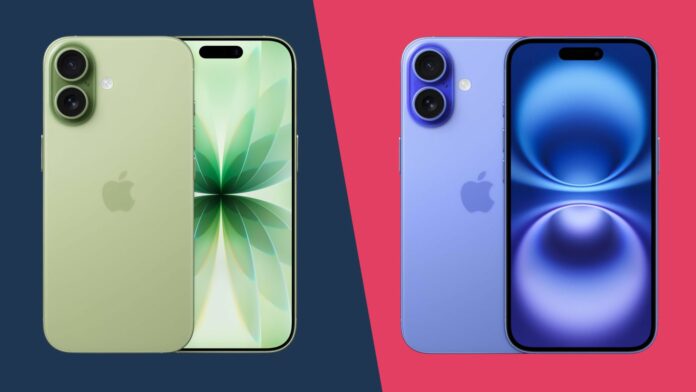
With a 120Hz refresh rate, the iPhone 17 finally catches up with Android. That makes a difference, as do the improved ultra-wide-angle and selfie cameras, and the performance improvements are also welcome.
The iPhone 16 falls behind the iPhone 17 in many aspects, including cameras and refresh rates. But it’s also cheaper, smaller and lighter, which could still be a very attractive option for some buyers.
The iPhone 17 is Apple’s entry-level iPhone model for 2025, but it received some notable improvements over last year’s base model, including some we’ve been waiting for for years, like a display with a 120Hz refresh rate.
On the other hand, some things are the same or similar to last year, so it’s not a complete overhaul.
So have we done enough to justify a purchase? Or should you stick with the iPhone 16? Below is a closer look at how these two phones compare to help you make a decision.
iPhone 17 vs. iPhone 16: Technical data comparison
Before we take a detailed look at the specifications and features of these phones, the table below provides a quick overview of their key specifications so you can see at a glance how they compare.
iPhone 17 vs iPhone 16: Price and availability
The iPhone 17 shipped on September 19, 2025 and is widely available worldwide. The iPhone 16 was released around the same time in 2024 and is also widely available as Apple still sells it.
As for price, the iPhone 17 starts at $799 / £799 / AU$1,399, giving you a model with 256GB of storage. There’s also a 512GB version for $999 / £999 / AU$1,799.
The iPhone 16 launched at the same price of $799 / £799 / AU$1,399, but since the launch of the iPhone 17 the price has dropped to $699 / £699 / AU$1,249. However, that’s only 128GB of storage, so you’re getting half of what the iPhone 17 offers to begin with.
There was also a 256GB model of the iPhone 16 for $899 / £899 / AU$1,599 and a 512GB model for $1,099 / £1,099 / AU$1,949, but these have been discontinued.
Winner: iPhone 16, unless you need extra storage
iPhone 17 vs iPhone 16: Design
While most of the iPhone 17 series has been redesigned, the iPhone 17 itself is very similar to the iPhone 16, as both phones feature a glass back that houses a dual-lens camera.
Both also feature an aluminum frame, a flat panel with a Dynamic Island cutout on top, an action button, a camera control button, and an IP68 rating for water and dust resistance.
So what’s different? Well, the colors available are a little different: the iPhone 17 is sold in black, white, misty blue, sage and lavender, while the iPhone 16 is available in black, white, pink, teal and ultramarine.
The iPhone 17 also uses Ceramic Shield 2 on its screen, which is said to offer three times the scratch resistance of the original Ceramic Shield on the iPhone 16 screen.
And their weights and dimensions are slightly different: the iPhone 17 measures 149.6 x 71.5 x 8 mm and 177 g, while the iPhone 16 measures 147.6 x 71.6 x 7.8 mm and 170 g. The new phone is therefore a little bigger, thicker and heavier.
Winner: iPhone 17 thanks to Ceramic Shield 2
iPhone 17 vs iPhone 16: Display
The iPhone 17 display has changed a lot as this phone features a 6.3-inch 1206 x 2622 OLED display with 460 pixels per inch, a 120Hz refresh rate, and a maximum brightness of 3000 nits.
The iPhone 16, on the other hand, has a 6.1-inch OLED display with 1,179 x 2,556 pixels, 460 pixels per inch, a 60Hz refresh rate, and a maximum brightness of 2,000 nits.
So the iPhone 17’s screen is larger, it has a much higher refresh rate – which was described as a “really cool upgrade” in our iPhone 17 review – and it can get much brighter. Its refresh rate can also be much lower than the iPhone 16 when a high refresh rate is not needed, meaning it can also support an always-on display, something the iPhone 16 cannot.
All of this represents a significant improvement to the iPhone 17’s front screen; in fact, it is one of the biggest advantages over the previous model.
Winner: iPhone 17
iPhone 17 vs iPhone 16: Cameras
The iPhone 17 also features improved cameras, as it features a 48MP f/1.6 main sensor, a 48MP f/2.2 ultra-wide-angle (with a 120-degree field of view), and an 18MP f/1.9 center-stage front camera. The latter feature allows you to take photos in portrait or landscape orientation without having to physically turn the phone over.
The iPhone 16 has the same 48MP f/1.6 main camera, but then it has a 12MP f/2.2 ultrawide camera (with 120-degree field of view) and a 12MP f/1.9 front camera (without center stage). Therefore, its ultra-wide-angle and selfie cameras are less efficient.
However, both phones can record 4K quality videos at up to 60 frames per second or 1080p at up to 240 frames per second.
Our iPhone 17 review praised its cameras, describing them as “excellent” and “very versatile,” making it worth considering an iPhone 17.
Winner: iPhone 17
iPhone 17 vs iPhone 16: Performance and Software
The iPhone 17 is also a more powerful phone than the iPhone 16, with a new A19 chipset instead of its predecessor’s A18. This change offers “excellent performance,” according to our iPhone 17 review, although both phones have 8GB of RAM and the iPhone 16 is still a fast phone, so ask yourself if you really need all the extra power of the iPhone 17.
Both phones also run iOS 26, although the iPhone 17 is new, it will likely support software updates for longer.
Winner: iPhone 17
iPhone 17 vs iPhone 16: Battery
Now let’s move on to the battery, which has also been updated for the iPhone 17. This phone has a capacity of 3,692 mAh, up from 3,561 mAh for the iPhone 16. Of course, it also has a larger screen for power, and neither capacity is particularly large.
How is life going? Well, Apple claims that the iPhone 17 can last up to 30 hours of video playback, while the iPhone 16 only lasts for 22 hours.
So that’s a big eight hour difference. However, we didn’t see any major changes in our iPhone 17 review: “It can still last all day, but there are no major improvements.” So let’s take Apple’s claims with a grain of salt.
Charging speeds should be a little faster with the new phone anyway, as Apple claims you can charge the iPhone 17 up to 50% in about 20 minutes (if you use a 40W or higher charger), while the iPhone 16 takes about 30 minutes to reach the same charge level.
Winner: iPhone 17
iPhone 17 vs iPhone 16: Verdict
As expected, the iPhone 17 wins in almost every category, but some improvements are more significant than others.
At least when it comes to the screen and camera, there are good reasons to choose the newer phone. With the former, you finally get a 120Hz refresh rate and an always-on display, and the screen is bigger and brighter than before. In the latter, both the ultra-wide-angle and front cameras have been significantly improved.
Additionally, the iPhone 17 has a larger battery, faster charging, more power, and better scratch resistance. Plus, you get double the storage for the same price as the launched iPhone 16, although the iPhone 16 is now cheaper.
Aside from the lower price, the iPhone 16’s only real advantage on paper is that it’s a bit smaller and lighter. So if a compact phone is important to you, it’s worth considering. But overall, the iPhone 17 seems to be able to keep up or surpass it.
Maybe you like it too
- 5 hidden features in iOS 26, including iMessage polls and faster reminders
- After a week with the iPhone 17, I’m convinced it’s the best value iPhone ever.
- The Apple iPhone 17 Pro Max is the best iPhone I’ve ever tested and I love it, even in Cosmic Orange
