Lankeleisi MG600 Pro vs MG600 Plus: Trail Bike or Fat Bike?

Two very different Lankeleisi machines share the same 960Wh battery and similar price territory, yet they answer completely opposite questions. The MG600 Pro is a 29-inch full-suspension e-MTB built for forest trails and technical terrain. The MG600 Plus is a 26-inch fat bike engineered for all-weather utility, heavy loads, and road-to-gravel versatility. Both run under the EU’s 250W legal ceiling at nominal power, but their peak outputs, geometries, and intended riders could not be more distinct. This comparison cuts through the specs to show you which machine matches your actual riding priorities.
Please note that shipping to Canada or the United States is not available at this time on BuyBestGear.
Full suspension trail e-MTB, technical riding
- 29” full suspension — 150mm front, 130mm rear DNM shock
- 65 Nm torque — responsive power on trails and climbs
- Maxxis Rekon 29” × 2.4” — XC tires for rolling speed and grip
- 960Wh Samsung battery — ~150 km range on pedal-assist
- ZOOM HB-890E brakes — 4-piston hydraulic, proven reliability
Powerful fat bike, all-terrain utility
- 1000W peak motor, 85 Nm — crushes steep hills and heavy loads
- 26” × 4.0” fat tires — grip on sand, snow, mud, gravel
- 960Wh Samsung battery — ~150 km range, 36.9 kg total weight
- Step-through frame — easy mounting, 200 kg max load capacity
- 2025 upgrades — internal cables, integrated turn signals, refined welds
Contents
The choice between these two is straightforward once you answer one question: do you want a bike optimized for technical off-road trails, or a bike designed for all-weather utility riding? The Pro sacrifices payload capacity and upright comfort for full suspension geometry that opens up rocky terrain and root-strewn forest paths. The Plus trades away technical capability in favor of 36.9 kg of robust, step-through frame engineering, fat tires that bite into sand and snow, and four times the peak motor output. This comparison guides you through their real-world differences so you know which one matches your terrain and riding priorities.
Head-to-Head Comparison
| Specification | MG600 Pro | MG600 Plus | Advantage |
|---|---|---|---|
| Wheel Size | 29” trail | 26” fat (4.0”) | Pro: rolling efficiency; Plus: traction |
| Frame Type | Full suspension MTB | Step-through fat bike | Pro: technical terrain; Plus: accessibility |
| Motor (Nominal) | 250W brushless | 250W brushless | Equal (EU legal limit) |
| Motor (Peak) | 750W (750 W) | 1000W (Bafang) | Plus: +25% peak power |
| Torque | 65 Nm | 70–85 Nm | Plus: slightly higher |
| Battery | 960Wh (48V 20Ah Samsung) | 960Wh (48V 20Ah Samsung) | Equal |
| Claimed Range | ~150 km pedal-assist | ~150 km pedal-assist | Equal (terrain-dependent) |
| Weight | Not published | 36.9 kg (battery included) | Pro lighter (estimated 32–35 kg) |
| Suspension | Full (150mm front, 130mm rear) | Front only (oil spring) | Pro: technical capability |
| Brakes | ZOOM HB-890E 4-piston hydraulic | Dyisland hydraulic disc (180mm) | Pro: proven brand (Zoom) |
| Drivetrain | Shimano Altus 8-speed | Shimano 7 or 8-speed | Roughly equal |
| Tires | Maxxis Rekon 29” × 2.4” | Fat tires 26” × 4.0” | Plus: sand/snow; Pro: rolling speed |
| Price | €2,199 | €1,899–1,999 | Plus: –€300 |
| Availability | Pre-order (Europe/UK only) | Pre-order (2025 version) | Both exclusive to BuyBestGear |
MG600 Pro — Strengths & Limitations
Design and Build
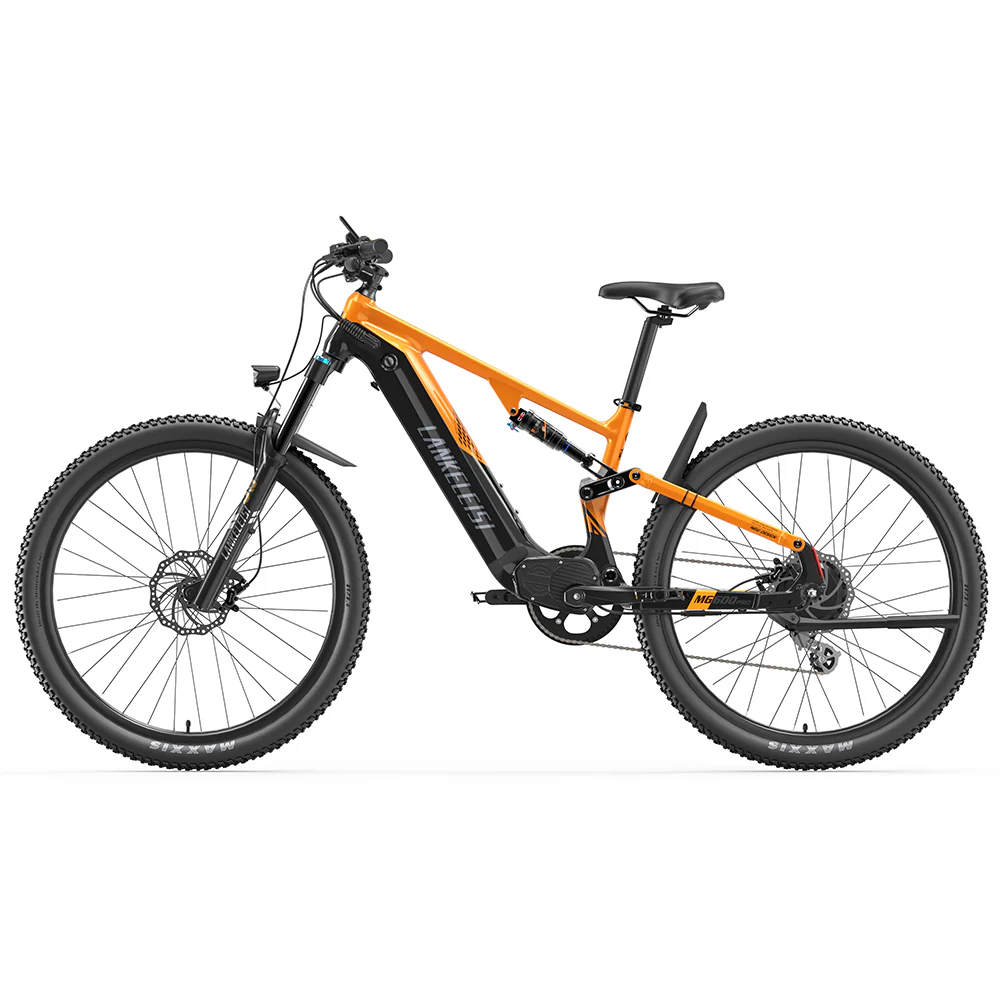
The MG600 Pro is the only Lankeleisi in the MG600 family built around full-suspension trail geometry. This choice creates a notably different riding position and handling profile than the Plus. The 29-inch wheel diameter and active riding position (handlebars drop forward over the front wheel) angle the bike toward climbing and descent control rather than upright comfort. The frame is 6061 aluminum alloy with internally routed cables, keeping the cockpit clean and protecting wiring from mud, water, and trail debris. For riders coming from hardtail mountain bikes or aggressive trekking setups, the Pro’s geometry feels familiar and purposeful.
Suspension geometry is the defining strength here: a 150mm travel fork in front handles root strikes and brake bumps, while the rear linkage (DNM air shock, 130mm travel) absorbs landing forces and sustained rough terrain that a hardtail would transmit directly into your body. This is not a luxury. On technical singletrack or forest paths with sustained chattery terrain, suspension is the difference between a bike that opens up the trail and one that forces you to pick a line around every obstacle. French testers noted the Pro’s suspension felt “well-balanced for cross-country riding,” with compliance that matched the lightweight tire profile without feeling wallowy on hardpack.
Performance and Terrain
The 750W peak motor with 65 Nm torque is the same architecture found in other MG600 variants, meaning performance is predictable: adequate for moderate climbs and sustained power delivery, not explosive acceleration. Rider weight and assist level matter more than raw watts. At nominal 250W under EU regulations, the motor feels proportional to a 29-inch trail bike — responsive, not overwhelming. German testers riding 500+ km reported natural power delivery in torque sensor mode, with cadence mode available for flat terrain cruising.
Where the Pro shines is technical capability. The 29-inch Maxxis Rekon tires (2.4” width) roll efficiently on packed trails while maintaining grip on loose, rooty terrain. The full suspension means you can maintain line and momentum through rocky sections where a hardtail forces you to slow down or absorb impact. At rated 150 km range on pedal-assist, the 960Wh battery is the real advantage over the MG600 Lite—for long forest loops or multi-day adventures, the extra capacity pays real dividends. The switchable torque/cadence sensor is genuinely useful for extending range on climbing sections.
Who Should Buy the MG600 Pro
Buy the Pro if you spend 70% or more of your riding time on forest trails, singletrack, or technical terrain where suspension matters. Buy it if you have time and fitness to exploit its geometry—an upright commuter is wasting the Pro’s trail-focused design. Choose the Pro if you ride in regions with sustained technical terrain (UK peak district, German Black Forest, Pyrenees) rather than flat mixed paths. The 960Wh battery and pre-order status mean dispatch timing is critical: verify the estimated ship date with BuyBestGear before committing, as this is the sole authorized seller in Europe and the UK.
Do not buy the Pro if you need an urban commuter with mudguards and a cargo rack, or if you regularly need to carry heavy loads. Do not buy it if weight handling is a concern (weight not published, but full suspension adds ~2–3 kg over Plus). Do not buy if your local terrain is mostly roads, paved paths, or sand.
MG600 Plus — Strengths & Limitations
Design and Build
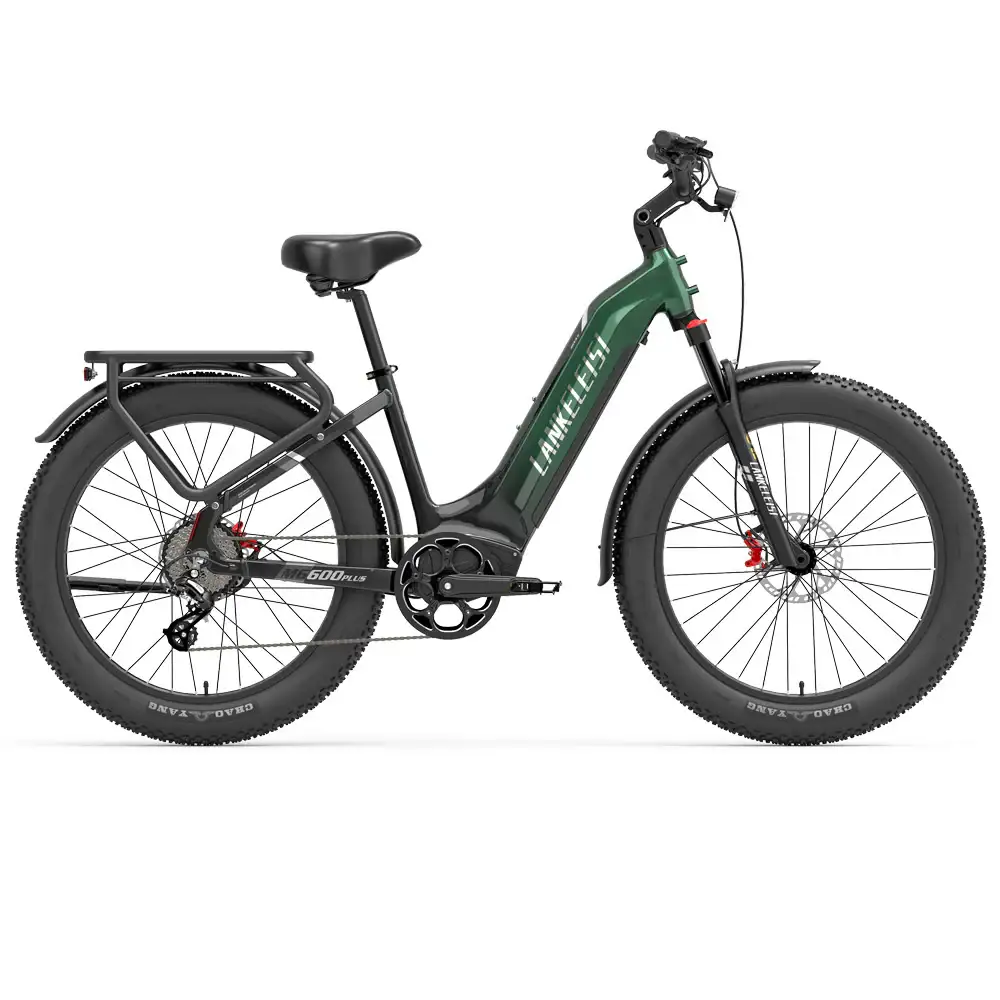
The MG600 Plus is purpose-built for all-terrain utility. The low-slung step-through frame makes mounting and dismounting effortless regardless of fitness or age. The 26-inch wheels paired with massive 4.0-inch fat tires create a platform optimized for surface absorption and traction rather than rolling efficiency. At 36.9 kg loaded, the Plus is genuinely heavy, but the weight distribution (battery low in the frame) means the bike feels planted and stable when rolling, even with cargo on the rear rack. The 2025 refresh upgraded cable routing to be fully internal, added a color LCD display, and integrated turn signals into the tail light—refinements that address the previous generation’s cosmetic roughness.
The Bafang 1000W motor is the Plus’s signature component. This is an order of magnitude more powerful than the Pro, and it shows in acceleration and climbing intent. The 70–85 Nm torque output means the Plus can handle steep gradients and slippery surfaces with authority. Dyisland hydraulic brakes with 180mm rotors handle the weight and power without fading, though French and German testers noted they lack the refinement and modulation of Zoom or Tektro alternatives. The Shimano 7-speed drivetrain is entry-level but adequate for utility riding where you are not constantly chasing cadence optimization.
Performance and Terrain
This is where the Plus dominates. The 1000W peak motor can maintain assist on 25+ degree slopes without dropping to lower assist modes. Testers reported the Plus climbing at 10–12 km/h on sustained 20-degree grades in Mode 3 (60% assist), with Mode 4 (80% assist) pushing speeds to 15+ km/h on the same gradient. This is 4–5 km/h faster than the Pro on equivalent terrain, and for loaded commuting or cargo work, that delta is meaningful. The fat tires provide traction on sand, gravel, wet grass, and snow where narrower trail tires slip. Swedish riders testing the Plus in winter conditions reported confidence and stability that regular e-bikes could not match.
The weight is a genuine drawback. At 36.9 kg, dismounting on a hillside to push the bike uphill is genuinely exhausting. The walk-assist function (engage at 6 km/h with motor support) helps, but does not eliminate the handling challenge. Inside a car or transported by hand, the Plus is noticeably harder than the Pro. For around-town riding, the weight is never felt; for multi-modal transport or bike park access, it is a real limitation.
Who Should Buy the MG600 Plus
Buy the Plus if your terrain is mostly roads, gravel, sand, or loose surfaces where fat tires shine. Buy it for commuting on mixed paths where cargo capacity and powerful climbing matter more than technical agility. Buy it if you prioritize stability and confidence-inspiring handling over suspension compliance. The €1,899 price point (€300 less than Pro) makes sense if your budget is tight and you value pure utility power over trail performance.
Do not buy the Plus if your local terrain is technically demanding forest trails, rocky singletrack, or steep rooty terrain where suspension geometry matters. Do not buy if you regularly transport the bike by car without a rack, or if you live in a compact apartment without secured parking (36.9 kg is genuinely difficult to handle daily). Do not buy if lightweight climbing and rolling efficiency are priorities.
Category Context: How Both Compare to Alternatives
The Lankeleisi MG600 family occupies a price tier (€1,500–2,200) where few other brands offer comparable specifications. The Vakole V26 (250W, 998Wh, fat bike) is slightly cheaper but trades Lankeleisi’s established reputation and internal cable routing for similar power. The Engwe L20 SE offers a foldable platform at €1,099, but sacrifices full suspension and motor power for portability. Neither alternative offers the Pro’s full-suspension geometry at this price point.
Within the Lankeleisi ecosystem, the MG600 Lite (720Wh, 250W, 30 kg, €1,549) bridges the gap between recreational commuting and trail capability, though it lacks the Pro’s suspension and Plus’s motor muscle. Riders should treat the Pro and Plus not as “one is better,” but as answers to different questions. The Plus competes with general-purpose all-terrain bikes; the Pro competes with sub-€2,500 full-suspension e-MTBs.
Final Verdict: Which Should You Choose?
Choose the MG600 Pro if: Trail performance, full suspension geometry, and technical capability are your priorities. Choose it for forest riding, singletrack, or terrain where suspension and 29-inch wheels open up options. Choose it if you have time to ride aggressively and want a bike that rewards speed and flow. The €2,199 price reflects its specialized focus.
Choose the MG600 Plus if: All-terrain utility, powerful climbing, and all-weather traction matter more than technical agility. Choose it for commuting on mixed roads and gravel. Choose it if weight capacity (200 kg) and cargo carrying are part of your lifestyle. Choose it if budget favors €1,899 over €2,199 and you want raw power without suspension complexity.
Decision matrix:
| Your Priority | Winner | Why |
|---|---|---|
| Forest trail riding | Pro | Full suspension, 29” geometry |
| Climbing on steep terrain | Plus | 1000W peak, 85 Nm torque |
| All-weather commuting | Plus | Fat tires, step-through comfort |
| Technical agility | Pro | Suspension, lighter estimated weight |
| Budget consciousness | Plus | €300 less |
| Cargo and utility | Plus | 200 kg capacity, step-through |
Frequently Asked Questions
What does the 250W nominal motor mean if peak is 750W or 1000W?
Can either bike be unlocked to higher speeds?
How much does the MG600 Pro weigh?
Is the battery removable on both bikes?
How do real-world ranges compare to claimed 150 km?
Which brakes are more reliable: Zoom or Dyisland?
Is there warranty support if I order from BuyBestGear?
The Bottom Line
The MG600 Pro and Plus are not competing bikes—they are different answers to different questions. The Pro is the specialized, trail-focused choice for riders who live on technical terrain and want full suspension to match their ambitions. The Plus is the practical, utility-first choice for commuters and adventurers who value all-weather traction, powerful climbing, and all-terrain versatility over suspension and trail geometry. If neither quite fits, the MG600 Lite sits between them with trekking comfort and balanced specs. For most riders choosing between these two, the answer is clear: trail ambition points to Pro, utility ambition points to Plus.
Both models are available for pre-order exclusively through BuyBestGear. Verify current dispatch timelines and full specification details on each product page before committing to order, as availability and configuration details may shift between publication and purchase.