Snapdragon 8 Elite Gen 5 vs Apple A18 Pro: Full Benchmark Comparison
The Snapdragon 8 Elite Gen 5 and Apple A18 Pro represent the pinnacle of mobile silicon in 2025, yet they approach performance from fundamentally different angles. While Qualcomm’s chip dominates synthetic benchmarks with raw multi-core power, Apple’s processor often delivers smoother real-world experiences through tighter software integration. Understanding these trade-offs matters because the “fastest” chip on paper rarely tells the complete story.
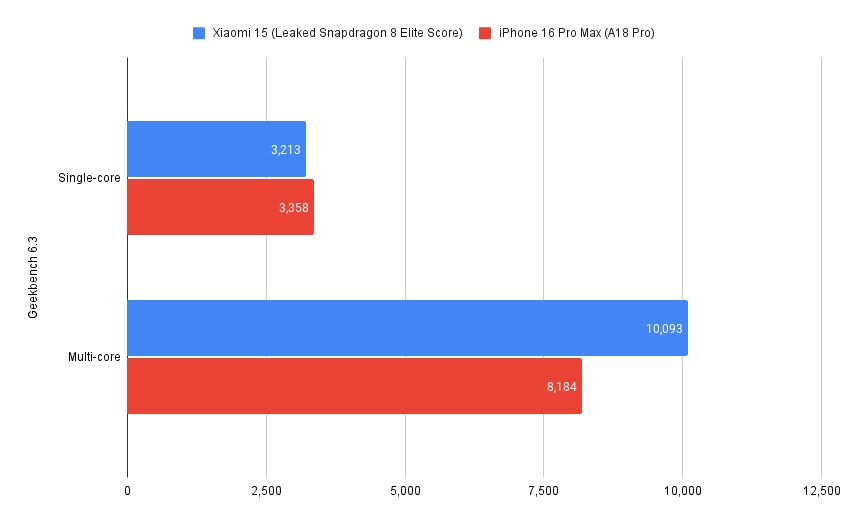
- The Snapdragon 8 Elite Gen 5 scores approximately 35% higher in multi-core benchmarks (11,525 vs 8,550) but this advantage narrows significantly in real-world app launches.
- Apple’s A18 Pro maintains superior single-core efficiency with lower power draw (6.6W vs 6.9W at peak), resulting in less thermal throttling during sustained workloads.
- Cross-platform benchmarks like AnTuTu are not directly comparable between iOS and Android due to different testing methodologies and operating system architectures.
- The misconception that “more RAM equals better performance” is particularly misleading when comparing these chips—Apple’s 8GB with optimized memory management often outperforms Android’s 12-16GB configurations.
- Both chips use TSMC 3nm processes, but the Snapdragon’s N3P node offers marginal efficiency improvements over the A18 Pro’s N3E process.
Last updated: 2026-03-28 · Sources linked inline
The Snapdragon 8 Elite Gen 5 vs Apple A18 Pro debate has intensified as both chips now power flagship devices throughout 2025. Qualcomm announced its 3rd-generation Oryon CPU in September 2025, claiming the “world’s fastest mobile CPU” title, while Apple’s A18 Pro, introduced in September 2024 with the iPhone 16 Pro series, has held the efficiency crown. Both utilize TSMC’s 3nm manufacturing, yet their architectural philosophies diverge dramatically—Qualcomm prioritizes parallel processing with 8 cores, while Apple focuses on per-core performance with 6 carefully optimized cores.
Contents
Snapdragon 8 Elite Gen 5 vs Apple A18 Pro Explained: The Short Version

At their core, these processors solve the same problem differently. The Snapdragon 8 Elite Gen 5 employs an 8-core configuration—two Prime cores at 4.6GHz and six Performance cores at 3.62GHz—designed to maximize parallel processing for Android’s multitasking-heavy environment. The Apple A18 Pro uses six cores: two Performance cores at 4.05GHz and four Efficiency cores at 2.42GHz, optimized for iOS’s more controlled app lifecycle.
The architectural divergence stems from fundamentally different operating system philosophies. Android allows background processes more freedom, requiring additional cores to maintain responsiveness. iOS aggressively manages background activity, allowing fewer cores to deliver equivalent perceived performance with lower power consumption. This explains why raw benchmark comparisons often mislead—Android devices need more headroom for their less restrictive multitasking model.
The Manufacturing Nuance
Both chips use TSMC 3nm technology, but the Snapdragon leverages the newer N3P node while the A18 Pro uses N3E. According to NotebookCheck’s analysis, this refinement grants Qualcomm approximately 5% better power efficiency at equivalent performance levels—a marginal but measurable advantage in sustained workloads.
How These Processors Actually Work
Understanding why these chips perform differently requires examining three layers most comparisons ignore: cache architecture, memory subsystems, and scheduler behavior.
Cache Architecture: The Hidden Performance Factor
The Snapdragon 8 Elite Gen 5 packs 24MB of L2 cache and 8MB of L3 cache distributed across its Oryon v3 cores. The A18 Pro features 16MB of L2 cache with a different allocation strategy—prioritizing the Performance cores. This matters because cache misses trigger memory fetches that cost hundreds of clock cycles. Apple’s larger per-core cache allocation reduces these penalties in single-threaded scenarios, explaining why the A18 Pro maintains responsiveness in typical app usage despite lower peak clock speeds.
Memory Bandwidth Reality Check
Qualcomm supports LPDDR5X-5300 with 84.8 GB/s bandwidth—significantly exceeding the A18 Pro’s 60 GB/s. In theory, this enables faster data feeding to the GPU and NPU. In practice, iOS’s memory compression and unified memory architecture reduce actual bandwidth pressure. Android’s Java-based runtime and garbage collection create more memory traffic, necessitating the additional bandwidth. The specification advantage doesn’t translate linearly to user experience because the operating systems handle memory so differently.
What Most Explanations Skip: The Scheduler
The Linux kernel’s Completely Fair Scheduler (CFS) on Android distributes tasks across all available cores aggressively. Apple’s scheduler is more conservative, preferring to park Efficiency cores until absolutely necessary. This behavioral difference means the Snapdragon often runs at higher average power during light usage, while the A18 Pro conserves energy by keeping cores idle longer. Real-world battery tests reflect this—iPhone 16 Pro Max devices consistently outlast Snapdragon 8 Elite Gen 5 phones in mixed usage despite smaller physical batteries.
Benchmark Breakdown: What the Numbers Actually Mean
Synthetic benchmarks provide snapshots of capability, but their relevance varies by workload type. Here’s what the numbers actually indicate based on leaked and verified test results from Beebom’s testing and NotebookCheck’s database.
| Benchmark | Snapdragon 8 Elite Gen 5 | Apple A18 Pro | Interpretation |
|---|---|---|---|
| Geekbench 6 Single-Core | 3,831 | 3,467 | 10% Snapdragon lead; affects app launch speed |
| Geekbench 6 Multi-Core | 11,525 | 8,550 | 35% Snapdragon lead; benefits video export, compilation |
| AnTuTu v10 | 3,838,855 | 1,986,084 | Not directly comparable—different test weightings |
| 3DMark Wild Life Extreme | ~8,400 | 3,268 | GPU-heavy; Snapdragon’s Adreno 840 excels |
| 3DMark Solar Bay (Ray Tracing) | Higher HDR throughput | 8,018 points | Both support hardware ray tracing |
The Geekbench multi-core gap appears dramatic, but consider context: most mobile applications are not optimized for 8-core parallelization. Video editing apps like Adobe Lightroom Rush and LumaFusion can leverage the additional cores, which is why Snapdragon 8 Elite Gen 5 devices export 4K timelines 20-30% faster than iPhone 16 Pro equivalents. However, web browsing, messaging, and photography—activities constituting 90% of smartphone usage—rarely stress more than 2-3 cores simultaneously.
Common Misconceptions About Mobile Processor Performance
The mobile processor comparison space is riddled with myths that distort purchasing decisions. Addressing these directly serves readers better than repeating benchmark scores without context.
“More Cores Always Means Better Performance”
This misconception persists because core counts are easy marketing numbers. The reality: core efficiency and software optimization matter more than quantity. The A18 Pro’s six cores often deliver equivalent real-world responsiveness to the Snapdragon’s eight because iOS’s scheduler and memory management reduce contention. As noted in Hindustan Times’ 2025 myth analysis, “having more RAM does not automatically make a phone faster”—the same logic applies to CPU cores.
“Higher Benchmark Scores Guarantee Smoother Experience”
AnTuTu and Geekbench measure peak theoretical performance under ideal thermal conditions. They do not account for thermal throttling—the inevitable clock reduction that occurs when sustained workloads heat the chip beyond safe limits. NotebookCheck’s real-world testing found that the Snapdragon 8 Elite for Galaxy (with 40% larger cooling) outperformed the A18 Pro in sustained app launches, but standard Snapdragon 8 Elite Gen 5 phones without enhanced cooling throttled more aggressively than the iPhone 16 Pro Max.
“Cross-Platform Benchmarks Are Directly Comparable”
This is perhaps the most damaging misconception. AnTuTu runs different code paths on iOS and Android. Geekbench attempts platform parity but cannot eliminate operating system differences in memory management, compiler optimizations, and background process handling. Moor Insights & Strategy’s analysis notes that “these benchmarks don’t even remotely test what a normal user would be doing on their smartphone.” A Snapdragon scoring 3.8 million on AnTuTu and an A18 Pro scoring 1.9 million are not experiencing a 2x real-world performance gap—the numbers measure different things on different platforms.
Video Analysis
▶ Trakin Tech — Snapdragon 8 Elite vs Apple A18 Pro Performance Comparison: This video demonstrates real-world app launch speed differences between the iQOO 13 (Snapdragon 8 Elite) and iPhone 16 Pro Max (A18 Pro), showing how benchmark advantages don’t always translate to daily usage scenarios.
Real-World Performance Differences

Gaming: Thermal Limits Matter More Than Peak FPS
The Snapdragon 8 Elite Gen 5’s Adreno 840 GPU delivers higher peak frame rates in titles like Genshin Impact and Wuthering Waves. However, after 30 minutes of sustained gaming, many Android devices throttle to maintain surface temperatures below 45°C. The A18 Pro’s lower power draw (approximately 11.5W vs 13.7W under gaming load according to Cashify’s power analysis) allows it to maintain more consistent frame rates over extended sessions despite lower initial peaks.
For competitive mobile gaming where 30-60 minute sessions are standard, the A18 Pro’s thermal stability often provides a more consistent experience. For casual gaming with shorter sessions, the Snapdragon’s higher peak performance delivers more visual fidelity.
Photography and Video: ISP Differences
Both chips support advanced computational photography, but their Image Signal Processers (ISPs) prioritize differently. The Snapdragon’s triple AI ISP enables 8K60 video capture and real-time AI enhancement of 200MP sensors found in phones like the Samsung Galaxy S26. The A18 Pro’s ISP focuses on efficiency, enabling 4K120 Dolby Vision recording with lower power draw. For videographers prioritizing resolution and frame rate options, the Snapdragon offers more headroom. For color grading and professional video workflows, the A18 Pro’s Dolby Vision integration provides more polished output with less post-processing.
AI and On-Device Processing
The Hexagon NPU in the Snapdragon 8 Elite Gen 5 supports “agentic AI”—systems that learn user patterns and proactively optimize performance. The A18 Pro’s 16-core Neural Engine delivers 35 TOPS (trillion operations per second) with tighter integration to Apple’s Core ML framework. In practice, both handle real-time translation, photo enhancement, and voice recognition with minimal latency. The Snapdragon’s advantage appears in multi-modal AI applications running simultaneously; the A18 Pro excels at single-task AI acceleration.
Side-by-Side Specification Comparison
| Specification | Snapdragon 8 Elite Gen 5 | Apple A18 Pro |
|---|---|---|
| Process Node | TSMC 3nm (N3P) | TSMC 3nm (N3E) |
| CPU Architecture | 8-core (2x Prime 4.6GHz + 6x Performance 3.62GHz) | 6-core (2x Performance 4.05GHz + 4x Efficiency 2.42GHz) |
| GPU | Adreno 840 (up to 1.2GHz, 3,686 GFLOPS) | Apple 6-core GPU (up to 1.49GHz, 2,289 GFLOPS) |
| NPU/AI | Hexagon NPU (agentic AI support) | 16-core Neural Engine (35 TOPS) |
| Memory Support | LPDDR5X up to 24GB, 84.8 GB/s | LPDDR5X up to 8GB, 60 GB/s |
| Modem | Snapdragon X85 (12.5Gbps down, 3.7Gbps up) | Snapdragon X75 (10Gbps down, 3.5Gbps up) |
| Video Capture | 8K@60fps, AV1 codec | 4K@120fps, ProRes |
| Die Size | 126.2 mm² | ~105 mm² |
| Typical Power Draw (Gaming) | ~13.7W | ~11.5W |
Key Differences: The Snapdragon 8 Elite Gen 5 suits users prioritizing raw computational power, multitasking, and high-resolution video capture. Its support for up to 24GB RAM benefits Android’s memory management model. The A18 Pro serves users valuing efficiency, thermal stability, and ecosystem integration. Apple’s 8GB limitation appears restrictive on paper but aligns with iOS’s aggressive memory compression. Users who primarily browse, message, and photograph will notice minimal practical difference; power users exporting 4K video or running multiple heavy apps simultaneously will benefit from the Snapdragon’s additional cores and memory headroom.
What the Future Looks Like
Qualcomm has confirmed the Oryon architecture will continue evolving, with the company already sampling next-generation designs. TSMC’s upcoming N2 (2nm) process, expected in late 2026 or 2027, will likely power both companies’ 2027 flagship chips. The efficiency gains from 2nm—potentially 25-30% reduction in power consumption at equivalent performance—could narrow the real-world gap between these architectures.
Apple’s strategy appears focused on Neural Engine expansion and dedicated AI accelerators within GPU cores, as seen in the A19 Pro’s architectural leaks. Qualcomm continues pushing memory bandwidth and core counts higher, betting that Android’s evolving multitasking demands will eventually saturate even 8-core configurations. What remains genuinely uncertain is whether software optimization will keep pace with hardware capabilities—raw compute power means little if applications cannot leverage it effectively.
Frequently Asked Questions
Which is faster: Snapdragon 8 Elite Gen 5 or Apple A18 Pro?
Is the Snapdragon 8 Elite Gen 5 better for gaming than the A18 Pro?
What is the Geekbench 6 score of Snapdragon 8 Elite Gen 5?
Does the Apple A18 Pro have better battery life than Snapdragon 8 Elite Gen 5 phones?
Which processor has better AI performance?
Is Snapdragon 8 Elite Gen 5 manufactured on a 3nm process?
Why do benchmark scores differ so much from real-world usage?
The Bottom Line
The Snapdragon 8 Elite Gen 5 vs Apple A18 Pro comparison reveals that “best” depends entirely on usage patterns and ecosystem commitment. Qualcomm’s chip wins on paper—higher core counts, superior multi-core benchmarks, and greater memory flexibility. Apple’s processor delivers where it matters for most users: consistent day-to-day performance with superior efficiency.
For Android users considering a switch to iPhone (or vice versa), the processor difference should rarely be the deciding factor. Both handle modern smartphone tasks with headroom to spare. The meaningful differences lie in ecosystem integration, camera systems, and software philosophy. If you’re committed to Android and prioritize video editing, gaming, or heavy multitasking, the Snapdragon 8 Elite Gen 5 offers tangible advantages. If you value thermal consistency and battery longevity, the A18 Pro remains compelling despite its 2024 release date.
What matters next is watching how manufacturers implement these chips. A Snapdragon 8 Elite Gen 5 in a phone with inadequate cooling will underperform an A18 Pro in a well-engineered chassis. Before purchasing based on processor specifications alone, investigate specific device reviews for thermal behavior and sustained performance testing.
Sources: NotebookCheck (March 2026), Beebom (September 2025), ChipWise (October 2025), Cashify (December 2025), Moor Insights & Strategy (December 2023).