Coswheel R6000 Review: A 7,000W Electric Dirt Bike for €1,799
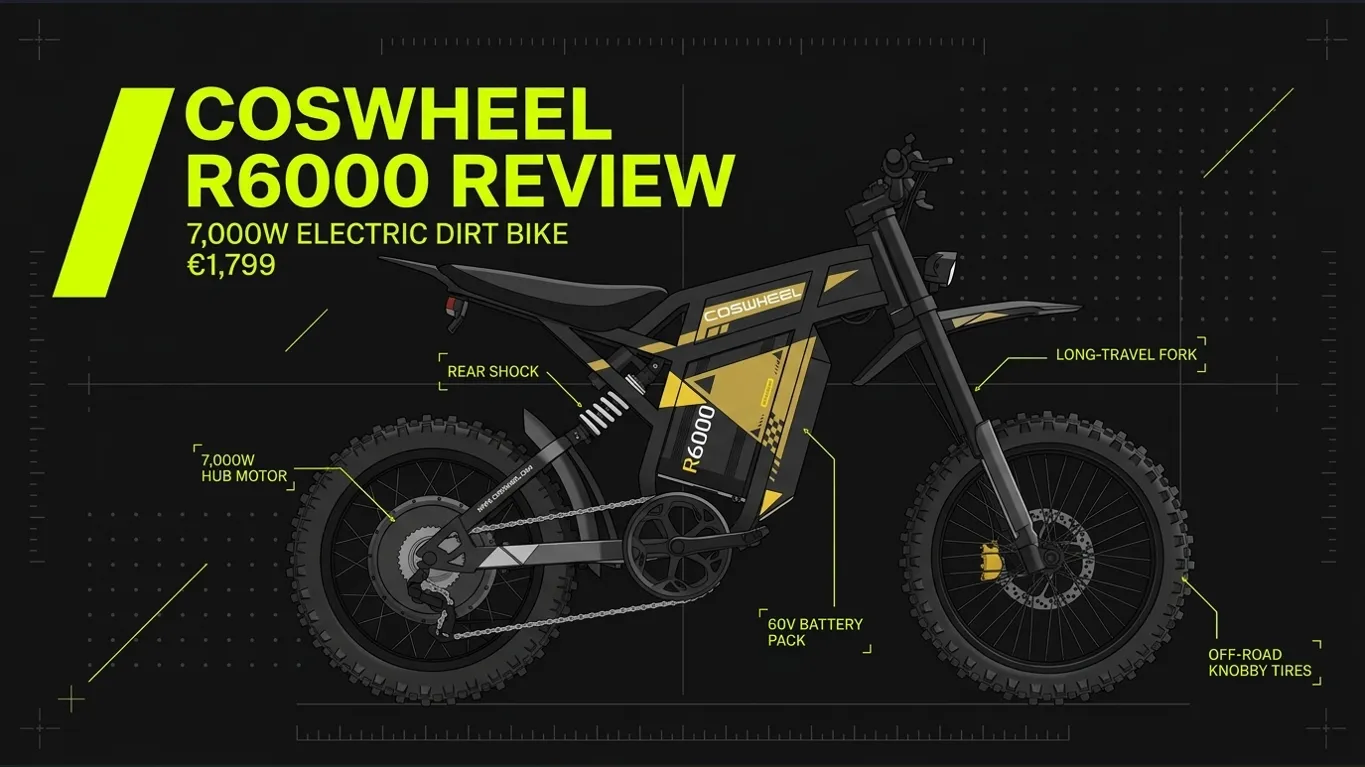
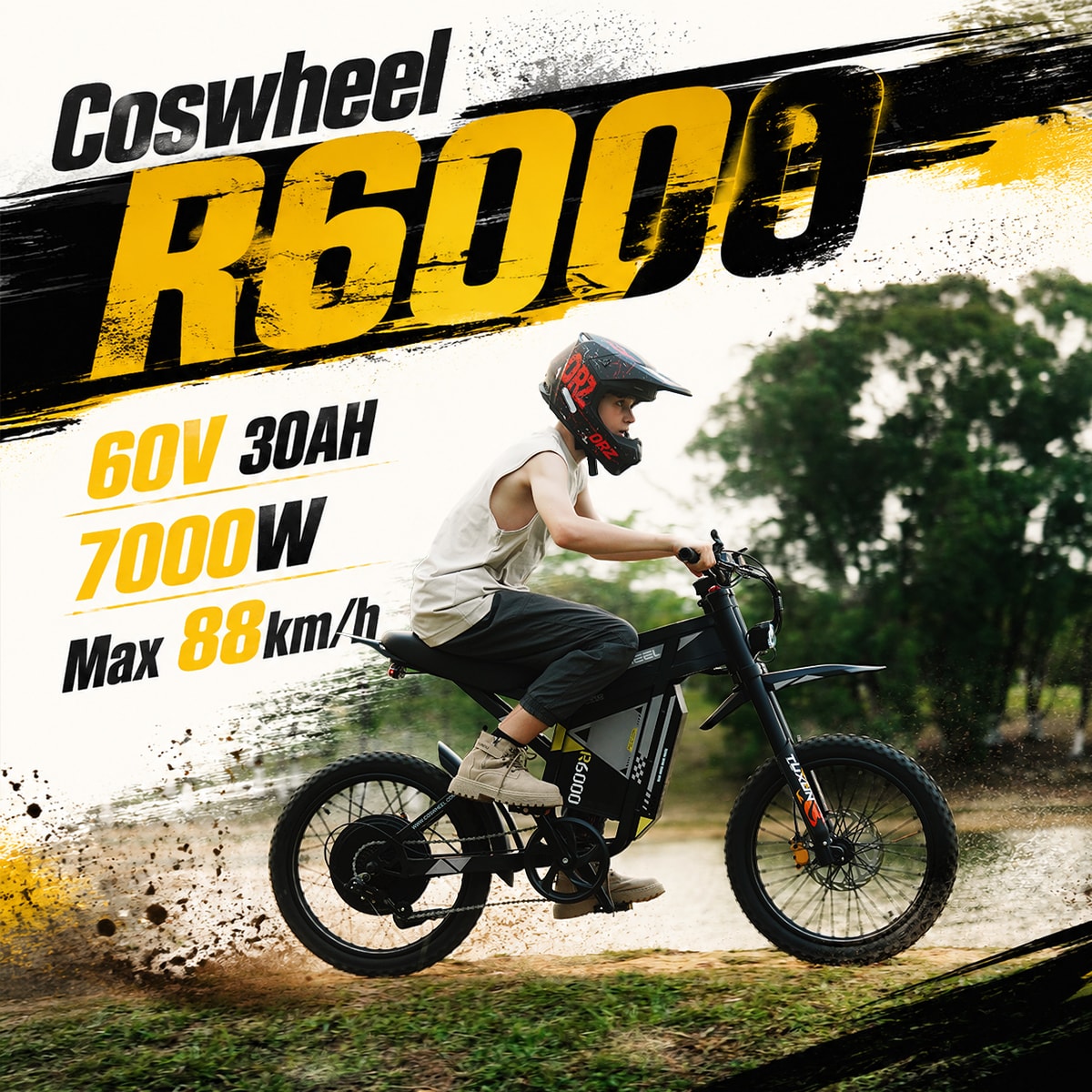
The Coswheel R6000 sells one specific idea: the spec sheet of an expensive electric dirt bike at a price closer to a decent commuter e-bike. Peak motor power is listed at 7,000W, the battery holds 1,800Wh, and the fork has 180 mm of travel. BuyBestGear lists the whole thing at €1,799.
I haven’t ridden an R6000. What follows comes from Coswheel’s spec sheets, retailer listings and what owners have posted, and I flag every place where the numbers don’t add up. Some of them don’t, and that changes who this bike is for.
- Beginner-friendly 60V dirt bike with a 1,800Wh battery, priced around €1,799 at BuyBestGear.
- The 7,000W figure is peak; a 60V 70A controller works out to roughly 4,200W.
- European units ship capped at 25 km/h; 88 km/h needs a seller-guided unlock.
- Skip it if you want a road-legal bike or a proven dealer network.
Price, coupon and what the money buys
BuyBestGear lists the R6000 at €1,799.00. Enter the code NFT4 at checkout for 4% off, which brings it to roughly €1,727. A US Amazon listing for the same bike mentions a tool kit, fenders, a charger and a manual in the box, so check the contents list on the BuyBestGear page before you order.
Coswheel R6000 specs at a glance
These are the numbers published for the European version on Coswheel’s European store. I’ve questioned the ones that looked shaky in the sections below.
| Motor | 60V rear hub, 7,000W peak, 3,000W rated |
|---|---|
| Torque | 180 N·m |
| Controller | 60V 70A |
| Battery | 60V 30Ah (1,800Wh), 100A BMS |
| Charger | 60V 5A, 6 to 7 hours |
| Claimed top speed | 88 km/h (25 km/h as shipped in the EU) |
| Claimed range | 90 km throttle only, 130 km with pedal assist |
| Front suspension | Inverted dual-crown fork, 180 mm travel |
| Rear suspension | Shock with 300 lb spring, 40 mm travel |
| Brakes | Dual-piston hydraulic, 203 mm discs |
| Tyres | 70/100-17 off-road, front and rear |
| Frame | High-carbon steel |
| Drivetrain | Shimano 7-speed derailleur, 3 assist levels |
| Display | 3.5-inch colour LCD, NFC card unlock |
| Weight | 55 kg with battery |
| Max load | 150 kg |
| Seat height | 84 cm |
| Rider height | 155 to 196 cm |
All specifications are manufacturer-claimed. Real-world performance will vary with usage conditions, environment, and individual configuration.
Power: what the 7,000W figure means
Motor power on electric bikes is a slippery number, so I did the sums. The R6000 runs a 60V system and Coswheel lists a 70A controller. Multiply the two and you get 4,200W. Even the 100A battery management system tops out at 6,000W. Neither route reaches 7,000W.
A German-speaking buyer made the same point in a 3-star review on Coswheel’s European store. The store’s reply, as it appears on the page, told the reviewer to post elsewhere instead of addressing the arithmetic. That doesn’t inspire confidence, though it doesn’t make the maths wrong either. Nominal voltage is only a rough guide, since a pack reads higher when full, but not by enough to close a 40% gap.
Does it matter on a trail? Probably less than the number suggests. The rated figure is 3,000W, torque is listed at 180 N·m, and owners describe strong acceleration and easy climbs. One 16-year-old owner, 6’2″ and 150 lb, says it fits well and touches around 80 km/h. That review sits on Coswheel’s own store, so weigh it accordingly. I’d buy this bike on the 3,000W rating and treat 7,000W as marketing.
Battery and range
The 60V 30Ah pack stores 1,800Wh, which is a big battery for a bike this light. Coswheel claims 90 km on throttle alone and up to 130 km with pedal assist. Note where the bigger number comes from: it is the pedal-assist figure, which assumes a gentle pace.
Nobody I found has published a full-throttle range test, so this part is my estimate rather than a measurement. Ride flat out near 88 km/h, the way most people ride a dirt bike, and I’d plan on well under 90 km. Charging uses a 60V 5A charger and Coswheel quotes 6 to 7 hours. That checks out, since 1,800Wh at about 300W is roughly six hours before losses. Fine overnight, awkward if you want two long sessions in a day.
Frame, suspension and fit
The frame is high-carbon steel and the whole bike weighs 55 kg with the battery fitted. Coswheel says that is 8 kg less than its bigger R19. A current Sur-Ron Light Bee X is listed at around 59 kg, so both are awkward to lift into a van on your own.

The fork is the best line on the spec sheet. Dual-crown inverted forks with 180 mm of travel are what you would expect on a much dearer bike. The rear is thinner: the listed shock has 40 mm of travel and a 300 lb spring. Coswheel doesn’t say whether that is shock stroke or wheel travel, and if it’s shock stroke the wheel moves more than that. Either way, I’d expect the front end to be better than the back.
Coswheel rates the bike for riders from 155 to 196 cm, with an 84 cm seat height and a 150 kg maximum load. Both wheels are 17-inch with 70/100-17 off-road tyres, smaller than the 19 and 18 inch wheels on a Light Bee X. Coswheel also says the R6000 sits lower than the R19, which is how it aims at newer riders.
Brakes
Braking is dual-piston hydraulic. The spec list gives 203 mm discs, while the marketing copy on the same page quotes a 220 mm front and 180 mm rear disc and names the R19 rather than the R6000. That reads like text carried over from another product page. Ask BuyBestGear or Coswheel which discs actually ship.

Display, throttle and pedal assist
The cockpit is simple: a twist throttle, a 3.5-inch colour LCD, NFC card unlock, three pedal-assist levels and a Shimano 7-speed derailleur. Lighting is a 12V headlight and an LED tail light. I’d expect most owners to ignore the pedals, but pedal assist is where the 130 km range figure comes from, so they aren’t decoration.

Can you ride it on the road in Europe?
Not as sold, and I’d be wary of anyone who says otherwise. EU-bound R6000s ship limited to 25 km/h, and Coswheel says it will guide you through lifting that limit after delivery. It also offers a 250W label to stick on the motor to match European rules.
A sticker doesn’t change what the motor is. The listing rates it at 3,000W continuous and the throttle is a twist grip, which puts it well outside the 250W pedelec category. Bikes in that power range generally need moped-class type approval for public roads. Sur-Ron sells a homologated L1e-B version of the Light Bee X in Europe, limited to 45 km/h. Nothing I found says the R6000 has one.
If you plan to commute on public roads, this is the wrong bike. Look at a homologated moped-class model or a genuine 250W e-bike instead. If you plan to ride private land or a closed course, the problem shrinks a lot. Rules differ by country, so check yours.
Coswheel R6000 vs Sur-Ron Light Bee X
The obvious rival is the Sur-Ron Light Bee X, the bike this class is measured against. The Sur-Ron figures are for the 2026 model. European dealer prices swing with stock and model year.
| Spec | Coswheel R6000 | Sur-Ron Light Bee X |
|---|---|---|
| Peak power | 7,000W claimed | 10,000W |
| Battery | 60V 30Ah, 1,800Wh | 72V 35Ah, about 2,520Wh |
| Weight | 55 kg | About 59 kg |
| Claimed top speed | 88 km/h | 80 km/h |
| Wheels | 17 in front and rear | 19 in front, 18 in rear |
| EU price seen | €1,799 | €3,550 to €4,699 |
| Road-legal version | None listed | L1e-B version sold |
On paper the Sur-Ron wins where it counts on a trail: more power, a bigger battery and bigger wheels. The R6000 wins on price by a wide margin and comes in a few kilos lighter. A deals write-up I read makes the same point, noting that Sur-Ron and Talaria sit well above the R6000’s price with established dealers and easy parts supply. A cheaper bike from a smaller brand is only cheap if you can get parts and warranty help when something breaks. Coswheel quotes a one-year warranty, so ask how claims work in your country.
Pros and cons
Here is the short version before the score.
- 1,800Wh battery
- 3,000W rated hub motor
- 180 mm dual-crown fork
- 203 mm hydraulic disc brakes
- 55 kg including battery
- No road homologation listed
- Ships limited to 25 km/h
- 7000W claim outruns 70A controller
- Only 40 mm rear shock travel
- 6 to 7 hour recharge
How I’d score the R6000
This score comes from specs, listing details and owner feedback, not from my own time on the bike, so read it as a buying-guide rating rather than a ride verdict. Power and battery score well, road use scores badly, and the 7,000W claim costs a little trust.
- Power8.0
- Battery8.5
- Components7.0
- Value8.0
- EU road use4.0
Who should buy it, and who shouldn’t
Buy it if you want a big battery and a strong fork for the money, you have private land or legal trails to ride, and you can live with a smaller brand. It suits a taller teenager or an adult beginner, since Coswheel tuned it for gentler power than the R19 and the 25 km/h mode gives you a place to start.
Skip it if you need a road-legal commuter, want a dealer nearby for parts and servicing, or plan to race. In those cases the extra money for a Sur-Ron or a homologated moped-class bike buys things the R6000 can’t.
Frequently Asked Questions
01Is the Coswheel R6000 road legal in Europe?
02How far does the Coswheel R6000 go on one charge?
03Is the Coswheel R6000 suitable for beginners or teenagers?
04How does the R6000 compare with the Sur-Ron Light Bee X?
05Can the R6000’s 25 km/h speed limit be removed?
Verdict
The R6000 is a lot of dirt bike hardware for €1,799, or roughly €1,727 with NFT4. The 1,800Wh battery and the 180 mm fork are the parts I’d pay for. The 7,000W headline doesn’t survive the arithmetic, the rear suspension looks light, the spec sheet contradicts itself on brake discs, and the European road-legal answer amounts to a 250W sticker. Treat it as a private-land bike with a serious battery and buy it with your eyes open. See the Coswheel R6000 at BuyBestGear.
Shipping to Canada or the United States is not currently available on BuyBestGear.
Note: This post contains affiliate links. We may earn a small commission at no cost to you.
Related Stories
CMACEWHEEL HQ20 Review: A €1,199 Longtail Cargo Ebike That Almost Gets Everything Right
Fafrees F700 Review: A 250W City E-Bike With a Torque Sensor for €1,099