Fafrees F700 Review: A 250W City E-Bike With a Torque Sensor for €1,099
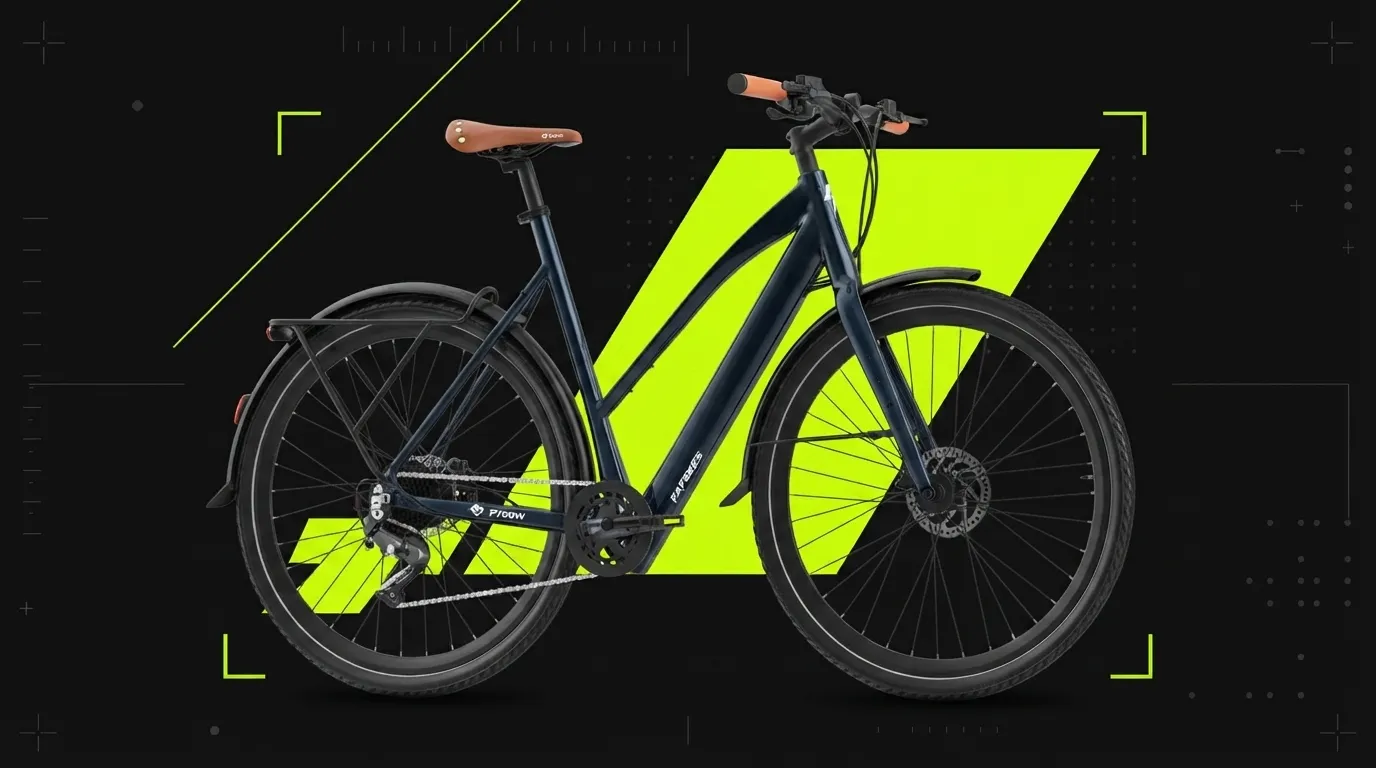
The Fafrees F700 review requests keep landing in the same place: is a torque-sensing city e-bike at €1,099 actually worth it, or is the sensor just a spec-sheet line item that doesn’t change how the bike rides? I spent time with the F700W — the only variant currently in stock, since the F700M has sold out in both colorways at BuyBestGear — running it against its own claims and against two competitors most shoppers will also be looking at.
Please note that shipping to Canada or the United States is not currently available on BuyBestGear.
- Torque sensor at a sub-€1,100 price point
- Shimano CUES 9-speed adapts to varied terrain
- Hydraulic disc brakes with strong, consistent bite
- Lighter than claimed on independent scales
- 4-hour full charge, no overnight wait
- Real-world range far below the 100km claim
- Battery is fixed, not removable, despite hidden design
- F700M variant currently sold out both colors
- Stretched geometry favors taller riders
Affiliate link · Price and availability subject to change — verify at checkout
The Fafrees F700 is a 250W, torque-sensing city e-bike with a 360Wh battery, Shimano 9-speed gearing, and hydraulic disc brakes for €1,099. It’s lighter than advertised, rides more naturally than most bikes at this price, and comes with one significant asterisk: the 100km range claim doesn’t survive contact with realistic riding.
Contents
Design and Build Quality
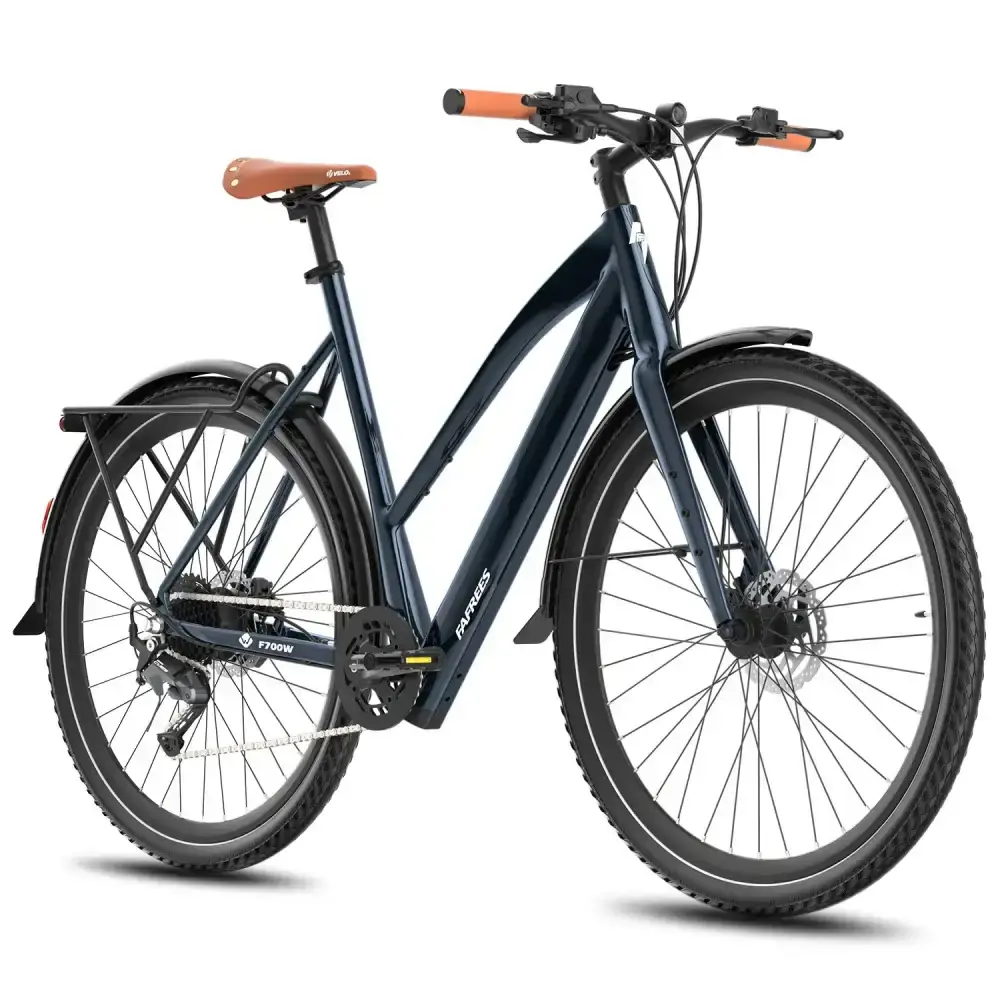
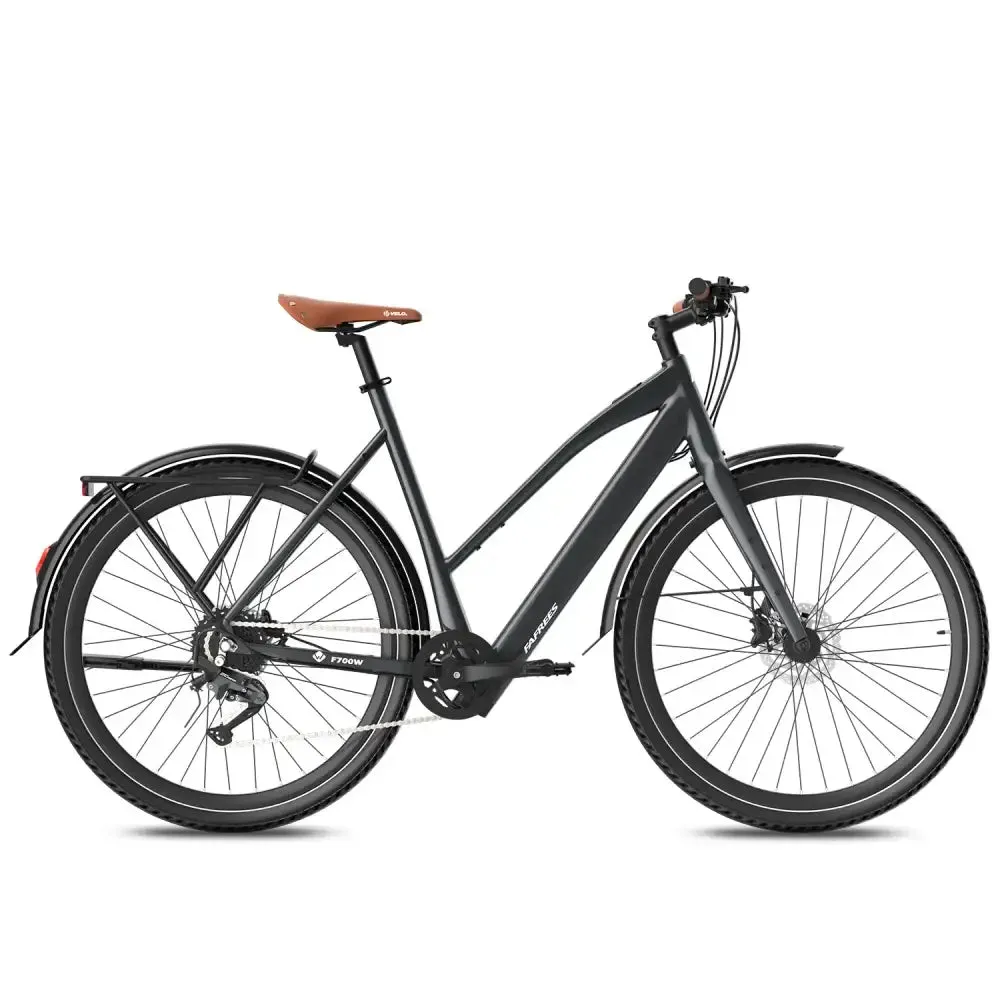
Fafrees builds the F700 around an aluminum alloy frame with the battery tucked into the down tube rather than clamped on top of it — the same “hidden battery” approach brands charge a premium for on pricier bikes. On the scale, that decision pays off: Fafrees claims 19.5kg, but the German outlet wattmoves.de weighed a test unit at closer to 18.5kg, a kilogram lighter than the spec sheet promises. That’s an unusual direction for a discrepancy — most manufacturers round down, not up.
The welds are clean where they’re visible, with rougher finishing only around the bottom bracket — normal for a bike in this price bracket, and not something that affects strength. Two colorways ship: Royal Blue and Pearl Black, both on the F700W. The F700M variant, in either color, is sold out at BuyBestGear as of this writing, so anyone shopping right now is choosing between two colors of the same bike rather than between two distinct models.
One geometry note worth flagging before anything else: Fafrees lists a suitable rider height of 175–210cm. That’s tall. The same German review independently noted the frame runs long and the stock handlebar is flat rather than swept back, which stretches the reach further for anyone on the shorter end of that range. If you’re under roughly 170cm, this isn’t the frame that will fit you comfortably.
Technical Specifications
Here’s the full spec sheet as listed by Fafrees and confirmed on the BuyBestGear product page.
| Spec | Fafrees F700 |
|---|---|
| Motor | 250W nominal rear hub, 580W peak |
| Torque | 40 Nm, torque sensor |
| Battery | 36V 10Ah (360Wh), non-removable |
| Claimed range | Up to 100km (optimal conditions) |
| Charging time | ~4 hours (36V 3A charger) |
| Top assisted speed | 25km/h (EU-legal) |
| Max climbing grade | 15° |
| Drivetrain | Shimano CUES 9-speed |
| Brakes | Hydraulic disc, unbranded |
| Tires | Chaoyang 700×42C |
| Frame | Aluminum alloy |
| Net weight | 19.5kg claimed (~18.5kg measured independently) |
| Max load | 150kg |
| Suitable height | 175–210cm |
| Water resistance | IPX4 |
| Warranty | 1 year, manufacturing defects only |
| Price | €1,099 (F700W, both colors) |
All specifications are manufacturer-claimed. Real-world performance will vary with usage conditions, environment, and individual configuration.
The Shimano CUES 9-speed group is worth a second look. It’s a genuine Shimano groupset, not a generic derailleur wearing a Shimano sticker — but CUES sits in Shimano’s entry-to-mid tier, roughly where Altus and Acera used to live. It shifts cleanly and it’s serviceable at any bike shop, which matters more long-term than the name recognition does.
Performance
Torque sensors at this price are still uncommon — most sub-€1,200 e-bikes rely on cadence sensors, which fire the motor at a fixed output the moment the cranks start turning, whether you’re pushing hard or barely turning the pedals. A torque sensor reads how much force you’re actually applying and scales assist to match. wattmoves.de’s independent test described exactly this: natural, direct assistance in the lowest mode that felt like a strong tailwind rather than a shove, with power ramping up smoothly through the higher levels without ever feeling disconnected from pedaling effort. Pedaling past the 25km/h assist cutoff, testers reported no resistance from the motor — you’re just riding a normal bike at that point.
The 580W peak output is enough to get moving from a stop without hesitation, and the claimed 15° max climbing grade is plausible given the torque figure — though, as with most rear-hub setups, steep sustained climbs will lean more on the rider’s legs than a mid-drive would.
▶ Independent F700M review — covers the gearing and motor response in more depth than the spec sheet alone can show.
Comfort and Handling
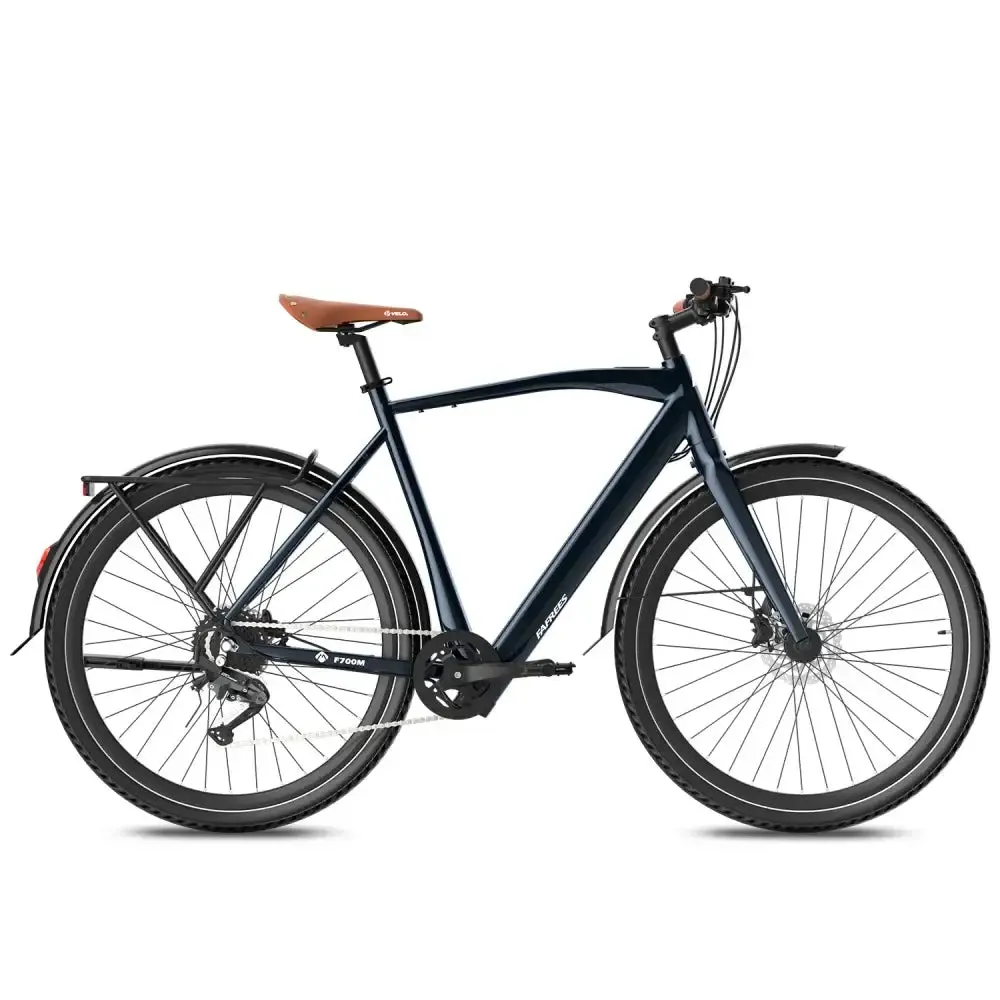
The 700×42C Chaoyang tires are wide enough to smooth out expansion joints and minor potholes without a suspension fork, and they held up fine on the light gravel paths testers tried. What they won’t do is compensate for a riding position that’s already leaning sporty. The straight bar keeps wrists in a flatter, more forward-loaded posture than the swept bars common on step-through commuters — fine for a confident rider covering distance, less fine for someone wanting an upright cruiser feel.
I want to be direct about the wrong-fit case here: if you’re shorter than about 170cm, or if you specifically want an upright, relaxed commuting posture, this isn’t your bike. The F700 rewards riders who are comfortable leaning slightly into the ride.
The hydraulic disc brakes are a clear step up from the mechanical discs common on budget e-bikes — testers described strong, low-effort stopping power that stayed consistent across repeated braking, which matters more in city traffic than most spec sheets give it credit for.
Battery, Range & Charging
This is the section where the F700’s marketing and its physics stop agreeing. Fafrees claims up to 100km on the 360Wh battery. Using NewForTech’s realistic consumption model (360Wh ÷ 15–20 Wh/km, based on typical mixed-terrain riding at moderate assist), the F700 lands closer to 18–24km per charge under normal conditions — a gap of more than 70% against the manufacturer figure. That’s a MATERIAL GAP by any reasonable standard, and it’s worth understanding why the two numbers diverge so widely: the 100km claim assumes the lowest assist level, flat terrain, a light rider, and favorable conditions all at once. Real commutes rarely stack all four.
One real-world data point supports a figure in between: an AliExpress-published tester on the related F700M reported finishing a roughly 8km commute with three climbs, riding mostly in Eco mode, with over 60% battery remaining — extrapolated, that suggests something closer to 20km before the battery runs low under similar mixed-terrain conditions, which lines up with the lower end of our estimate rather than the marketing number.
The battery itself is fixed inside the down tube rather than removable — a point that tripped up at least one UK buyer, who left a review expecting a removable pack with two release keys (as some retailer listings imply) and received neither. If charging at a wall outlet near where you park the bike works for your routine, this is a non-issue. If you were counting on carrying the battery upstairs to charge separately, it’s a real limitation. On the plus side, a full charge from empty takes about four hours with the included 36V 3A charger — quick enough to top up overnight without thinking about it.
Display and Ride Modes
The F700 uses a simple integrated LED display with single-button control and four assist levels — no color touchscreen, no Bluetooth pairing, no companion app. That’s a deliberate simplicity, not a missing feature: this is a display built for glancing at speed and battery percentage while riding, not for scrolling through settings. One UK buyer review noted the retailer imagery had suggested Bluetooth connectivity that wasn’t present on their unit; treat any smart-connectivity claims for this bike with some skepticism until Fafrees confirms otherwise.
Power assist adjusts in four discrete steps rather than the continuous ramp some higher-end torque systems offer, but combined with the torque sensor’s proportional response within each level, the practical riding feel doesn’t suffer much from the simpler hardware.
Accessories and Extras
In the Box
Every F700 ships with the bike itself, a battery charger, a printed user manual, and a small accessory box: two spare brake pads, an inner tube, two valve caps, two reflectors, a multi-tool, a 13/15mm wrench, and a keychain. It’s a genuinely useful starter kit rather than the bare-minimum inclusions some budget e-bikes ship with — the spare inner tube and brake pads in particular save a trip to the bike shop for the first minor issue.
Recommended Upgrades
Front and rear mudguards and lights are already included from the factory, so the main upgrade path is comfort-oriented: a swept-back handlebar or shorter stem for shorter riders who want to counteract the stretched reach, and a wider saddle for anyone planning commutes longer than 30 minutes. Neither is Fafrees-specific — any standard aftermarket part compatible with a 700c road-style frame will fit.
Model Comparisons
Fafrees F700 vs Tenways CGO600
| Spec | Fafrees F700 | Tenways CGO600 |
|---|---|---|
| Weight | ~18.5–19.5kg | ~15kg |
| Battery | 360Wh, fixed | ~360Wh, fixed |
| Drivetrain | Shimano 9-speed | Single-speed belt |
| Brakes | Hydraulic disc | Hydraulic disc |
| Sensor | Torque | Torque |
| Price | €1,099 | ~€1,450–1,600 |
Key differences: the CGO600 is around 3–4kg lighter and belt-driven, which means near-zero drivetrain maintenance, but its single speed makes hills work harder than the F700’s 9-speed gearing does. For flat city commuting, the CGO600’s simplicity is genuinely appealing; for anyone dealing with hills or wanting gear range, the F700 has the mechanical advantage — at roughly two-thirds the price. Read our full torque vs. cadence sensor guide if you want the underlying mechanics of why both bikes ride the way they do.
Fafrees F700 vs Engwe L20 SE
The Engwe L20 SE, also sold through BuyBestGear at €949, takes the opposite approach: a foldable, step-through frame with 20″×4.0″ fat tires and a larger 561Wh battery, but mechanical rather than hydraulic disc brakes and no torque sensor. It’s the better pick if foldability or a low step-through frame matters more than motor refinement; the F700 is the better pick if ride quality and stopping power matter more than portability. Neither is objectively “better” — they’re built for different commutes.
Worth noting: both discontinued-competitor checks came back clean. The CGO600 and L20 SE are both actively sold in the EU and UK as of this writing, so this comparison holds rather than needing a historical-reference caveat.
FAQ
Is the Fafrees F700 legal to ride in the EU without a license?
How far will the Fafrees F700 actually go on one charge?
What’s the difference between the F700W and F700M?
Is the battery on the Fafrees F700 removable?
Can I ride the Fafrees F700 in the rain?
What’s the warranty on the Fafrees F700?
Final Verdict
The Fafrees F700 does the two things that matter most on a city e-bike — deliver assist that feels like your own effort, and stop reliably in traffic — better than its price suggests it should. The torque sensor and hydraulic brakes alone put it ahead of most bikes in the €1,000–1,200 range, and the accessory kit and Shimano gearing round out a package that feels considered rather than cost-cut. Independent weighing even found it lighter than Fafrees claims, which almost never happens.
Set the 100km range claim aside and plan around 20-ish kilometers per charge, and this is a genuinely good short-commute bike for taller riders who don’t need an upright posture. It is the wrong bike if you’re under 170cm, need a removable battery for indoor charging, or were sold on the range figure as a real number. One more thing worth doing before you buy: Fafrees’ own EU store and at least one German retailer have listed this exact bike between €773 and €899 with promotional codes — worth a quick price check across retailers before paying BuyBestGear’s regular €1,099.
For riders weighing a heavier all-terrain option instead, our Lankeleisi MG600 Lite review covers a bike built for rougher roads at a higher price, and our Engwe P20 review looks at another folding torque-sensor option under €1,300 if portability matters more than gearing.
Related Stories
Coswheel R6000 Review: A 7,000W Electric Dirt Bike for €1,799
CMACEWHEEL HQ20 Review: A €1,199 Longtail Cargo Ebike That Almost Gets Everything Right