Gemini Free Tier Changes: What You Lose on October 9
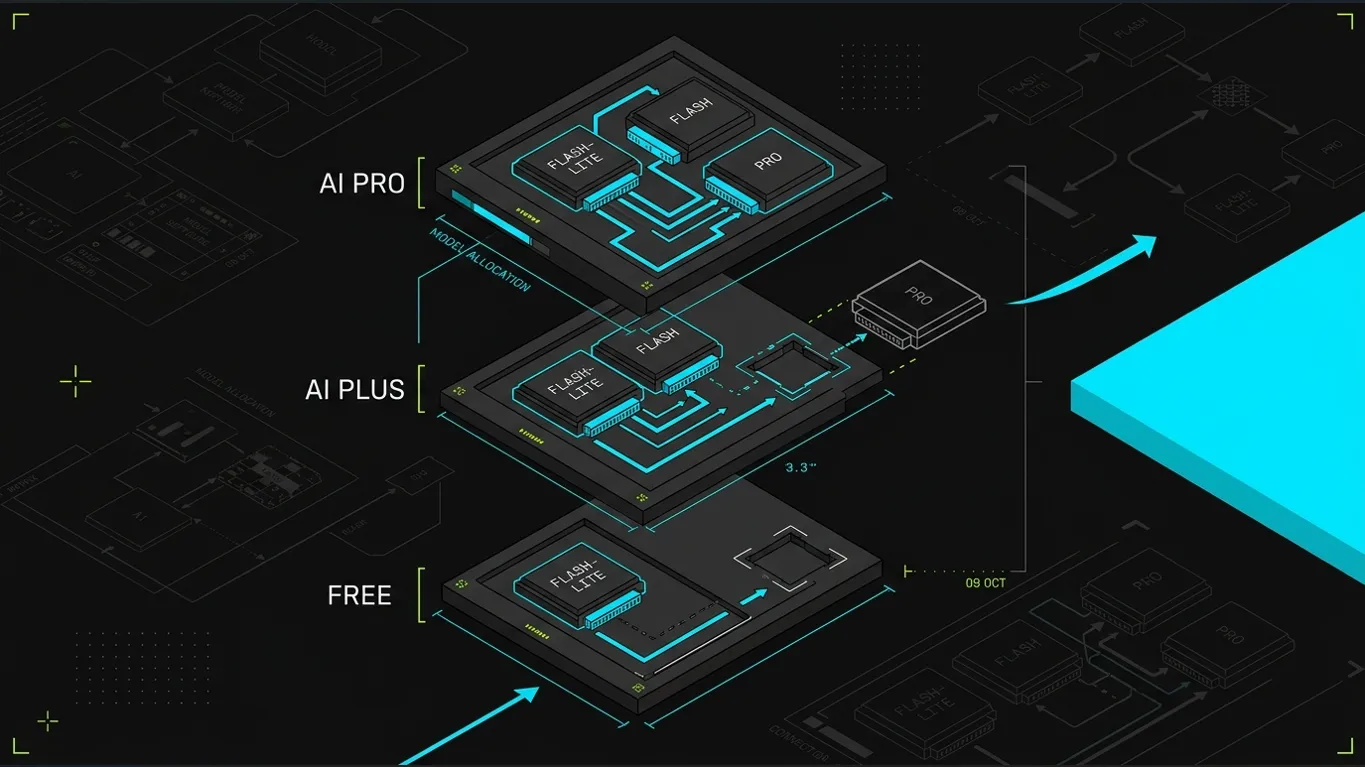
Google is changing which Gemini models personal users can access, and the first cutoff arrives Friday, October 9. Free users will keep Flash-Lite, while AI Plus keeps Flash but loses Pro. AI Pro and AI Ultra keep access to all three listed models.
The distinction matters because this is not another prompt quota change. Google is moving model choice itself behind subscription tiers. The company has also confirmed that AI Plus users will receive an email with the date their change takes effect.
- Free Gemini keeps Flash-Lite after October 9.
- AI Plus keeps Flash but loses Pro.
- AI Pro keeps Pro and gains Deep Think.
- Usage limits still apply separately.
- The best choice depends on how much reasoning you need.
What changes on October 9
Google’s updated support page gives the clearest answer. Once the October changes apply, accounts without a Google AI plan can use Flash-Lite, but not Flash or Pro. AI Plus keeps Flash-Lite and Flash, but Pro disappears.
AI Pro and AI Ultra are unchanged in the access table. AI Pro also gets Deep Think, which Google describes as maximum parallel reasoning. The support page says the October rollout affects personal accounts, so this announcement should not be read as a change to every Gemini surface.
Recent reports from 9to5Google and TechRadar attach version numbers to these model names: 3.5 Flash-Lite, 3.6 Flash and 3.1 Pro. Google’s support table itself uses the shorter Flash-Lite, Flash and Pro labels, so those version numbers are best treated as the current model mapping reported by outlets rather than wording from the access table.
That settles the reporting conflict that appeared over the weekend. The answer is not “free users lose Flash only.” Google’s support page says free users lose both Flash and Pro, leaving Flash-Lite as their listed model.
Free vs AI Plus vs AI Pro: model access at a glance
The simplest way to read the new structure is to treat model access as a separate layer from usage. Free is now the narrowest model tier. Plus sits in the middle. Pro restores the full three-model lineup.
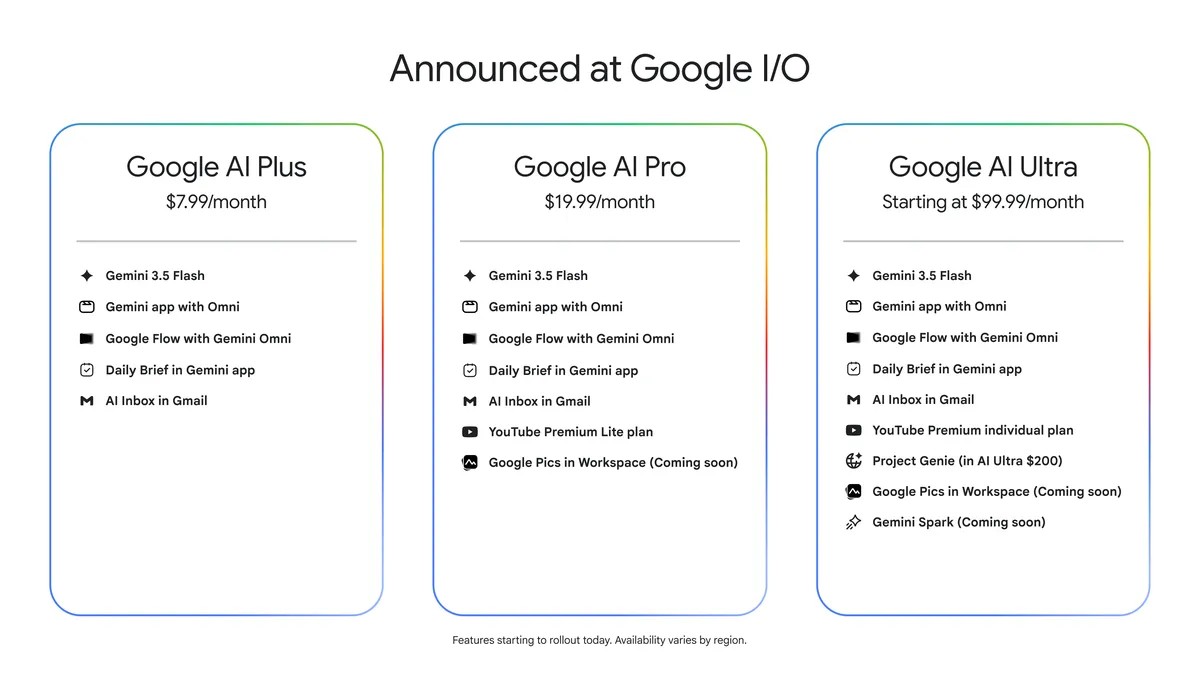
For a free user, the main loss is choice. For an AI Plus subscriber, the main loss is Pro. For an AI Pro subscriber, there is no downgrade in model access. That makes Plus the awkward tier in this particular change because it still costs money but no longer includes Google’s top listed Gemini model.
There is another detail worth separating from the model names. Google says effort levels can be set to low, medium or high for each available model. Its AI subscription overview also shows how the paid tiers bundle model access with other benefits. Higher effort can improve task depth, but it also consumes more of the user’s allowance.
What you will notice in daily use
Most casual users may notice almost nothing on simple prompts. Flash-Lite is positioned by Google as a fast workhorse for everyday tasks, including summarization and brainstorming.
The difference becomes more relevant when a task benefits from deeper reasoning, heavier coding work or more demanding analysis. Google describes Flash as a stronger general-purpose model, while Pro is its most advanced model for complex math and coding.
So a person who mostly asks for rewrites, quick summaries or routine questions can probably stay on the free tier. A developer who relies on Pro for difficult debugging has a much more obvious problem.
The practical detail I would watch is the model picker. Losing prompts from a quota is temporary. Losing the model entirely changes which system can answer the task in the first place.
There is also a caveat. Flash-Lite is still a capable model, and the free tier is not becoming unusable. The limitation is that Google is deciding the ceiling for you instead of letting you choose among the available models.
How this differs from Gemini usage limits
Google introduced compute-based usage limits earlier in 2026. Those limits count how demanding a request is, along with the features used and the length of a chat.
Those limits still exist after the October model-access change. Google says usage refreshes every five hours until a weekly limit is reached, and paid plans get higher limits than accounts without a subscription.
The two restrictions therefore work differently. A usage limit can temporarily stop you from continuing with a model. A model-access restriction removes that model from your plan even when you have unused quota.
That distinction matters when comparing plans. Paying for AI Plus does not simply buy more free-tier prompts. It also keeps Flash available. Paying for AI Pro goes further by restoring Pro and adding Deep Think.
Your three options: stay, upgrade or switch
There is no reason to pay for a model you rarely use. Start with the task that matters most to you, then decide whether Gemini’s new boundaries actually interfere with it.
Stay free if your Gemini use is mostly routine. Flash-Lite should cover summaries, brainstorming, simple drafting and many everyday questions. The obvious downside is that you lose direct access to Flash and Pro, so you cannot move up the model ladder when a task gets harder.
Choose AI Plus when Flash is enough but Flash-Lite is not. This is the more defensible upgrade for someone who wants a stronger everyday model without paying for Pro. However, Plus no longer makes sense as a Pro substitute because Google explicitly removes Pro from that tier.
Choose AI Pro when Pro itself is the reason you use Gemini. That includes workflows where complex coding, advanced mathematical work or deeper reasoning matters. The extra Deep Think access also gives Pro users a capability that free and Plus users do not get.
Switch assistants when the model you need is no longer worth the subscription or Gemini’s ecosystem is not central to your work. Our AI-for-work guide covers the broader choice between Gemini, ChatGPT, Claude and Copilot. For another Google-related angle, our Gemini and Apple assistant comparison looks at how Gemini fits into a wider assistant setup.
Is a paid Gemini plan worth it?
For light users, probably not. The free tier still provides Gemini, but the model ceiling is now fixed at Flash-Lite, so the decision comes down to whether you need the stronger models often enough to justify paying.
AI Plus is harder to recommend on model access alone. It restores Flash, which can be meaningful for regular work, but Pro is no longer part of the package. If your reason for upgrading is “I want the best Gemini model,” Plus is the wrong stop.
AI Pro is the clearer choice for heavy users who specifically need Pro. That does not mean everyone should upgrade. Most people will get more value by keeping the free tier and using another assistant when they hit a task that needs a different model.
The other factor is ecosystem. Google can make a subscription more attractive when you already rely on Gemini across Google products. If you mostly use one chatbot as a standalone tool, a cross-shop between assistants is more rational than paying automatically.
What this change signals for Gemini users
Google is moving from a mostly quota-based model system toward a tiered access model. That is a meaningful shift because the free product is no longer simply a lower-volume version of the paid product.
The change also makes comparisons between AI subscriptions less straightforward. Two plans can differ in model access, usage limits, context size, tools and ecosystem benefits at the same time. Checking only the prompt allowance can therefore miss the feature that matters most.
For Gemini, the immediate question is simple: is Flash-Lite enough? If it is, the October 9 change may be mostly cosmetic. If it is not, the choice becomes a budget decision or a reason to use another assistant.
Frequently Asked Questions
01 Does Gemini Free lose Flash on October 9?
02 Does Google AI Plus still include Gemini Pro?
03 Is Gemini Flash-Lite the same as a usage limit?
What to do before October 9
First, check which Gemini model you actually use when a task becomes difficult. If you never leave Flash-Lite, the free tier may be enough. If you depend on Flash, Plus preserves it.
Next, check whether Pro is part of your workflow. If it is, skip the idea that AI Plus is a cheaper replacement because Google’s new table says it is not. Either move to AI Pro or compare another assistant on the tasks you care about.
Finally, do not confuse a temporary usage cap with a permanent plan boundary. One refreshes. The other is a change in what your subscription can access.
What to watch next
The next useful data point will be how often users actually hit the new model boundary in normal work. Google has set the rules, but the practical effect will depend on how quickly Flash-Lite handles the tasks people previously sent to Flash or Pro.
Google has also introduced a new generation of models this year, so today’s access table may not stay fixed for long. For now, the October 9 rule is clear: free users get Flash-Lite, AI Plus keeps Flash, and Pro sits with the higher tiers.
For readers who only need an everyday chatbot, staying free is the sensible default. For heavier users, this is the point to test the alternatives before paying for a tier that no longer includes the model you actually want.