Engwe P20 Review: Complete Guide to Performance and Features

The Engwe P20 enters a market littered with folding commuter bikes that promise everything and deliver half of it. This one is different in a specific way: it replaces the chain entirely with a carbon belt drive, adds a torque sensor that most bikes at this price omit, and still lands under €1,300. Whether those decisions add up to a bike worth buying — or whether the 100 km range claim and the unbranded hydraulic brakes deserve more scrutiny than the promotional copy suggests — is what this review works through. We cover the real-world range arithmetic, the single-speed limitation on hills, the folding mechanism flaw that multiple reviewers have independently flagged, and exactly which rider this bike suits and which it will disappoint.
Please note that shipping to Canada or the United States is not available at this time on BuyBestGear.
- 18.5 kg — lightest Engwe folder
- Carbon belt: 33,000 km maintenance-free
- Torque sensor with 3 PAS levels
- Hydraulic disc brakes included
- Integrated lights, indicators, rear rack
- Single-speed — steep hills need effort
- 345 Wh: realistic 40–50 km range
- Folding mechanism: handlebar flails folded
- No EU after-sales service network
Affiliate link · Price and availability subject to change — verify at checkout
The Engwe P20 is a 18.5 kg foldable city e-bike built around a single-speed JK Carbon belt drive and a torque sensor — two features rarely combined at this price point. It folds in under 10 seconds, runs on a 36V 9.6Ah (345 Wh) removable battery, and ships with rack, fenders, and integrated lighting as standard. Available at BuyBestGear for €1,299 (verify at checkout), it targets urban commuters who want a clean, low-maintenance ride without the greasy chainset. The real-world range and single-gear limitation deserve more honesty than most coverage gives them — both are addressed here in full.
Contents
Engwe P20 Review: Design and Build Quality
Frame and Construction
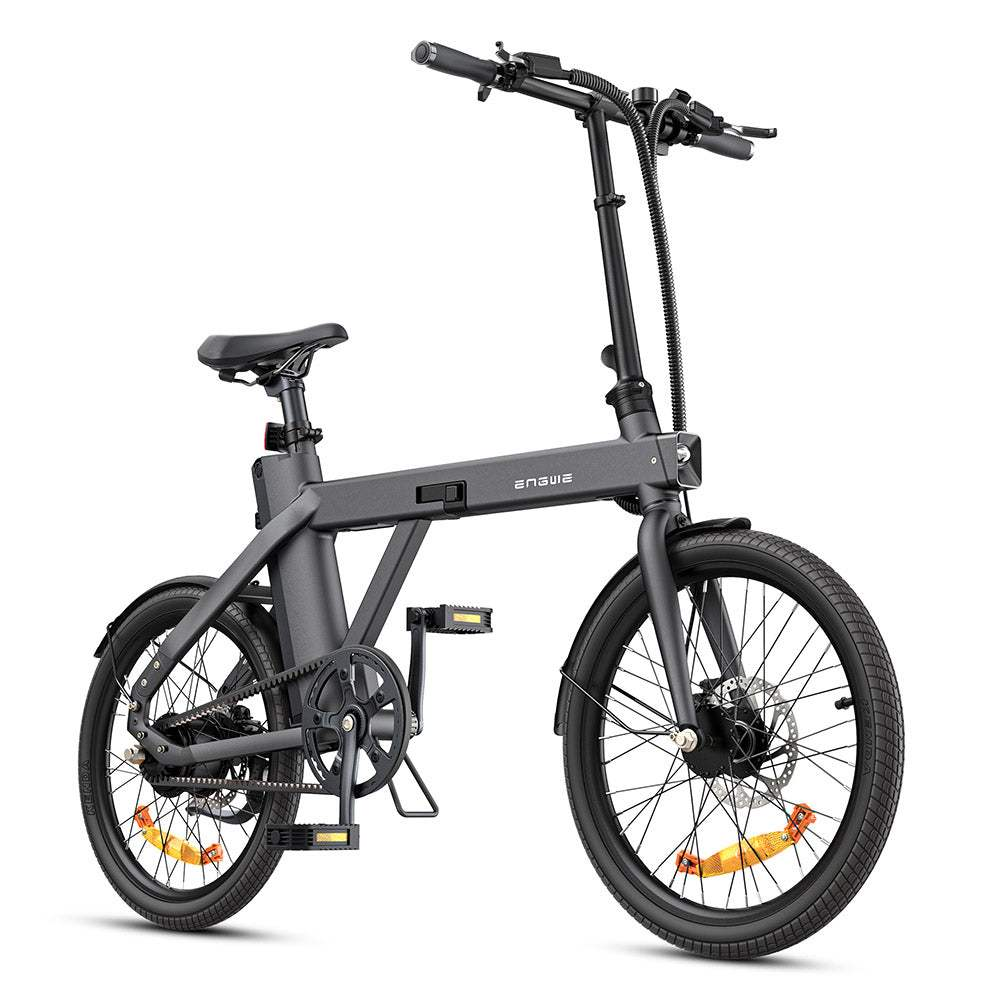
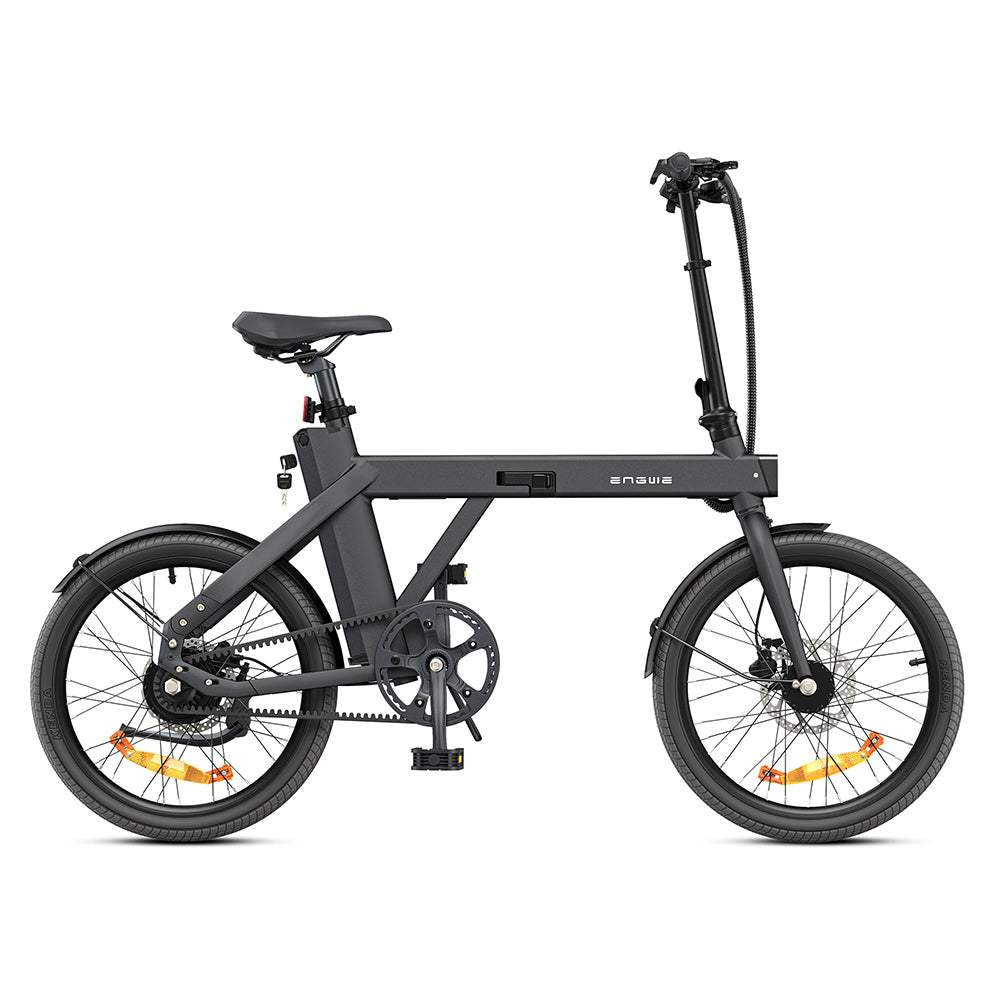
The P20’s 6061 aluminum alloy frame is the cleanest Engwe has shipped at this price point. Cables are routed internally through the frame, the battery sits flush behind the seatpost with a keyed lock, and there are no exposed brackets or rack mounts bolted onto the outside. The rectangular tube geometry keeps the silhouette narrow. Next to its Engwe stablemates — the M20 with its moped bulk or the E26’s fat-tire stance — the P20 looks deliberate and restrained. The weight is the headline: 18.5 kg, which makes it meaningfully lighter than most folding commuter bikes in this price band. It’s not ultralight, but it’s light enough to carry up a flight of stairs without making the decision a significant one.
Battery Integration
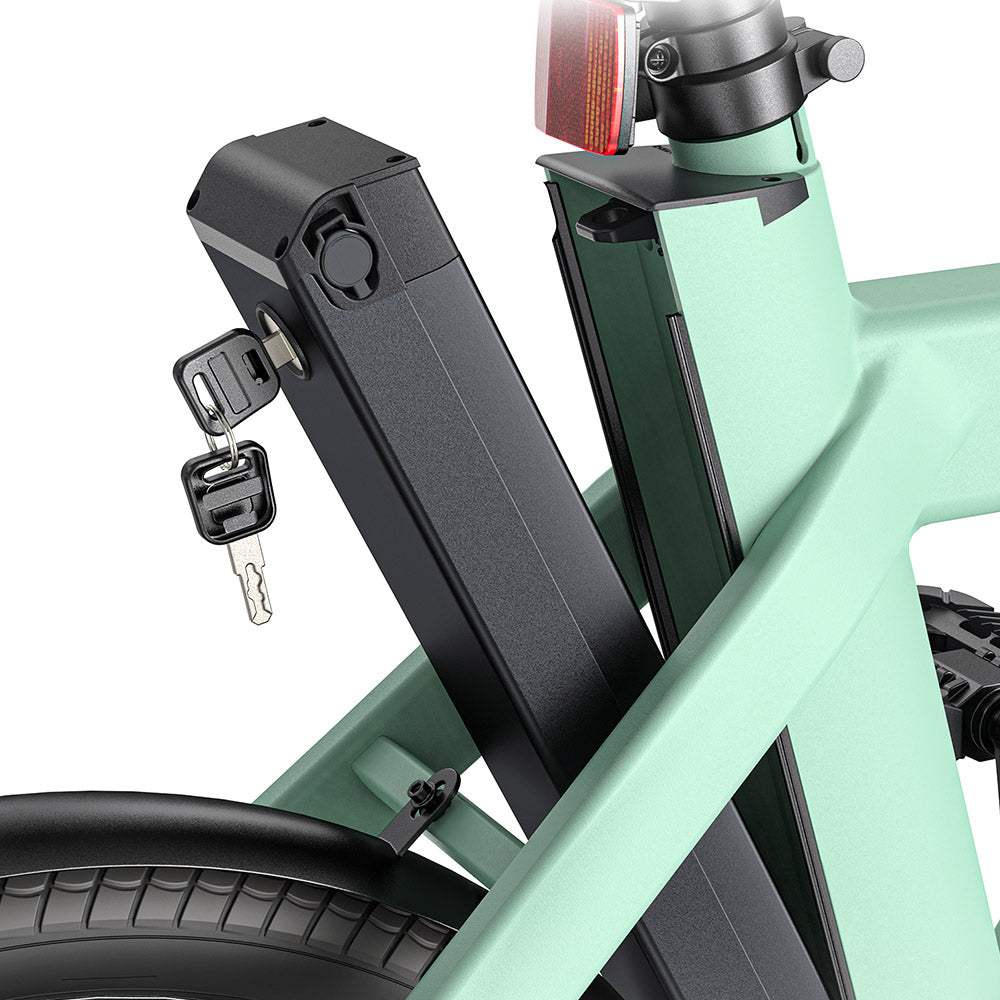
The 36V 9.6Ah pack (345 Wh) locks into a cavity behind the seatpost with a keyed barrel lock. Pull a lever, turn the key, slide it out. On or off the bike, it charges at the same five-hour rate via the same port. The design keeps the center of gravity low and the frame profile uninterrupted, which is worth something aesthetically. What it cannot do is overcome the arithmetic of a 345 Wh capacity — covered in full in the Performance section below.
Suspension System
There is none. The P20 runs a rigid frame front to back, no fork, no rear linkage. For urban surfaces — tarmac, bike lanes, smooth cycle paths — Kenda K-Shield tires at 20 × 1.95 absorb enough incidental road texture to make the omission irrelevant. Introduce cobblestones, kerbs, or poorly maintained road surfaces and you will feel every one of them through the handlebar. This is a city bike in the strictest sense. It is not engineered to go anywhere that requires suspension. Factor that boundary into the purchase decision before spending €1,299.
Safety Features
Integrated rear lights activate when the headlight turns on. The brake lights brighten when either lever is pulled — just like a car’s brake cluster. Turn indicators on both sides are controlled from the handlebar. This kind of integrated lighting setup does not appear consistently on competing folding bikes at this price; it is one of the P20’s legitimate differentiators for riders who commute in low-light conditions. The IP6-rated display enclosure handles rain and road spray without issue.
Engwe P20 Review: Technical Specifications
All specifications below are sourced from Engwe’s official product listing and the BuyBestGear product page — the authorised EU retailer for this model. Verify current pricing and configuration at checkout before ordering, as hardware configurations can change between production runs.
| Specification | Detail |
|---|---|
| Motor | 250W brushless rear hub, 42 Nm torque |
| Battery | 36V 9.6Ah lithium-ion (345 Wh), removable, key-locked |
| Charge time | ~5 hours |
| Sensor | Torque sensor, 3 PAS levels |
| Range (claimed) | Up to 100 km (manufacturer-stated, best-case conditions) |
| Max speed | 25 km/h (EU pedelec ceiling) |
| Drivetrain | Single-speed JK Carbon belt drive |
| Brakes | Unbranded hydraulic disc, front and rear |
| Tires | Kenda K-Shield 20 × 1.95 urban |
| Suspension | Rigid (none) |
| Display | SW102/2, IP6 waterproof |
| Lighting | Integrated LED front, rear/tail/brake, turn indicators |
| Frame | 6061 aluminum alloy |
| Weight | 18.5 kg |
| Max load | 120 kg |
| Rider height | 155–190 cm |
| Fold time | 3-step, ~10 seconds |
| Throttle | Thumb throttle (included) |
| IP rating | IP6 (display), IPX4 (frame/battery area) |
| Price | €1,299 (verify at checkout) |
For a broader context on EU electric bicycle classification, specifically, why a 250W nominal motor and 25 km/h cutoff define a legal pedelec under EN 15194.
Engwe P20 Review: Performance
Motor and Power Delivery
The 250W nominal motor is the EU legal ceiling for a road-legal pedelec — not a performance differentiator. Every EU-legal e-bike in this category runs 250W nominal by regulation; what separates them is how the power is managed and delivered. Here, the torque sensor does the work. Unlike the cadence-only systems used on many competing folding bikes in this price band — where the motor fires at a fixed level the moment pedal movement is detected — the P20’s sensor reads pedal force in real time and scales motor output proportionally. The practical result: acceleration from standing is smooth rather than lurching, and the motor fades out naturally rather than cutting abruptly at 25 km/h. If you want to understand exactly why torque sensing changes the ride feel in this category, our torque vs cadence sensor guide covers the physics in full. The 42 Nm torque figure is adequate for flat urban surfaces and moderate inclines up to around 8–10%. Steeper gradients quickly expose the single-speed limitation.
Battery Life and Range
Engwe rates the P20 at up to 100 km range. That figure requires ideal conditions: flat terrain, low speed, light rider, minimal assist — a test environment, not a commute. Using the industry-standard consumption baseline of 15–20 Wh/km for e-bikes in this class, the 345 Wh pack produces a formula range of 17–23 km. That gap between formula result and manufacturer claim — 335% — is so large it warrants plain language: the 100 km figure is not a target most riders should plan around. Multiple independent testers are more instructive. The BK42 channel reviewer reported 41 km at sustained Mode 3 assist. The eMountainBikeKings team found 45–50 km under similar mixed urban conditions. Both figures align with what a 345 Wh pack delivers under real commuting load at moderate assist, where consumption for a lightweight 250W city bike runs closer to 7–8 Wh/km than the heavier-bike formula assumes. Plan for 40–50 km per charge under normal use. That covers a typical urban commute round-trip of 20–25 km with reserve. It does not cover longer day rides without access to a charging point.
Climbing and Terrain Handling
Single-speed drivetrains and hills are an uncomfortable pairing. The P20’s 250W motor and torque sensor handle gradients up to around 8–10% without requiring significant rider effort, particularly at lower speeds. Beyond that, the absence of a lower gear becomes the constraint. There is no mechanical option to reduce resistance; the only tools are the motor’s three assist levels and your own legs. Multiple reviewers, including the ebiketips tester, noted that the P20 spins out above 15–16 km/h on flat ground — the fixed gear ratio optimizes for urban cruising speed, not climbing. Riders whose commute involves sustained inclines above 5% should treat this as a meaningful limitation, not a minor footnote.
Engwe P20 Review: Comfort and Handling
Ride Quality
The combination of torque sensing and belt drive produces a ride texture that stands out clearly in back-to-back testing against chain-and-cadence alternatives. The motor onset is proportional; there is no jolt at the pedal, no delay on pick-up. The belt contributes the same silence and smoothness at low and high cadence. On well-maintained urban surfaces, the overall ride character is noticeably more composed than the P20’s price point suggests. The ebiketips reviewer described it as feeling “more like a strong tailwind” than an e-bike assist, which captures the torque sensor effect accurately. The rigid frame means none of that remains true on cobblestones or broken pavement. Roads and smooth bike lanes are the P20’s domain.
Ergonomics
Handlebar height is adjustable, with the stem offering a range that covers riders between 155 and 190 cm. The mountain bike-style saddle is comfortable for commutes up to around 30 km; sustained longer distances will prompt most riders to swap it for something with more padding. One specific texture issue: the handlebar stem on the P20 develops a rattle at higher speeds under certain road conditions — a common complaint with folding bike stems that the Neowin reviewer documented during a sustained wet-road test. It is not structurally significant, but it is audible.
Weight and Maneuverability
18.5 kg is the P20’s clearest advantage in direct handling comparisons. The Engwe L20 3.0 PRO — another folding commuter from the same brand — weighs significantly more due to its full-suspension frame and larger battery. The P20 is manageable in one hand on stairs, liftable into a car boot without rehearsal, and narrow enough to navigate through stopped traffic without difficulty. This does not apply if you need to carry it more than one or two floors; at 18.5 kg it is not a bag. But for most urban storage scenarios, it is the right side of the threshold.
Engwe P20 Review: Braking and Safety Systems
Hydraulic Braking
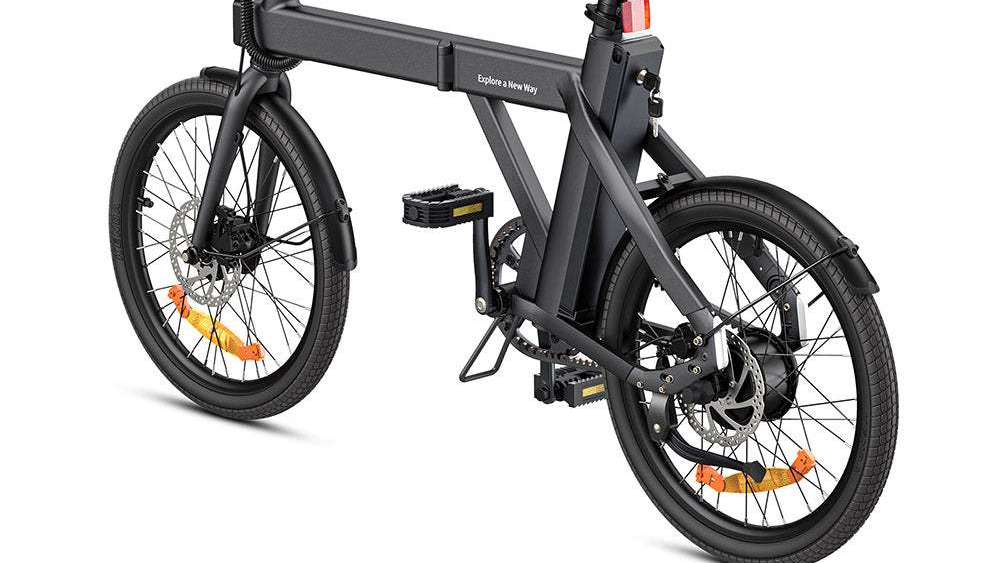
Hydraulic disc brakes on a sub-€1,300 folding bike are not the default. Most comparable models at this price use mechanical disc brakes that require periodic cable adjustment and deliver inconsistent modulation in wet conditions. The P20’s hydraulic setup avoids both problems. The calipers are unbranded — not Shimano, not Tektro, no stated manufacturer — which is worth noting for long-term serviceability. The ebiketips tester found modulation and bite adequate in mixed wet and dry conditions across an extended test period, but characterised them as entry-level hydraulic: functional, not exceptional. Brake levers are equipped with motor cutoff sensors, which immediately interrupt motor power when either lever is pulled.
Integrated Lighting
The front headlight, rear running light, brake activation light, and turn indicators are all factory-fitted and controlled from the handlebar. The headlight carries an IP6 waterproof rating. Turn signals are a feature that most folding e-bikes at this price omit entirely; their presence here is a practical safety benefit rather than a marketing decoration, particularly for riders navigating junctions on urban routes. Running all lights draws from the main battery — Engwe does not publish a lumen figure for the headlight. Expect adequate visibility for urban roads; expect to supplement with a dedicated front light for faster or unlit routes.
Engwe P20 Review: User Interface and Controls
Display and Controls
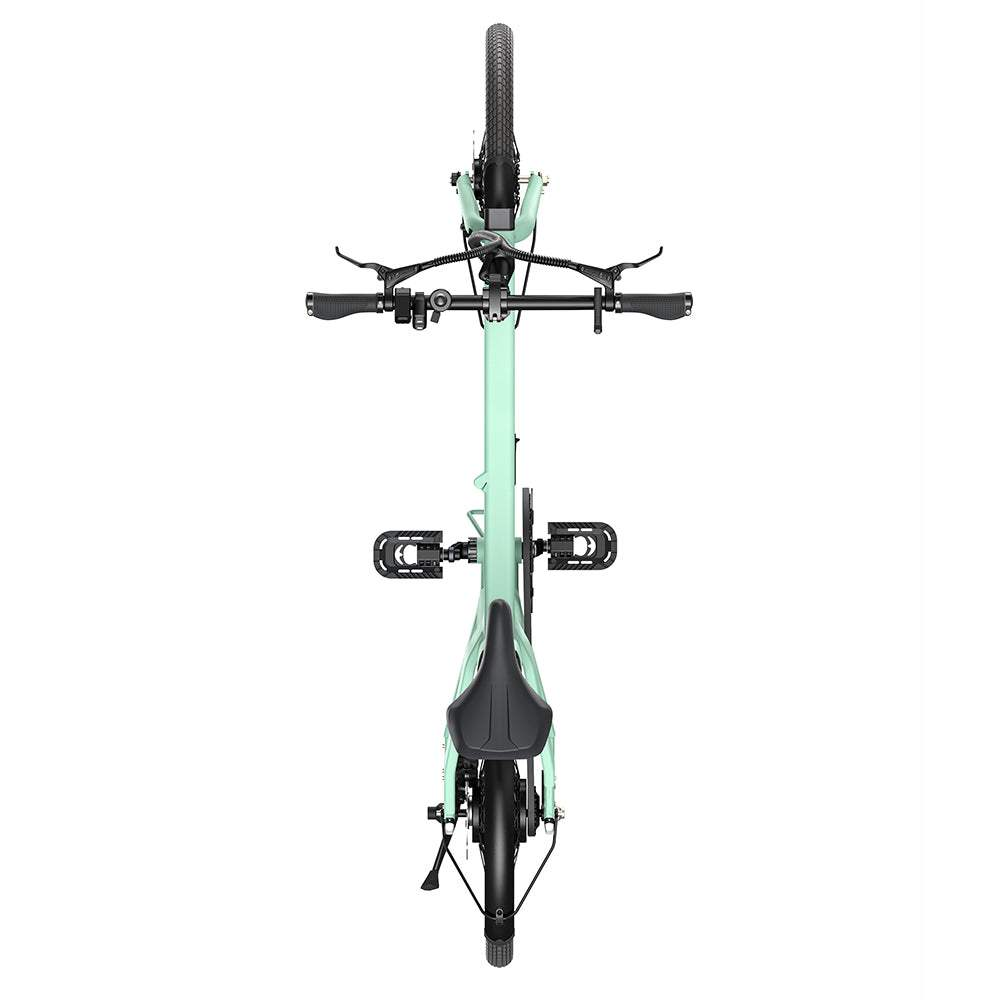
The SW102/2 unit shows speed, battery level, PAS mode, and trip distance. IP6-rated, so rain is not a concern. The Neowin reviewer flagged one specific friction point: Bluetooth pairing with the Engwe app requires the app to initiate the connection after the bike is powered on — you cannot pair from the phone’s Bluetooth settings directly. First-time setup required several rounds of troubleshooting. It is the kind of UX decision that is buried three menus deep for no good reason, and it appears consistently enough across user reviews to flag as a known issue rather than a one-off setup problem.
Sensor Modes
Three PAS levels are the standard configuration. PAS 1 and 2 cover most flat urban commuting without drawing aggressively on the battery; PAS 3 is where the motor assists at full output and range drops accordingly. The thumb throttle ships in the box and provides direct electric drive without pedaling — useful for slow-speed maneuvering in tight spaces or pulling away from a standstill. Understanding the difference between how a torque sensor and a cadence sensor respond to these inputs is worth the five minutes it takes to read our full sensor comparison guide if this is your first torque-sensor bike.
Engwe P20 Review: Accessories and Compatibility
Included Equipment
The box ships with a rear rack, front and rear fenders, pedals, a thumb throttle, battery charger, assembly tools, and a user manual. No additional purchase is required to use the P20 as a daily commuter. The plastic fenders cover the tire arc adequately for road spray, and the rear rack supports standard pannier mounting. BK42’s reviewer mounted an Engwe side bag directly to the rack for grocery runs without issue. Assembly requires attaching the front wheel, seatpost, and pedals — it takes around 30 minutes on first setup; have a set of Allen keys to hand, as the included tools do not cover every bolt size on every unit.
Compatible Upgrades
The Engwe ecosystem offers a direct 36V 9.6Ah replacement battery for the P20, available separately through the Engwe official store. A second battery effectively doubles the range ceiling without any modification to the bike. Beyond that, the P20’s single-speed drivetrain means there is no gearing upgrade path; the belt system is closed. Saddle, grips, and stem are all standard-diameter fitments and swap without issue. The ENGWE app, available on iOS and Android, enables trip tracking, real-time stats, and speed mode configuration via Bluetooth.
Engwe P20 Review: Model Comparisons
Engwe P20 vs Engwe L20 SE
| Specification | Engwe P20 | Engwe L20 SE |
|---|---|---|
| Motor | 250W hub, 42 Nm, torque sensor | 250W hub, 38 Nm, cadence sensor |
| Battery | 36V 9.6Ah (345 Wh) | 36V 15.6Ah (561 Wh) |
| Drivetrain | Single-speed belt (JK Carbon) | 7-speed chain |
| Brakes | Hydraulic disc | Mechanical disc |
| Suspension | Rigid | Front fork suspension |
| Tires | 20 × 1.95 urban | 20 × 3.0 fat |
| Weight | 18.5 kg | ~28–30 kg (approx. — verify) |
| Max load | 120 kg | 120 kg |
| Price | €1,299 | ~€899 |
Key Differences: The L20 SE carries 62% more battery capacity (561 Wh vs 345 Wh), a 7-speed chain drivetrain, front suspension, and fat tires — at a price around €400 lower. The P20 wins on weight (18.5 kg vs ~28–30 kg), belt-drive maintenance simplicity, torque sensing, and hydraulic braking. Riders who prioritize range, gearing versatility, or mixed-terrain capability should choose the Engwe L20 family instead. The P20 is the better choice only if low weight, zero drivetrain maintenance, and a clean urban aesthetic matter more than battery capacity and terrain capability. If you regularly carry the bike on public transit, up stairs, or into an office, the 10+ kg weight difference makes the P20 the practical answer.
Engwe P20 vs ADO Air 20
| Specification | Engwe P20 | ADO Air 20 |
|---|---|---|
| Motor | 250W hub, 42 Nm, torque sensor | 250W hub, 42 Nm, torque sensor |
| Battery | 36V 9.6Ah (345 Wh), removable seatback | 36V 9.6Ah (346 Wh), Samsung 21700, seatpost |
| Drivetrain | Single-speed JK Carbon belt | Single-speed Dayco Carbon belt |
| Brakes | Hydraulic disc, unbranded | Hydraulic disc, 160 mm rotors |
| Suspension | Rigid | Rigid (base model) |
| Weight | 18.5 kg | 16–18 kg stated (~19–21 kg actual per reviewers) |
| Rack / fenders included | Yes | No (add-on, extra cost) |
| Indicators | Yes (integrated) | No |
| App connectivity | Yes (Engwe app) | Yes (ADO app) |
| Price | €1,299 | ~€1,099 (approx. — verify) |
Key Differences: These two bikes are the closest direct comparison in the folding belt-drive commuter category. Specs are nearly identical on paper: same motor class, same battery capacity, same single-speed belt approach, torque sensing on both. The P20 includes rack, fenders, and turn indicators as standard; the ADO Air 20 charges extra for accessories that many commuters will consider essential. The ADO uses a Dayco Carbon belt — a known brand with a confirmed 30,000 km rating — against the P20’s JK Carbon unit, which is unbranded outside the Engwe ecosystem. ADO’s price advantage (~€200 less) is offset in practice once accessories are added. Riders who want a fully ready-to-commute bike without additional spending should choose the P20. Riders who prefer a slightly lighter package — or who already own accessories — and want a belt brand with an independent service record should look at the ADO Air 20 instead. The P20 is not the right choice for anyone expecting Engwe’s retail pricing to come with Shimano-level component pedigree or a European service network.
Engwe P20: Frequently Asked Questions
Is the Engwe P20 worth buying?
What is the real range of the Engwe P20?
How long does the Engwe P20 battery last?
Does the Engwe P20 have gears?
Can the Engwe P20 handle hills?
How heavy is the Engwe P20?
Is the Engwe P20 suitable for tall riders?
How does the P20’s belt drive compare to a chain?
Final Verdict
The Engwe P20 is a focused product that does what it is designed for without pretending to do more. The 18.5 kg weight, torque-sensing assist, carbon belt drivetrain, and integrated lighting package give it a real competitive argument against everything in the folding urban commuter category at this price. The hydraulic brakes are unbranded but functional. The ride quality on smooth urban surfaces is genuinely good — the torque sensor and belt combine to produce the kind of analog ride texture that cadence-based chain bikes cannot replicate. The CMACEWheel V20 and the Vakole Y20 Pro are worth comparing if you want more battery capacity or a geared drivetrain at a similar price point.
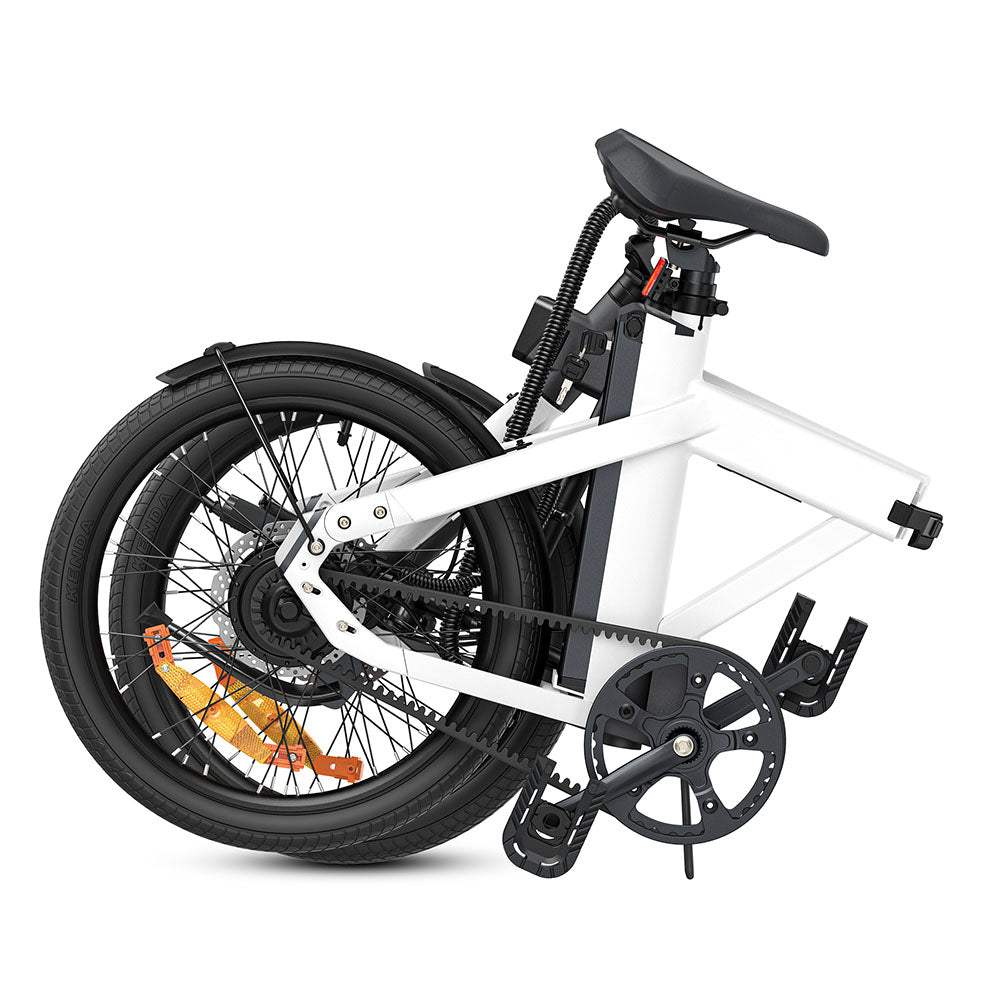
The honest limitations are specific. The 345 Wh battery produces a realistic 40–50 km range under normal use — adequate for urban commuting, not for longer rides. The single-speed belt has no climbing gear; hilly routes will expose that boundary. The folding mechanism has a documented flaw: the handlebar does not lock into place when folded, which prevents the magnetic closure from engaging cleanly and makes carrying the folded bike more awkward than it should be. After-sales support depends entirely on BuyBestGear as the primary warranty contact — there is no dedicated Engwe service network in EU markets, which is a factor worth weighing against brands with physical service infrastructure. The Engwe P20 earns its price for the right buyer; the wrong buyer will find its constraints apparent within the first week. BuyBestGear carries the P20 at €1,299 — use code NFT4 at checkout for 4% off, and verify availability before ordering.