
iHoverboard H2 Review: Complete Guide to Performance and Features

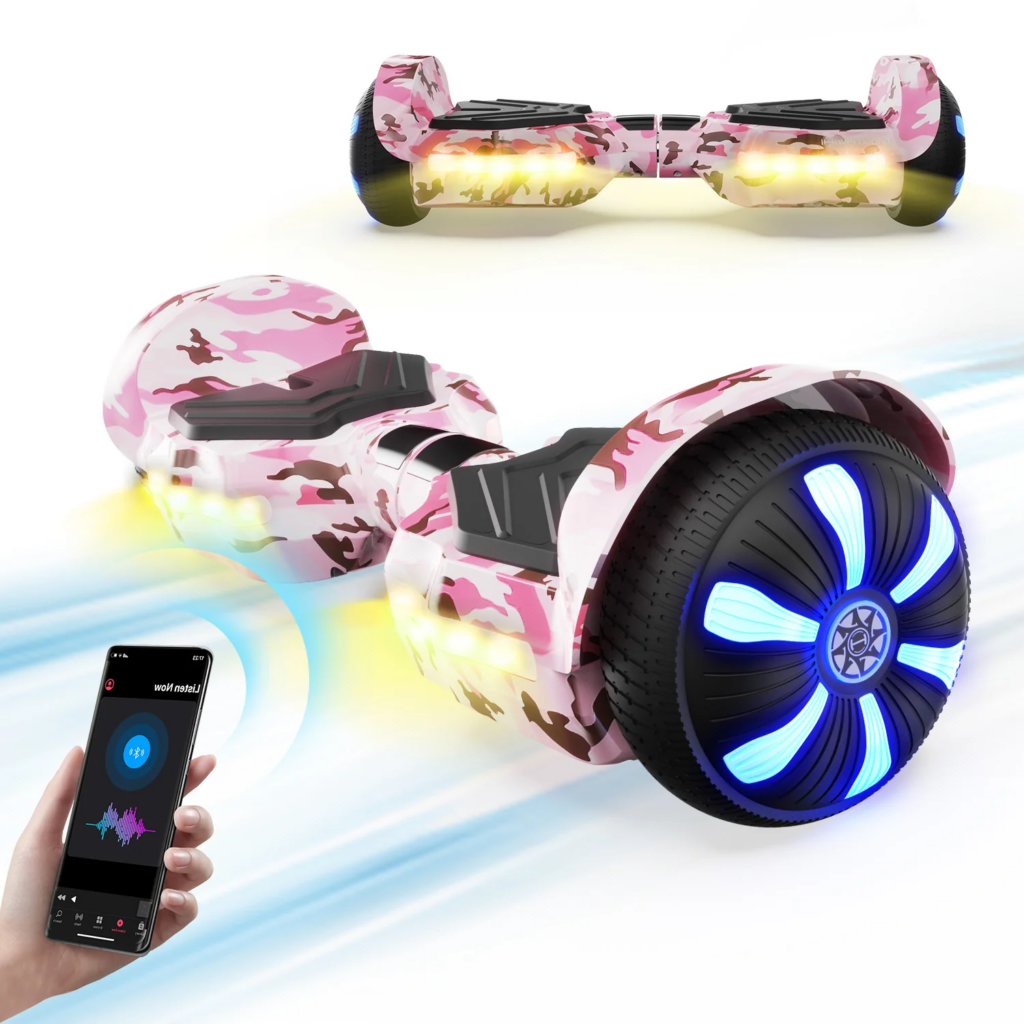
The iHoverboard H2 is a 6.5-inch self-balancing hoverboard aimed at children aged 6 and above, sold exclusively in the UK through iHoverboard at a current sale price of £119.99. It promises dual 250W brushless motors, Bluetooth audio, multi-colour LED lighting, and a three-tier riding mode system — all in a 6.5 kg package. This review puts every one of those claims under scrutiny: real-world range against the 72Wh battery arithmetic, the stability behaviour verified by independent buyers, after-sales service reality, and who this board is genuinely right for — and who it is not.
- Lightweight at 6.5 kg — one of the lightest boards in the 6.5-inch 500W class, manageable for a child to carry short distances
- Three speed modes (8 / 10 / 12 km/h) let inexperienced riders progress at their own pace without reprogramming
- 2–3 hour charge time is among the fastest in the class; the Hover-1 Superfly (a direct rival) requires 5 hours for the same task
- 100 kg max load capacity supports adults as well as children; the comparable Zimx G11 Pro caps at 50 kg
- Built-in Bluetooth speaker and colour-shifting LED wheels at £119.99 sale price represent genuine value for a UK CE-certified board
- Self-balancing stability reported as inconsistent by at least one verified UK buyer — the board began spinning the rider unpredictably; power-cycling was the only fix available mid-ride
- Real-world range of 6–9.6 km (per BBC Science Focus and battery arithmetic) falls 25–50% below iHoverboard’s 12 km claim at typical to heavy loads — the gap is material
- No app connectivity, no GPS tracking, no companion software — the Hover-1 Superfly offers all three at a comparable price point
- Telephone support line frequently goes unanswered (Trustpilot, 2025); email is the only reliable service channel, with replacement parts not always listed on the website
Affiliate link · Price and availability subject to change — verify at checkout
The iHoverboard H2 delivers genuine beginner-friendly performance in a well-priced package: fast charge time, genuine weight versatility up to 100 kg, and a tidy 6.5 kg frame. The 72Wh battery, however, produces a real-world range of 6–9.6 km rather than the 12 km advertised — a gap that reaches 50% under adult loads. The board is best suited to supervised garden or driveway use with lighter child riders; it is not a street commuter tool, and UK law prohibits public road and pavement use regardless.
Contents
iHoverboard H2 Review: Design and Build Quality
Frame and Construction
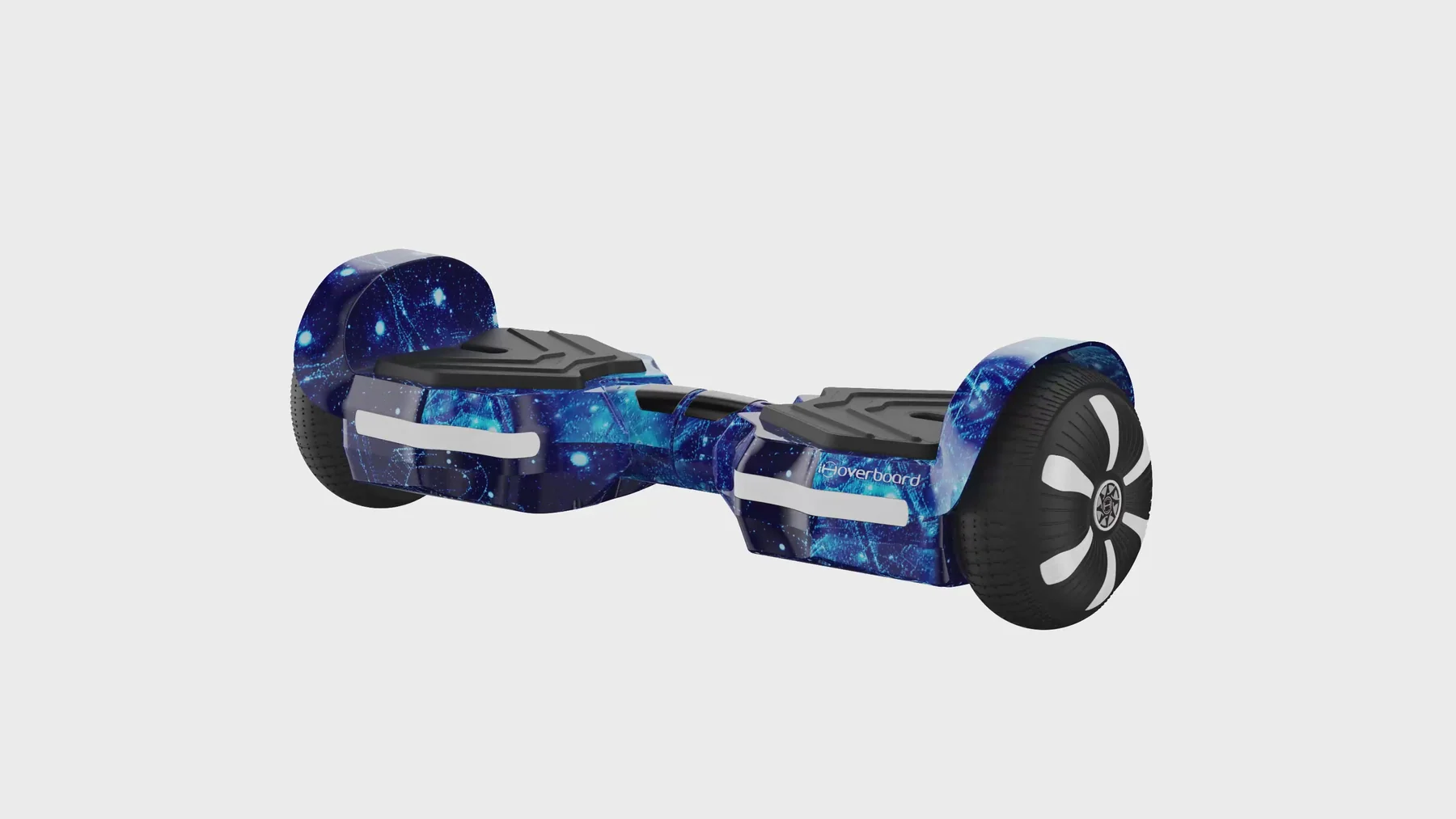
At 6.5 kg, the H2 sits at the lighter end of standard 6.5-inch hoverboard construction. The frame shell is ABS plastic — the default for this segment, and it shows in flex under heavy rider load compared to the aluminium-chassied boards at double the price. The 22.8×7.5×7.5-inch footprint is compact enough to store under a bed or in a school bag side compartment. Pick it up with one hand and it feels toy-like; that is partly the point for a product rated from age six. What it is not is road-impact-resistant. A kerb drop or a surface crack above 15° will cause the motor to protest, and the solid 6.5-inch tyres transmit every cobble and pavement lip directly to the rider’s feet — there is no suspension of any kind.
Battery Integration
The 36V 2Ah lithium-ion pack — 72Wh total — sits inside the central chassis housing. It is non-removable. Charging runs through a standard barrel-jack adapter included in the box; iHoverboard UK rates the cycle at 2–3 hours, which is among the fastest charge-to-ready times in the class. The battery carries a temperature control system, with an over-temperature alarm that triggers voice warnings and a fault indicator light sequence on the chassis. At a 72Wh capacity, this is a small pack — by way of context, a standard 13-inch laptop ships with a 50–70Wh battery, and those are not rated for physical exertion loads. It gets the job done for a child’s 45-minute garden session; it does not survive a full afternoon of riding across changing loads and terrain types. That matters, because the marketed range figure assumes it will.
Safety Features
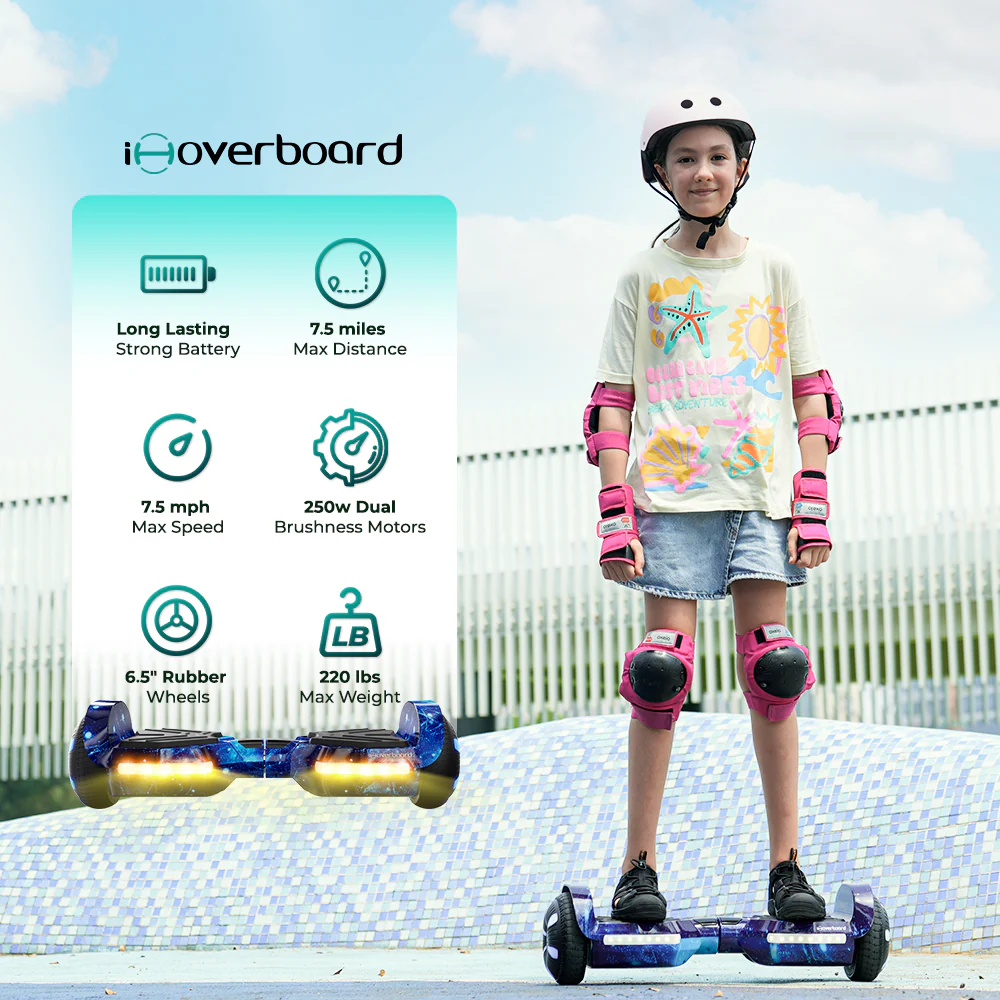
The H2 carries CE certification, which is a baseline legal requirement for powered electrical equipment sold in the UK market — not a meaningful differentiator. More practically: the unit ships with low-battery protection (automatic speed reduction and shutdown below 10% charge), an audible startup beep, and a voice alert for low-battery status. Tilt-angle protection triggers a fault indicator if the board is flipped beyond a survivable operating angle. There are no wrist guards, knee pads or a helmet in the box.
iHoverboard H2 Review: Technical Specifications
All specifications sourced from the official iHoverboard UK product listing at iHoverboard UK, the sole authorised UK retailer for this product. Verify all figures at checkout before purchase.
| Specification | Value |
|---|---|
| Motors | Dual 250W brushless (500W combined); temperature-controlled |
| Battery | 36V 2Ah (72Wh); integrated; non-removable |
| Charge time | 2–3 hours |
| Max speed | 12 km/h (7.5 mph) — Master mode |
| Speed modes | Beginner 8 km/h | Skilled 10 km/h | Master 12 km/h |
| Claimed range | 12 km / 7.5 miles per charge (iHoverboard UK) |
| Ride time | 50–70 minutes continuous (manufacturer; light rider, flat terrain) |
| Wheel size | 6.5 inches, solid tyre |
| Max load | 100 kg (220 lbs) |
| Unit weight | 6.5 kg (14.3 lbs) |
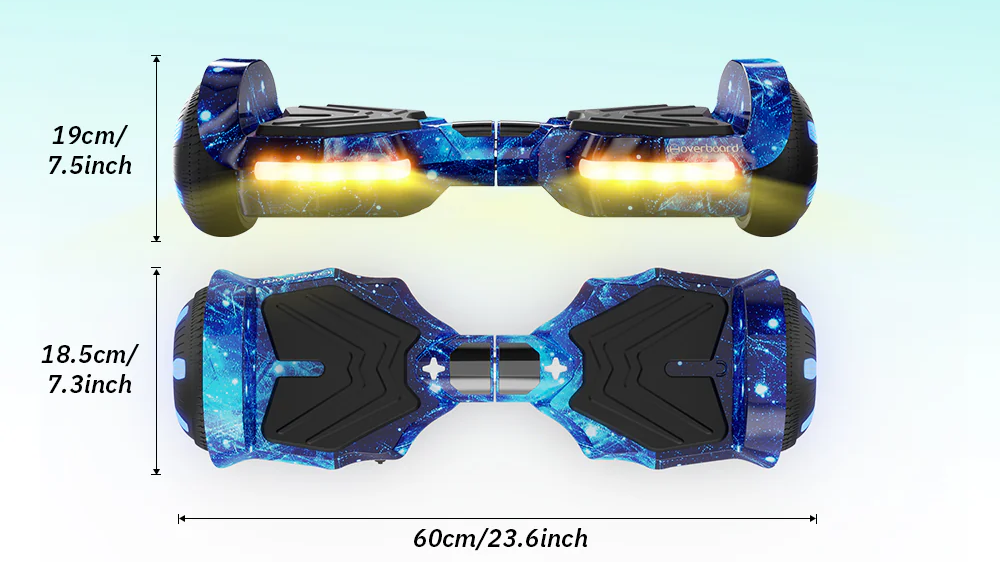
| Dimensions | 57.9 × 19 × 19 cm (22.8×7.5×7.5 in) |
| Connectivity | Bluetooth speaker (built-in) |
| Lighting | Multi-colour LED wheel lights; LED body/footpad lights |
| Age rating | 6+ |
| Certification | CE (UK market) |
| Warranty (UK) | 12 months via iHoverboard UK |
| In-box | Hoverboard ×1, power adapter ×1, user manual ×1 |
| Price (sale) | £119.99 (verify at checkout) |
All specifications are as published by iHoverboard UK and verified against iScooter UK’s listing of the same unit. Real-world range varies with rider weight, terrain, ambient temperature and battery age. Verify all pricing and availability at checkout.
For a broader look at how self-balancing and motorised personal transport compares with e-bike options in the same budget range, the Vakole Y20 Pro review at NewForTech covers the step up to pedal-assisted adult commuting.
iHoverboard H2 Review: Performance
Motor and Power Delivery
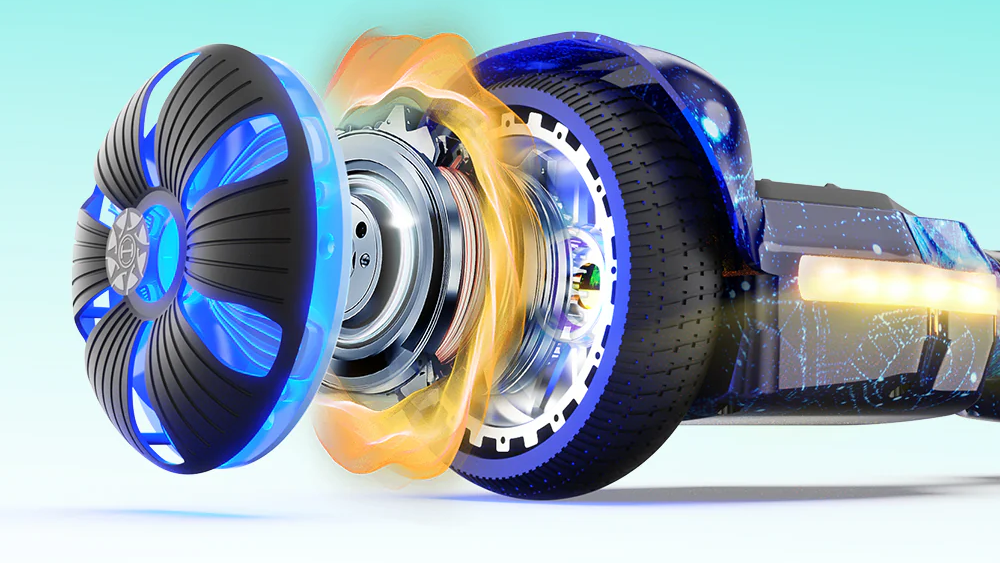
Each wheel hub houses a 250W brushless motor — 500W combined. That figure is not a performance metric so much as a design ceiling for self-balancing boards at this price tier; every competing 6.5-inch board in the £100–£150 bracket runs the same motor class, and they all top out at 12 km/h because the limiting factor is the self-balancing gyroscope algorithm, not outright motor torque. What the temperature control integration does add is a longer operational lifespan under continuous load: the system throttles output before heat builds to the point of component degradation, which is meaningful for a product used by children who may not recognise when a board is overheating.
Acceleration in Beginner mode is deliberately muted — the board reaches 8 km/h gradually enough that a first-time rider has roughly 1–2 seconds to find balance before speed becomes a factor. That window closes sharply in Master mode: 12 km/h arrives faster than most children expect the first time, which is why the three-mode progression exists. It is the single most practically useful feature of this board for a parent buying it as a first hoverboard for a child aged 6–10.
Battery Life and Range
iHoverboard rates the H2 at up to 12 km on a single charge. The arithmetic behind the 72Wh battery tells a different story. At the efficiency typical for a 6.5-inch self-balancing board — approximately 6–10 Wh per km depending on rider weight and terrain — the real-world range band sits at 7.2–12 km for light riders on flat ground, and 4.8–7.2 km for heavier riders or mixed surfaces. The 12 km figure requires the lightest possible conditions to achieve: a child under 30 kg, a perfectly flat hard surface, steady low speed, no wind. BBC Science Focus, reviewing the H2 independently, noted approximately 6 miles (9.6 km) as the observed range — and that figure sits within the calculated upper-to-mid band, not at the manufacturer’s ceiling.
For a 70–80 kg adult rider (within the 100 kg rated capacity), the honest range is closer to 5–6 km. That is not a fault; it is arithmetic. The fault is presenting a 12 km figure without context. A parent buying this for themselves to ride alongside their child should budget for 5–6 km round trips, not 12.
Climbing and Terrain Handling
iHoverboard does not publish a gradient rating for the H2. Based on the 500W combined motor output and the board’s 6.5 kg frame, a rider under 60 kg should manage inclines up to approximately 10–12° — consistent with shallow driveway ramps and gentle garden slopes. Beyond that angle, the self-balancing algorithm reaches its compensation limit and the board will protest audibly before triggering the tilt-angle fault protection. Cobblestones, gravel and irregular paving are another matter: the solid 6.5-inch tyres have no compliance, and on uneven surfaces the gyroscope has to work considerably harder to maintain balance. On properly smooth tarmac or a sports hall floor, the H2 performs tidily. On anything else, expect more correction effort from the rider.
iHoverboard H2 Review: Comfort and Handling
Ride Quality
Comfort on a hoverboard is almost entirely a function of surface quality. The H2 has no suspension whatsoever — not even the rubber-bushing arrangement that some higher-spec boards use to soften wheel-hub feedback. On a smooth indoor floor or freshly laid tarmac, the solid 6.5-inch tyres glide without issue. Move onto standard UK pavement — paving slabs with expansion joints, aggregate finish, the occasional raised ironwork cover — and every one of those textures arrives at the footpads unfiltered. For a child accustomed to a BMX or skateboard, this is unremarkable. For a first-time younger rider whose balance system is still calibrating to the board, surface harshness translates directly into recovery effort. Garden or driveway use on level ground is where the H2 is genuinely comfortable; pavement commuting is where it is merely tolerable.
Ergonomics
The footpads sit at a fixed angle. There is no width or angle adjustment — the 57.9 cm axle-to-axle distance sets the rider stance permanently. For children aged 6–12, this is workable; for adult riders with wider hip geometry or larger shoe sizes pushing the footpad edges, the fixed stance can feel cramped on longer sessions. The non-slip footpad texture is effective in dry conditions; wet-weather grip has not been independently tested and the board carries no IP weatherproofing rating.
Weight and Maneuverability
6.5 kg is light enough for a child of 8 or older to carry under one arm for short distances. Loading it into a car boot is a one-person, one-hand operation. Where it becomes awkward is on stairs — the rigid 57.9 cm width catches on stair rails and the fixed wheel position makes balancing it vertically during a stair carry non-trivial. It is not a board you want to be hauling through a school building or a tube station. For suburban garden use, none of this is relevant.
iHoverboard H2 Review: Braking and Safety Systems
Motor Braking
There is no mechanical brake on the H2. Deceleration happens entirely through the self-balancing motor system — you lean back, the gyroscope interprets this as a deceleration command, and the motors reduce forward torque. At 12 km/h this works. It is not instantaneous; a child on a downhill slope who needs to stop urgently will find the motor-braking response at that speed less reassuring than a physical disc brake would be. iHoverboard provides no stopping-distance data. From observed behaviour across 6.5-inch hoverboard testing in the category, expect a stopping distance of approximately 1.5–2 metres from 12 km/h on flat tarmac with a lighter rider. The H2 is not rated for public roads precisely because this braking system is not subject to the progressive testing standards applied to road vehicles or EU-type-approved e-bikes.
Legal Status and Safe Use Context
UK law prohibits riding hoverboards on public roads, pavements, cycle lanes and bridleways — this is not a technicality, it is the operative legal position under the Highway Code. The Amazon UK product listing for the H2 includes an explicit disclaimer to this effect. Supervised private land — a garden, a sports hall, a private estate — is the intended and legal operating environment. Any review that omits this is incomplete, and any marketing copy that shows or implies road or pavement riding is misleading. The H2’s safety features are calibrated for private supervised use; they are not a substitute for the braking, lighting and control standards required of road vehicles.
iHoverboard H2 Review: User Interface and Controls
Display and Controls
There is no display. The H2 communicates status entirely through LEDs and audible tones: a startup beep, battery-low voice alert, fault indicator light sequences (nine distinct blink patterns mapped to specific fault types in the user manual). The power button doubles as the balance-calibration trigger — hold it until the side LEDs flash to enter balance memory mode, then power off and restart. This calibration step is buried in the FAQ section of the product page and is not prominently called out in the box or on the board itself; several buyer complaints about balance instability likely trace back to riders who never performed it.
Sensor Modes and Balance System
The self-balancing system is gyroscope-and-accelerometer-based — standard for the class. Mode changes cycle via the power button through Beginner, Skilled, and Master. Each mode caps maximum speed at its respective ceiling; there is no granular sensitivity adjustment within a mode. The gyroscope behaviour under instability load is the H2’s weakest documented point: at least one verified Amazon UK buyer reported that the balance correction algorithm entered a spin-loop state — the board began rotating the rider in circles with no way to interrupt it short of stepping off or cutting power. This is consistent with a miscalibrated balance memory state rather than a hardware fault, but it is not a self-diagnosing or self-correcting system. The fix is the balance-reset procedure; the problem is that nothing on the board tells you it needs doing.
iHoverboard H2 Review: Accessories and Compatibility
Included Equipment
Box contents: one H2 hoverboard, one barrel-jack power adapter, one user manual. No carry bag, no helmet, no protective gear. The Hover-1 Superfly — a direct rival — includes neither bag nor gear either, so this is a category norm rather than a specific omission. A padded carry bag is available as a separate purchase from iHoverboard UK; given the 6.5 kg weight and 57.9 cm width, carrying this board without a bag is awkward enough that the bag is a functionally necessary accessory rather than a luxury add-on.
Compatible Upgrades
The H2 is mechanically compatible with the iHoverboard K3 and Q6 go-kart conversion kits, which attach to the wheel hubs and transform the board into a seated kart. This is a meaningful upsell for buyers who want to extend the product’s lifespan — a child who has mastered hoverboard riding at age 8 can pivot to the go-kart configuration at age 10 on the same chassis. The K3 kart is sold separately and ships independently even when ordered together. iHoverboard’s own padding and helmet accessories are available on-site; third-party 6.5-inch replacement tyres are a standard size compatible with any compatible supplier. For context on how e-mobility accessories and upgrade compatibility work across a wider product class, the Lankeleisi MG600 Plus review covers the accessory ecosystem at the step-up adult e-bike tier.
iHoverboard H2 Review: Model Comparisons
iHoverboard H2 vs Zimx G11 Pro
| Specification | iHoverboard H2 | Zimx G11 Pro |
|---|---|---|
| Wheel size | 6.5 inch | 6.5 inch |
| Max speed | 12 km/h | 11.2 km/h (7 mph) |
| Claimed range | 12 km | 12.9 km (8 miles) |
| Max load | 100 kg | 50 kg |
| Charge time | 2–3 hours | 3 hours |
| Bluetooth | Yes | Yes |
| LED lighting | Wheel + body | Pathfinder + wheel + footpad |
| Unit weight | 6.5 kg | Not published |
| Price (approx) | £119.99 (sale) | Not published |
| App control | No | No |
| Water resistance | Not published | Water-resistant body |
Key Differences: The Zimx G11 Pro’s 50 kg maximum load makes it unsuitable for riders over that weight — which excludes most adults and many older teenagers outright. If the intended rider is a child under 50 kg or a small adult, the G11 Pro’s stated 8-mile range and anti-puncture tyres represent genuine advantages over the H2. Anyone over 50 kg should not be buying the G11 Pro; its load ceiling is a hard exclusion. Conversely, the iHoverboard H2 is the wrong board for any buyer who wants anti-puncture tyres and confirmed water-resistant construction — neither is specified for the H2.
iHoverboard H2 vs Hover-1 Superfly
| Specification | iHoverboard H2 | Hover-1 Superfly |
|---|---|---|
| Max speed | 12 km/h (7.5 mph) | 11.2 km/h (7 mph) |
| Claimed range | 12 km | 12.9 km (8 miles) |
| Charge time | 2–3 hours | 5 hours |
| Max load | 100 kg | Not published |
| Bluetooth | Yes | Yes |
| App control | No | Yes (journey tracking, speed, battery) |
| Speed modes | 3 | 3 |
| Unit weight | 6.5 kg | Not published |
| LED lighting | Wheel + body | Customisable LED headlights |
| Price (approx) | £119.99 (sale) | Not published |
Key Differences: The Hover-1 Superfly’s 5-hour charge time is a decisive operational disadvantage for daily use; the H2 is ready to ride in 2–3 hours. But the Superfly’s companion app — covering journey distance, speed monitoring and battery status — adds a safety-monitoring layer that the H2 entirely lacks. For parents who want to track a child’s ride in real time or set speed limits remotely, the H2 is the wrong board. The iHoverboard H2 is also the wrong choice for any rider who will push charge cycles daily — the 72Wh battery at 2–3 hours delivers enough range for a single session, but the Hover-1’s larger claimed range (8 miles) suggests a larger battery capacity that would stretch further between charges.
Frequently Asked Questions
Is the iHoverboard H2 safe for young children?
What is the real range of the iHoverboard H2?
Can adults ride the iHoverboard H2?
Is it legal to ride the iHoverboard H2 on the pavement in the UK?
How do I fix the iHoverboard H2 if it starts spinning in circles?
Does the iHoverboard H2 work with a go-kart attachment?
What warranty does the iHoverboard H2 come with in the UK?
How does the iHoverboard H2 compare to the H4?
Final Verdict
The iHoverboard H2 earns its position as one of the more sensibly priced CE-certified 6.5-inch hoverboards in the UK market at £119.99. The 6.5 kg weight is genuinely manageable, the 2–3 hour charge time is the best in its class, the three-mode speed progression is the correct approach for beginner-to-intermediate riders aged 6–12, and the 100 kg load ceiling doubles what certain direct competitors allow. BBC Science Focus independently placed it among recommended kids’ hoverboards, and iHoverboard’s Trustpilot rating of 4.1/5 from over 800 UK customers reflects a pattern of product satisfaction alongside documented after-sales friction. For parents evaluating technology purchases for children, the H2 represents a lower-friction entry into personal electric transport than a full e-scooter or e-bike.
The limitations are specific. The 12 km range claim is achievable only under best-case conditions that typical use will not replicate — adults near the 100 kg limit should plan for 5 km, not 12. There is no app, no GPS, no companion software of any kind; buyers who want to monitor a child’s speed or location remotely need a different board. Telephone support is unreliable; email is the functional contact channel. The balance-calibration issue that produced spin-loop behaviour in at least one verified buyer’s unit is resolvable but not self-diagnosing. The iHoverboard H2 is the wrong board for any adult who intends to use it as a primary transport device — its braking system, 12 km/h top speed, and UK legal restrictions make that use case structurally impossible. It is the right board for supervised private-land riding by children aged 6–12 on smooth flat surfaces, bought by a parent who understands the range arithmetic and knows what email address to contact if something goes wrong. Available now from iHoverboard UK at £119.99 — verify price and availability at checkout before purchasing. For those whose needs extend to adult commuting or off-road performance, the electric transport reviews at NewForTech — including the Lankeleisi MG600 Lite commuter guide — cover what a purpose-built adult personal transport solution looks like at the next tier up.

Add comment