Lankeleisi MG800 Max Review: Complete Guide to Performance and Features
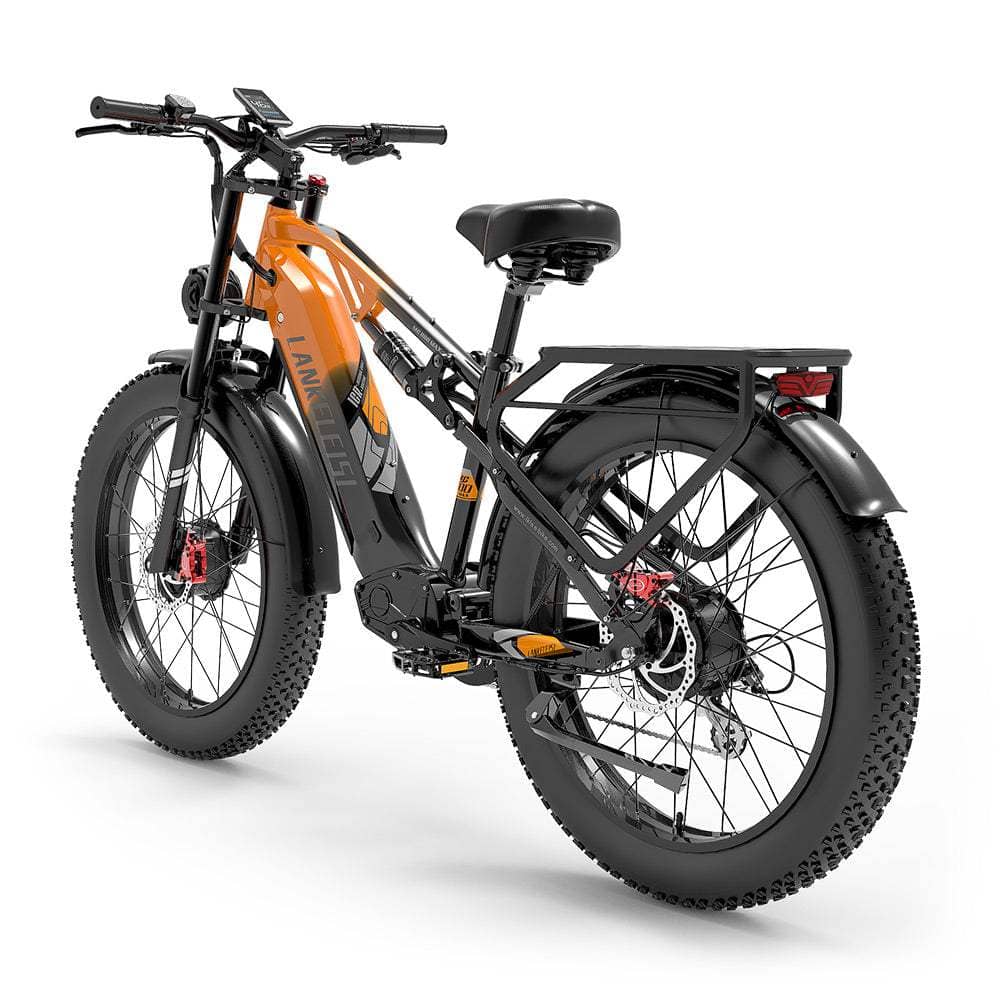
The Lankeleisi MG800 Max arrives as one of the most specification-dense dual-motor fat bikes available through BuyBestGear — a 43 kg full-suspension machine with two 1000W brushless hub motors, a 960Wh Samsung battery, and four-link rear linkage that puts it in a different mechanical category from the hardtail dual-motor bikes it frequently gets compared against. The question this review answers is not whether the spec sheet looks impressive. It does. The question is whether those numbers translate into a bike that earns its €2,599 price tag for the actual rider who has to lift it, charge it, and ride it through the terrain Lankeleisi’s marketing department imagines. This review covers everything: confirmed specifications, real-world range arithmetic, suspension reality, drivetrain tier, and two head-to-head comparisons with confirmed competitor data.
- Genuine full suspension: 120mm oil spring fork + four-link pneumatic rear — rare at this price tier
- 960Wh Samsung 21700 battery with BMS protection and IP54 sealing
- Dyisland hydraulic disc brakes with 180mm rotors and brake-activated rear light system
- 180 kg total load capacity — among the highest in the dual-motor fat bike category
- Independent front/rear motor switching: use one motor for range or both for maximum traction
- 43 kg kerb weight: without motor assist, French tester meilleur-velo-electrique.com found it tiring to ride unaided — stairs and car-rack loading require planning
- Shimano M315-7 is entry-level Altus/Acera groupset — criticized for drivetrain inefficiency in real-world testing relative to the bike’s motor output
- Manufacturer’s 130 km range claim requires best-case conditions: real-world estimate on mixed terrain is 48–64 km — a 103% gap from the headline figure
- No dedicated EU/UK service network: warranty and repair logistics rely on Lankeleisi’s mail-in process
Affiliate link · Price and availability subject to change — verify at checkout
The Lankeleisi MG800 Max is a full-suspension dual-motor fat e-bike running twin 48V 1000W brushless hub motors, a 960Wh Samsung 21700 battery, and four-link rear pneumatic suspension. Aimed at off-road riders who want AWD traction and genuine trail capability, it carries a 43 kg kerb weight and a €2,599 BuyBestGear price — making it one of the most mechanically complex bikes at this price point, but also one with specific physical demands that will disqualify it for a meaningful share of buyers. Verify current price and availability at checkout.
Contents
Lankeleisi MG800 Max Review: Design and Build Quality
Frame and Construction
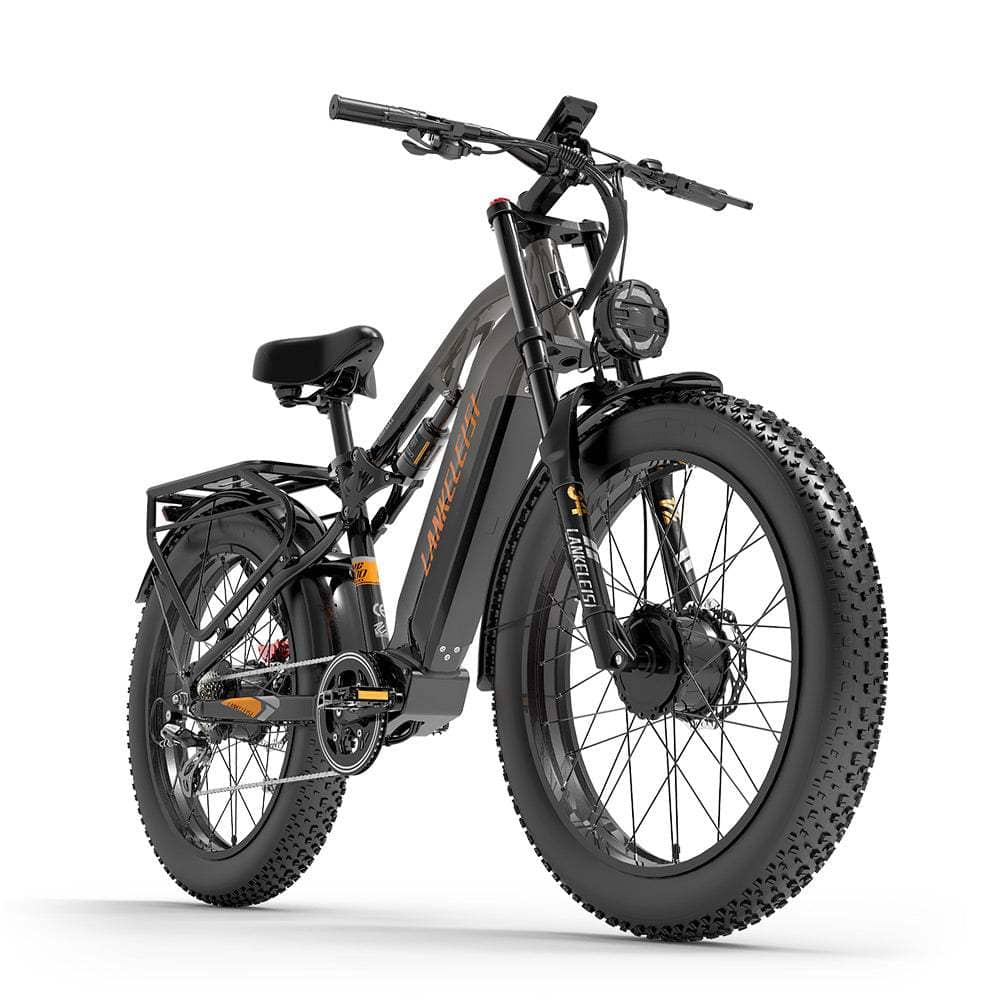
Before you ride it, you lift it — or try to. The aluminum alloy frame encloses the 48V 20Ah Samsung battery completely within the downtube, creating a clean external silhouette at the cost of removability. The welds are visible and deliberately industrial-looking; meilleur-velo-electrique.com’s October 2024 test noted they confirm structural intent rather than aesthetic finish. Cables route internally, eliminating snag points — a practical detail on a bike designed for brushing through vegetation and taking on rough gradients. Both orange and grey colorways are available, though neither conceals what this bike is: a large, purposeful machine built to take significant loading and sustained off-road use.
The aluminum frame geometry produces a 200 × 105 cm footprint with a saddle height adjustable between 88 and 105 cm. That last figure matters: the MG800 Max is explicitly designed for riders between 170 and 190 cm. Under 170 cm and you will struggle to mount it cleanly; over 190 cm and you may want to assess reach geometry carefully before committing.
Battery Integration
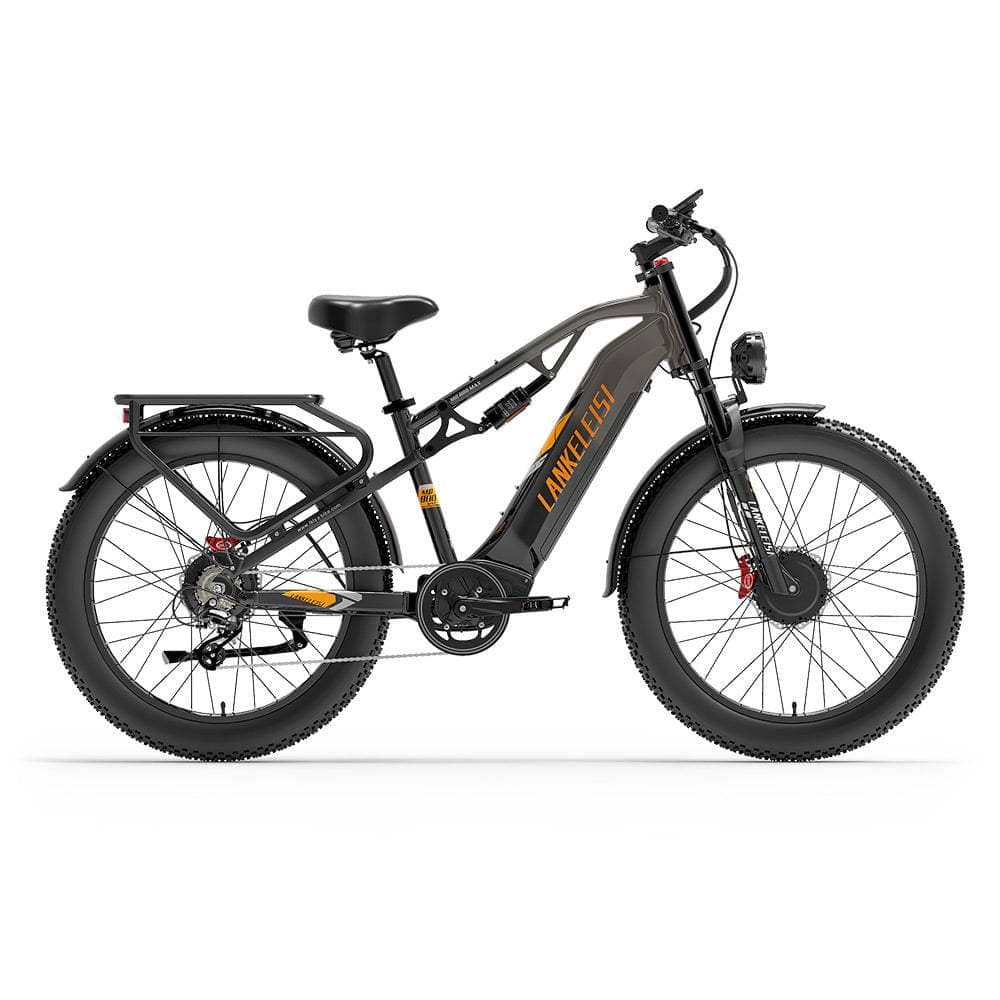
The battery is sealed inside the frame. This is worth stating plainly because it creates a trade-off that affects daily use: the 960Wh pack delivers excellent capacity, but you cannot remove it for charging at your desk or swap it for a charged spare before a second ride. You bring the whole bike to a power socket, or you run a cable to it. For owners with secure outdoor storage or garage access, the arrangement works well. For riders who park in public spaces and rely on indoor charging, it is a genuine inconvenience — and one that the direct competitor, the Lankeleisi MG740 Plus, avoids with its removable battery design.
Suspension System
The four-link rear suspension is the feature that separates the MG800 Max from the MG740 Plus and most of its dual-motor fat bike peers. Front travel is 120mm via a double-shoulder oil spring fork — confirmed by marktplatz.bike’s 2025 technical data. Rear travel is pneumatic, adjustable via air pressure to suit rider weight. The linkage geometry positions the rear axle path to track terrain without transmitting sharp impact directly to the seat. For trail use on broken hardpack, gravel, and rooted paths, this is a material improvement over hardtail dual-motor fat bikes at similar prices. It does not, however, transform the MG800 Max into a legitimate enduro machine — both suspension units are entry-level in specification, and the 43 kg mass means any rebound characteristic that is even slightly underdamped becomes amplified at speed.
Safety Features
IP54 waterproofing covers the frame and electronics — adequate for rain riding, though Lankeleisi explicitly cautions against sustained rain exposure or immersion. The Dyisland hydraulic brake system integrates an ABS function through the fork that prevents front-wheel lock on loose or slippery surfaces. The rear light activates automatically when either brake lever is depressed — a functional detail that riders doing any mixed-light trail riding will appreciate. The 95 dB electronic horn is mounted on the handlebar cluster and addresses the visibility gap that comes with how silently hub-motor bikes operate at 25 km/h.
Lankeleisi MG800 Max Review: Technical Specifications
The specifications below are drawn from the official Lankeleisi product listing, the confirmed spec sheet at lankeleisiuk.com, and the marktplatz.bike 2025 technical record. BuyBestGear is the sole authorised European retailer stocking this model through newfortech.com’s affiliate programme. All prices and availability are subject to change — verify at checkout before purchasing.
| Specification | Lankeleisi MG800 Max |
|---|---|
| Motor | 48V 1000W × 2 brushless hub (front + rear) |
| Torque | 92 Nm × 2 (spec sheet) |
| Controller | 48V 36A dual drive vector |
| Battery | 48V 20Ah Samsung 21700 — 960Wh, integrated |
| Charge time | 6–7 h (48V 3A charger) |
| Range — electric | 55–70 km (manufacturer); realistic: 48–64 km |
| Range — assist | 100–130 km (manufacturer best-case) |
| Max speed | 25 km/h (EU legal); unlocked: 48 km/h (road-illegal) |
| Front suspension | Oil spring, aluminum double-shoulder — 120mm travel |
| Rear suspension | Pneumatic shock, four-link linkage |
| Brakes | Dyisland hydraulic disc, 180mm rotors, ABS fork |
| Tires | 26 × 4.0 in fat rubber |
| Drivetrain | Shimano M315-7 (7-speed, Altus/Acera tier) |
| Sensor | Cadence (5 PAS levels) |
| Display | Color LCD, 11.5 × 6.5 cm |
| Headlight | 4.5” LED, 780 lumens |
| Horn | 95 dB electronic |
| Throttle | Half-twist (included) |
| Max load | 180 kg total; rear rack 30 kg |
| Weight | 43 kg |
| Rider height | 170–190 cm |
| Waterproofing | IP54 |
| Colors | Orange, Grey |
| Price | €2,599 (verify at checkout) |
Lankeleisi MG800 Max Review: Performance
Motor and Power Delivery
Two 1000W nominal brushless hub motors — one in the front wheel, one in the rear — give the MG800 Max a combined peak output of 2000W and total rated torque of 92 Nm per motor from Lankeleisi’s spec sheet. The French test site meilleur-velo-electrique.com put that figure at 70 Nm per motor under actual riding conditions in October 2024, which is still a significant figure: the combined pulling force accelerates the bike to 25 km/h in under 5 seconds by the manufacturer’s own measurement. The more useful number for most riders is what the bike does at low speed on a gradient. The star-gear internal amplification design within each hub concentrates torque output at low RPM — the configuration that matters when pulling 43 kg of bike plus rider weight up loose-surface climbs.
A word on legal context that most listings gloss over. Each motor is rated at 1000W nominal — four times the 250W ceiling that defines a legal e-bike under EU Regulation 168/2013. Operating the MG800 Max on public roads in the EU — even at 25 km/h — places it in the moped/speed pedelec category requiring registration, insurance, a helmet meeting motorcycle standards, and a driving licence in most member states. This is not a secondary concern. It is the primary legal reality of owning this bike in Europe. The hardware is sold and positioned as an adventure/off-road machine, and that framing has a specific legal meaning.
Battery Life and Range
Lankeleisi rates the MG800 Max at up to 130 km in pedal-assist mode. The arithmetic beneath that figure is worth working through directly. The battery holds 960Wh — a figure confirmed across the official spec sheet and multiple retailer listings. At 15 Wh/km, which represents optimistic conditions (flat terrain, low assist, sub-70 kg rider), the pack delivers 64 km. At 20 Wh/km, reflecting mixed terrain at moderate assist with a typical rider, you get 48 km. The manufacturer’s 130 km headline requires conditions that virtually no rider will encounter in normal use — it represents the absolute best-case ceiling, not a typical outcome. The gap between 130 km and the 48–64 km realistic band exceeds 100%, which is material and should be named: at low to moderate assist on actual terrain, plan for under 65 km per charge.
No independent range test specific to the MG800 Max had been published at the time of writing. The closest benchmark comes from a confirmed real-world test of the Lankeleisi MG740 Plus — a mechanically similar 960Wh dual-motor bike — where a 69 kg rider recorded 48 km at PAS 3 in cold conditions (6°C) using only the rear motor. Running dual motors at higher assist on the MG800 Max, with its heavier full-suspension frame, would produce a lower figure. That 48–64 km band is the right framework. A lankeleisi.fr owner also noted that the speed display reads meaningfully higher than GPS-confirmed speed — a detail worth knowing before calibrating range estimates to the onboard readout.
Climbing and Terrain Handling
Lankeleisi rates maximum gradeability at 40° — some variant listings cite 45°. The 40° figure is consistent with what the combined 2000W peak and torque figures would produce on paper. In practice, the variables are rider weight, surface traction, and which motor mode you select. Dual-motor AWD mode maximises traction on loose surfaces like gravel, sand, and wet roots — this is the configuration’s genuine strength over single-motor bikes in the same Wh bracket. Single rear-motor mode conserves battery while still providing adequate power for moderate gradients. The meilleur-velo-electrique.com tester noted the AWD pull on steep terrain as the standout performance characteristic, while flagging that navigating slow technical sections with 43 kg under you demands a different riding style than lighter trail machines require.
Lankeleisi MG800 Max Review: Comfort and Handling
Ride Quality
Fourteen centimetres of combined wheel diameter relative to a 43 kg machine changes what “rough” means. The 26×4.0 inch fat tires at trail pressures (typically 0.8–1.2 bar) absorb significant high-frequency vibration before it reaches the fork. The 120mm oil spring front suspension handles medium-amplitude impacts — rooted singletracks, broken hardpack, compressed gravel — with reasonable composure. The four-link rear pneumatic system does its best work at low to medium speed on irregular surfaces; the meilleur-velo-electrique.com tester described the suspension as absorbing shocks well on the kind of terrain the bike is designed for. Where the ride quality picture changes is on fast, rough descents: the suspension spec is trail-beginner rather than trail-aggressive, and the mass inertia at higher speeds amplifies rather than cancels any rebound overshoot.
Ergonomics
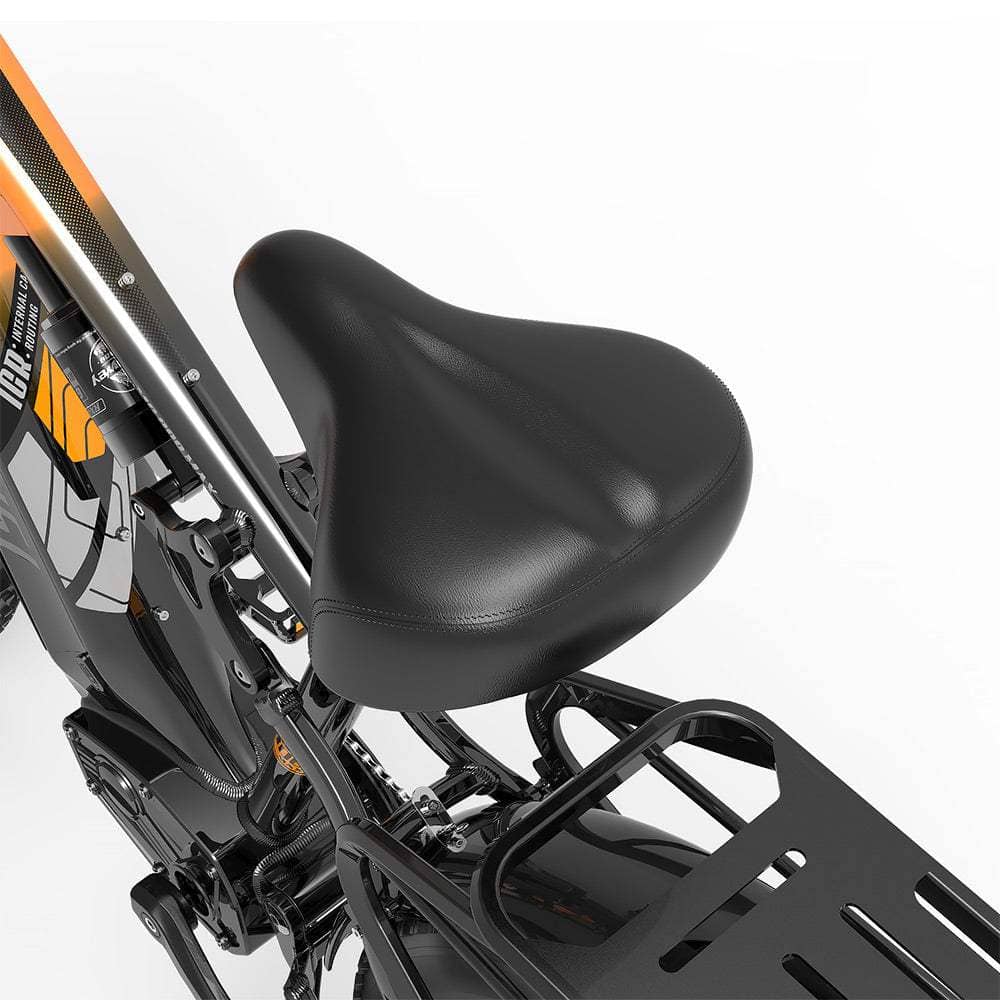
The saddle is wider than standard trail saddles — Lankeleisi describes it as an ergonomic sports seat — and the handlebar geometry positions riders in an upright MTB stance consistent with moderate trail use rather than aggressive cross-country posture. The half-twist throttle sits on the right grip. On extended flat sections, this is a welcome relief; you can stop pedaling and cruise. The left controller cluster manages motor mode and PAS level. The walk-assist function (activated by holding the minus button) moves the bike at 6 km/h without the rider pedaling — genuinely useful when navigating through narrow spaces or walking the bike up stairs, though 43 kg of dead weight resists any assisted mode when the climb requires directional steering.
Weight and Maneuverability
43 kg. This number appears elsewhere in this review and it will appear again, because it shapes every interaction with the MG800 Max that does not involve the motor running. Loading this bike into a standard car boot is a two-person operation for most riders. Carrying it up a flight of stairs is physically demanding. A standard car roof rack is borderline inaccessible without a ramp or a second person. The meilleur-velo-electrique.com October 2024 test stated plainly that the weight becomes immediately demanding without motor assistance. This is not a criticism of the engineering — full suspension, dual motors, 960Wh Samsung cells, and a load-bearing rear rack all weigh something. It is a fact about ownership that BuyBestGear’s listing does not foreground, and it should be.
If your living situation requires carrying an e-bike up stairs regularly, or if you frequently load it into a vehicle alone, the MG800 Max is the wrong bike. The Lankeleisi MG600 Lite at 30 kg and single-motor configuration handles that use case at substantially lower weight and price.
Lankeleisi MG800 Max Review: Braking and Safety Systems
Hydraulic Braking
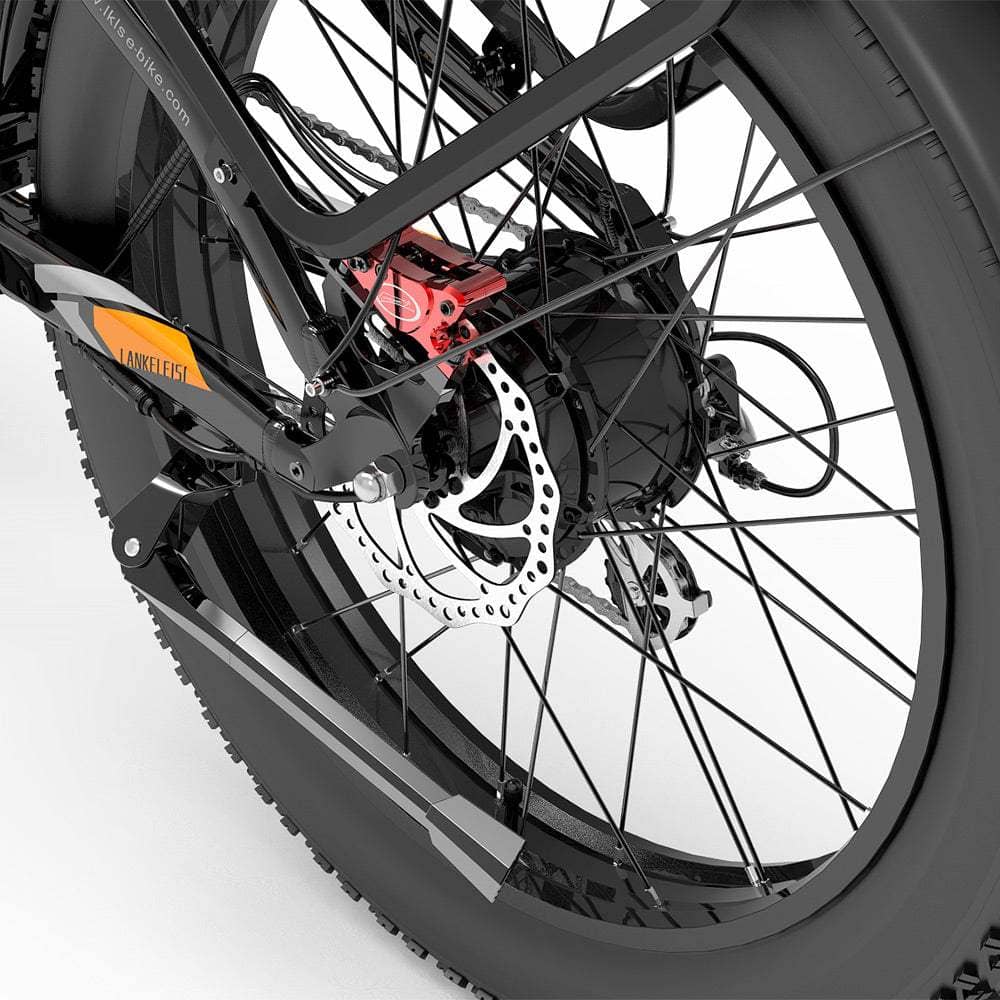
The braking hardware is one of the clearer wins on this bike. Dyisland hydraulic disc brakes with 180mm rotors front and rear deliver what the meilleur-velo-electrique.com tester described as “instant response at each press” with precision across full-speed descents and emergency stops. Each lever is user-adjustable via thumb screw — the reach can be shortened for smaller hands or lengthened for more progressive travel. An ABS function integrated into the fork prevents front-wheel lock on loose or slippery terrain. The motor cut-off activates when either brake lever is pulled, disengaging motor torque immediately. On a 2000W-capable machine, that cutoff is not optional equipment — it is a safety requirement, and Lankeleisi has implemented it correctly.
Integrated Lighting
The 4.5-inch LED headlight outputs 780 lumens with a wide-angle beam — adequate for trail riding at moderate speed in full darkness, not optimised for high-speed road illumination. The rear light activates automatically when a brake lever is depressed, providing visibility to vehicles approaching from behind during braking events. The 95 dB electronic horn is functional, if not subtle. Together these components provide a lighting package appropriate for mixed-light trail use; riders who want to commute regularly after dark may want to supplement with a dedicated trail light.
Lankeleisi MG800 Max Review: User Interface and Controls
Display and Controls
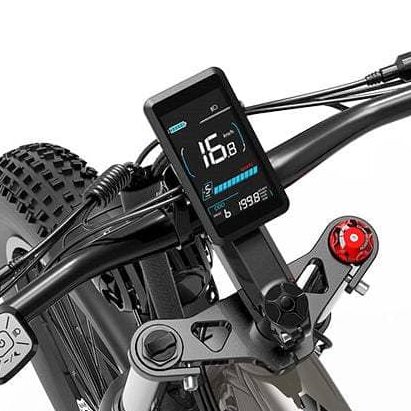
The color LCD measures 11.5 × 6.5 cm and sits at the center of the handlebar. It shows current speed, assist level, battery state, odometer, and trip distance as standard fields. An Info button cycles through secondary statistics — average speed, maximum speed, and trip duration. The meilleur-velo-electrique.com tester found the interface intuitive, with the plus and minus buttons managing assist level from the left grip cluster. One buried function: walk-assist activates via a long-press of the minus button rather than a dedicated control. It is three seconds away from normal use, not immediately accessible in an emergency. The display carries an IP64 waterproof rating — one grade above the IP54 frame rating — meaning it can handle direct water jets without damage.
Sensor Modes
The MG800 Max uses a cadence sensor as its standard assist input. A cadence sensor detects whether the cranks are turning; when they are, the motor engages at the selected PAS level. It does not measure how hard you push. This means the power delivery is consistent but unsophisticated — the motor gives you the same output whether you are sprinting or barely turning the pedals. For a 2000W dual-motor fat bike where the primary use case is trail riding and gradient climbing, this is an acceptable trade-off: the system is reliable, responsive in terms of motor engagement, and imposes zero additional complexity. It is, however, worth understanding — particularly in comparison to the Vakole CO20 MAX’s torque sensor, which provides proportional assist that feels more natural for technical terrain navigation. The differences between torque and cadence sensors for e-MTB riding are covered in detail if you want to understand the practical implications before deciding.
Lankeleisi MG800 Max Review: Accessories and Compatibility
Included Equipment
The box ships with the bike approximately 95% assembled. You install the front wheel (quick-release system included), pedals, and handlebar. Tools are in the box: a multi-function hex key tool, a wrench, a pump, a lock, and a user manual in English. Lankeleisi includes a 48V 3A charger. At 3A output into a 20Ah battery, expect 6–7 hours for a full charge from flat — overnight charging is the practical routine. The rear rack is fitted and rated to 30 kg, which opens the bike to cargo use alongside trail riding.
Compatible Upgrades
Lankeleisi sells replacement and upgrade components through their official store including batteries, controllers, display units, saddles, and suspension components. The 48V 36A dual drive vector controller is a proprietary unit; third-party controller swaps require electrical competency and careful matching. The Shimano M315-7 rear derailleur and TZ20-7 cassette can be upgraded within the Shimano 7-speed ecosystem without frame modification — a Shimano Acera or Deore-equivalent upgrade would address the drivetrain efficiency criticism that real-world testers have raised, though it adds cost to an already premium-priced bike.
Lankeleisi MG800 Max Review: Model Comparisons
Lankeleisi MG800 Max vs Lankeleisi MG740 Plus
| Specification | MG800 Max | MG740 Plus |
|---|---|---|
| Motor | 1000W × 2 hub | 1000W × 2 hub |
| Battery | 48V 20Ah Samsung 21700 (960Wh) — integrated | 48V 20Ah Samsung 18650 (960Wh) — removable |
| Suspension | Full: 120mm fork + pneumatic rear (4-link) | Hardtail: 100mm fork only |
| Wheel size | 26 × 4.0 | 26 × 4.0 |
| Sensor | Cadence | Cadence |
| Max load | 180 kg | 180 kg |
| Weight | 43 kg | Not published |
| Rider height | 170–190 cm | 170–195 cm |
| Price range | €2,599 | ~€1,699 |
Key Differences: The MG800 Max’s four-link full suspension is a genuine technical upgrade over the MG740 Plus’s hardtail — it absorbs rear-wheel impacts rather than transmitting them directly to the frame and rider. The MG740 Plus counters with a removable battery (charge it anywhere, swap for a second on long rides) and a roughly €900 lower price. Riders who prioritise trail comfort and sustained rough-terrain riding will find the MG800 Max’s suspension worth the premium. Riders who commute, store the bike in shared spaces, or charge away from a fixed socket will find the MG740 Plus’s removable battery more useful day to day. If your primary use is urban mixed-surface riding rather than dedicated off-road trail work, the MG740 Plus is the more practical choice and the MG800 Max’s suspension advantage goes largely unused.
Lankeleisi MG800 Max vs Vakole CO20 MAX
| Specification | MG800 Max | Vakole CO20 MAX |
|---|---|---|
| Motor | 1000W × 2 hub (2000W peak) | 750W × 2 hub (1500W peak) |
| Battery | 960Wh Samsung 21700 — integrated | 960Wh Samsung 21700 — removable |
| Suspension | Full: 120mm fork + pneumatic rear | Full: 50mm fork + 50mm rear |
| Wheel size | 26 × 4.0 | 20 × 4.0 |
| Sensor | Cadence | Torque sensor |
| Max load | 180 kg | 150 kg |
| Weight | 43 kg | Not published |
| Foldable | No | Yes |
| Rider height | 170–190 cm | 160–195 cm |
| Price range | €2,599 | €1,599 |
Key Differences: These two bikes share the same battery capacity but serve different buyers. The MG800 Max has more motor power, larger wheels, higher load rating, and genuine 120mm trail suspension. The Vakole CO20 MAX is foldable, €1,000 cheaper, equipped with a torque sensor for more natural assist feel, accepts a wider height range (minimum 160 cm vs 170 cm), and has a removable battery. For riders under 170 cm, the MG800 Max is not a viable option — the CO20 MAX is the only dual-motor choice of the two. For riders who want the bike stored in a car boot, a flat, or a shared lock-up, the CO20 MAX’s folding frame and removable battery matter more than the MG800 Max’s suspension quality. The MG800 Max outperforms on pure trail capability; the Vakole CO20 MAX outperforms on urban practicality and total value.
Final Verdict
The Lankeleisi MG800 Max delivers what its spec sheet promises in the areas that count for its intended purpose: AWD traction on gradients and loose surfaces, genuine full-suspension trail comfort from the four-link rear linkage, Dyisland hydraulic braking with ABS, and 960Wh of Samsung cell capacity that gives the bike a realistic 48–64 km range on mixed terrain. The build quality sits above what the price would suggest in the context of European-branded trail bikes — aluminum frame construction, internal cable routing, and the hydraulic brake package are all competitive. Independent testing by meilleur-velo-electrique.com confirmed the dual-motor traction as the standout performance characteristic on steep and broken terrain, where AWD mode’s grip advantage over single-motor alternatives is immediately tangible.
The honest limitations are just as specific. 43 kg is not a number to evaluate abstractly — it is heavier than a full-size motorcycle and physically demanding to move without the motor engaged, as meilleur-velo-electrique.com confirmed in real conditions. The Shimano M315-7 drivetrain is entry-level Altus/Acera tier, and the French tester noted its inefficiency relative to the bike’s available motor output. The 130 km range headline is best-case arithmetic that no rider on typical terrain will approach; plan for 50–60 km on a moderate ride. The non-removable battery constrains charging flexibility, and Lankeleisi does not operate a dedicated EU service network — warranty work routes through mail-in logistics, not high street workshops. For the off-road trail rider between 170 and 190 cm who has secure storage and access to a fixed charging point, the Lankeleisi MG800 Max is available through BuyBestGear at €2,599 (verify at checkout) — a price that reflects its full-suspension dual-motor specification accurately within this product category.