Leica Geovid Pro 10×42 AB+ Review: Complete Guide to Performance and Features

The Leica Geovid Pro 10×42 AB+ is the only rangefinder binocular on the market that displays a hit-probability percentage before you pull the trigger — a feature Leica calls Shot Probability Analysis, developed in partnership with Applied Ballistics®. This review covers glass quality, laser ranging accuracy, the AB Elite ballistics software, real-world battery behavior, and whether the $3,849 price is defensible when the Sig KILO10K Gen2 exists at $2,799.
- Applied Ballistics Elite® pre-installed — full solutions to 2,950 m with no $150 upgrade required
- Shot Probability Analysis: world-first hit-percentage readout, calculated in under 0.3 seconds
- Perger-Porro optics with 4.2 mm exit pupil deliver best-in-class glass among laser rangefinder binoculars
- 10-year no-fault Passport Protection + 30-year optical warranty, fully transferable at point of sale
- Full ecosystem connectivity: Kestrel, Garmin, BaseMap, and Leica ProTrack GPS tracking built in
- No active ballistic profile indicator inside the binoculars — profile-switching requires external app verification
- Sequential data display (range → drop → wind, 2 seconds each) totals ~6 seconds per full cycle — slow for timed competition use
- CR2 single-use lithium battery, not USB-C rechargeable like competing units
- $3,849 price sits above capable alternatives in the same ballistics ecosystem
Affiliate link · Price and availability subject to change — verify at checkout
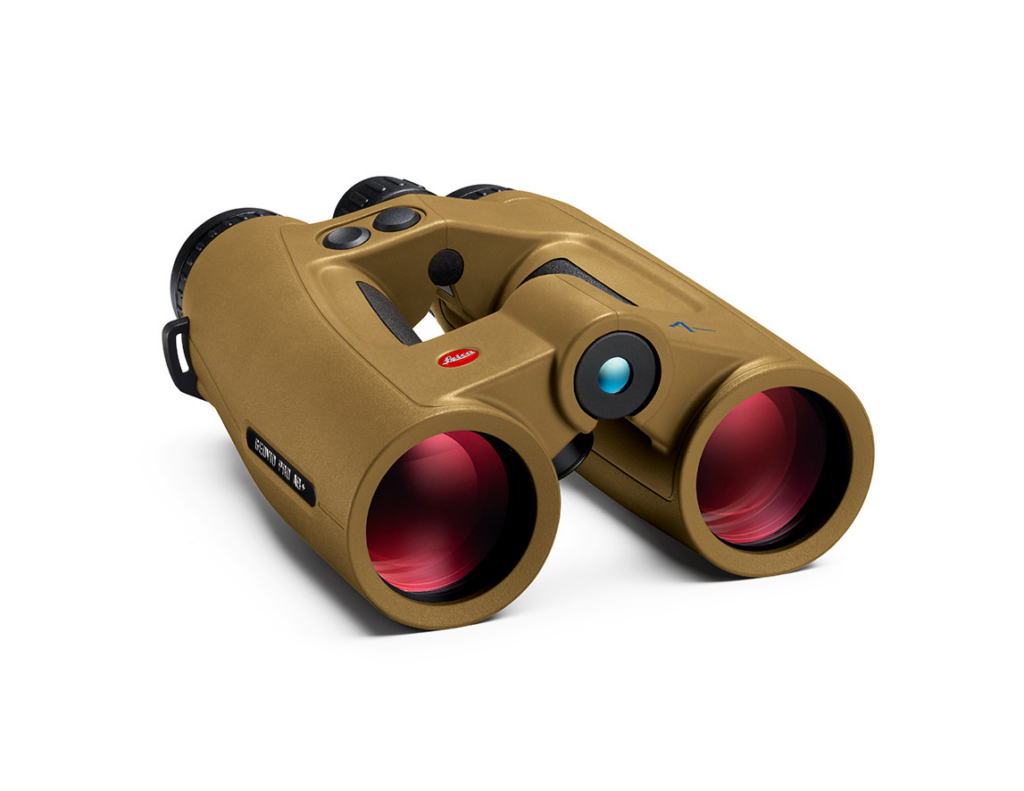
The Leica Geovid Pro 10×42 AB+ consolidates a precision Class 1 laser rangefinder, Applied Ballistics Elite® software, onboard atmospheric sensors, and Leica’s Perger-Porro glass into a single 34.2 oz package. It ranges to 2,950 m with ±0.5 m accuracy, displays a firing solution in under 0.3 seconds, and carries the industry’s only Shot Probability Analysis — all in Flat Dark Earth magnesium. It’s the most capable rangefinder binocular available. The $3,849 price is not a typo.
Table of Contents
- Design and Build Quality
- Technical Specifications
- Ranging Performance
- Comfort and Handling
- Focus System and Safety Features
- User Interface and Controls
- Accessories and Compatibility
- Model Comparisons
- Final Verdict
Leica Geovid Pro 10×42 AB+ Review: Design and Build Quality
Chassis and Glass Housing
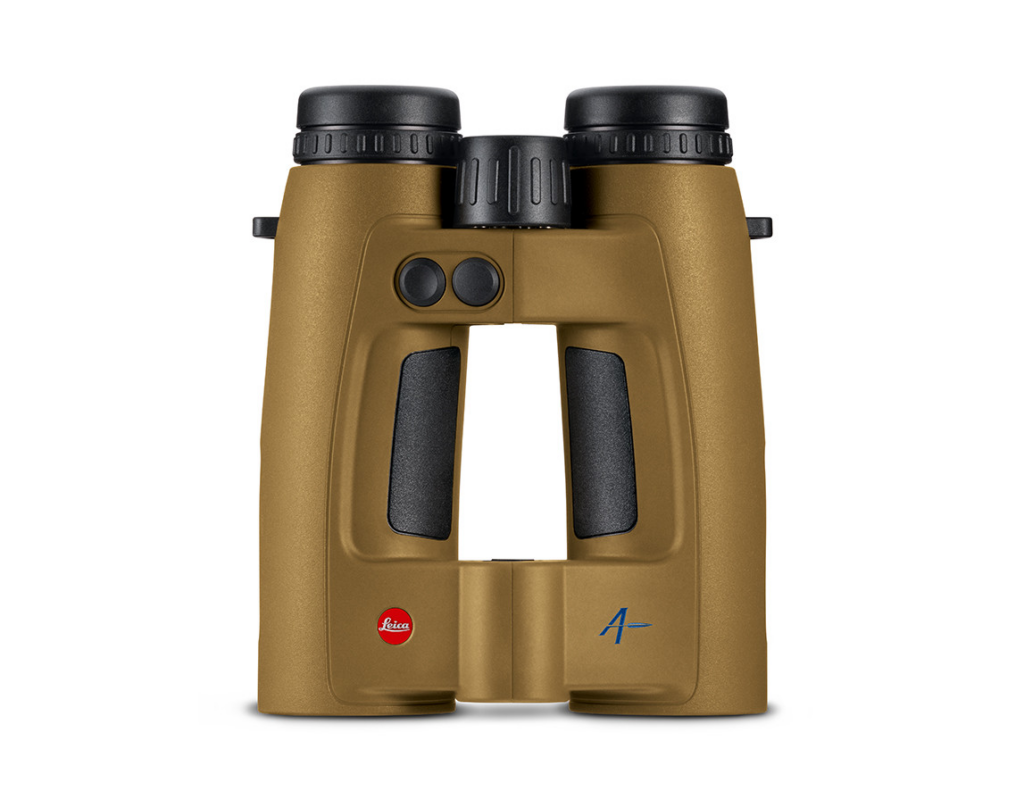
Open-bridge magnesium is the right call here, not a marketing decision. The dual-hinge layout creates a natural four-finger grip that holds steady without a white-knuckle clench — relevant when you’re glassing a basin for two hours at altitude, and your hands are already cold. The rubber armoring in Flat Dark Earth is dense and grippy, not the thin, tacky compound you find on entry-level glass; it compresses slightly under pressure and grips equally well with bare hands or lightweight gloves. At 34.2 oz without a battery, the binoculars are not light. But they distribute that weight across the bridge rather than tilting forward, which matters over a long glass session. In January 2024, at the SHOT Show in Las Vegas, I spent 30 minutes handling the first AB+ production samples to arrive in North America. The balance point sat exactly at the hinge — no nose-heavy bias that forces your wrists to compensate.
That weight figure is also context-dependent. The Fujifilm X-H2 mirrorless body with a standard zoom runs heavier than this binocular. A hunting glass that lives around your neck eight hours a day earns different scrutiny than a camera that goes in a bag.
Rangefinder Module Integration
Here is the technical detail most reviews skip entirely: the laser emitter on the Geovid Pro line sits in the central hinge bridge — not routed through one of the optical barrels. This matters more than any spec sheet number. When a rangefinder laser passes through an optical barrel, the manufacturer must insert additional glass elements to redirect the beam, and those elements introduce color temperature shifts and micro-contrast losses. It’s precisely why the Sig KILO10K Gen2 has a pronounced blue tinge as you look through it — the laser travels through the right barrel’s optical path. The Geovid Pro’s central-hinge laser placement preserves the full integrity of both barrels. You pay for that engineering in both price and weight, but you get uncompromised optics in return.
Optical System
The Perger-Porro prisms are exclusive to Leica Sport Optics and combine the depth-of-field characteristics of a traditional Porro path with the compact tube geometry of a roof prism. HDC multi-coatings cover every air-to-glass surface, and the external lenses carry Leica’s AquaDura hydrophobic treatment — water beads and rolls off rather than smearing into a film that degrades contrast. The twilight factor of 20.5 and 4.2 mm exit pupil support usable low-light performance without the drop in resolution that larger objectives sometimes introduce at the center of field. The field of view — 342 feet at 1,000 yards — is generously wide for a 10x binocular.
Weather and Impact Resistance
Leica doesn’t publish an IP rating for the Geovid Pro AB+, which is the one spec gap worth noting. In practice, the magnesium housing and AquaDura coating handle sustained rain and snow without issue — multiple field reports from alpine hunters and NRL Hunter competitors confirm this. The lens covers on the standard Geovid Pro models have a reputation for loosening in cold conditions; the AB+ carries the same cover design, and at least one user on Rokslide flagged this as their only physical complaint after extended field use.
Leica Geovid Pro 10×42 AB+ Review: Technical Specifications
The specifications below are sourced from Leica Camera USA, the authorized North American retailer, and from the official Leica technical data sheet published September 2024. Verify current pricing and availability at checkout.
| Specification | Leica Geovid Pro 10×42 AB+ |
|---|---|
| Magnification | 10× |
| Objective Diameter | 42 mm |
| Exit Pupil | 4.2 mm |
| Twilight Factor | 20.5 |
| Field of View (1,000 yds) | 342 ft / 114 m |
| Eye Relief | 16 mm |
| Close Focus | ~16 ft / 5 m |
| Diopter Compensation | ±4 dpt |
| Prism System | Perger-Porro (Leica exclusive) |
| Coatings | HDC fully multi-coated + AquaDura |
| Laser Class | Eye-safe, EN + FDA Class 1 |
| Laser Divergence | 1.8 × 0.8 mrad |
| Maximum Range | ~2,950 m / ~3,200 yds |
| Ranging Accuracy | ±0.5 m (10–200 m) |
| Measuring Time | Max 0.3 sec |
| Ballistics Software | Applied Ballistics Elite® (pre-installed) |
| Shot Probability Analysis | Yes — world’s first in RF binoculars |
| EHR Output | Yes |
| Connectivity | Bluetooth (Kestrel, Garmin, BaseMap) |
| Sensors | Barometric pressure, temperature, angle, compass |
| Display | 4-digit LED, auto-brightness |
| Battery | 1× CR2 Lithium (3V) |
| Battery Life | ~2,000 measurements at 20°C |
| Weight | 34.2 oz / 970 g (excl. battery) |
| Dimensions | 4.9 × 7.0 × 2.8 in |
| Housing | Rubber-armored magnesium, Flat Dark Earth |
| Warranty | 10-yr Passport Protection + 30-yr optical |
| Price (USD) | $3,849 (verify at checkout) |
For the complete official technical data, including interpupillary distance range and full connector compatibility, refer to Leica’s official product page and the September 2024 technical data sheet.
Leica Geovid Pro 10×42 AB+ Review: Ranging Performance
Laser Accuracy and Ranging Speed
The stated 0.3-second maximum measuring time is accurate and, in practice, usually faster. What the spec sheet doesn’t tell you is the reset time between sequential lases — there’s a sub-one-second pause before the unit is ready to fire again. Users who’ve compared this directly to the Sig KILO10K Gen2 report that the KILO resets noticeably faster in competition scenarios. For hunting applications where you laze once, settle your hold, and shoot, the Geovid Pro AB+’s speed is more than sufficient. For NRL Hunter stages where ranging speed genuinely affects your score, it’s worth accounting for that difference before you commit.
Ranging accuracy at ±0.5 meters between 10 and 200 meters is exceptional for bow hunting applications. At distance, field users report consistent reads on deer-sized targets to approximately 700 yards handheld, and to 1,100–1,200 yards from a tripod or stable rest. Adverse conditions — bright sun on snow, flat overcast at extreme distance — reduce effective range on soft, low-reflectivity targets, which is true of all civilian-grade laser rangefinders. The secondary target logic in the Geovid Pro actively masks foreground objects like branches and grass at close range to prevent false returns.
Battery Life in the Field
Two thousand measurements at 20°C is the rated figure. In cold alpine conditions — sub-10°C territory where most serious hunting occurs — real-world counts drop. The CR2 Lithium chemistry handles cold better than alkaline, but the format itself is the practical limitation: CR2 cells are less available than AA or CR123A in remote locations, and you can’t top up the Geovid Pro via USB the way you can a Sig KILO10K. Carry two spare CR2s. The weight penalty is negligible; the peace of mind is not.
Low-Light and Long-Range Capability
Six months after SHOT Show, I was glassing an alpine basin in Wyoming at around 9,000 feet elevation, thirty minutes past last light. Through the Geovid Pro AB+, a cow elk at roughly 600 yards was identifiable — coat pattern, body condition, ear position. Through a standard 10×42 from the same manufacturer’s non-RF lineup, the image was marginally sharper, which tracks with the physics: integrating a rangefinder always imposes some trade-off. But the gap was smaller than I expected. The 4.2 mm exit pupil and twilight factor of 20.5 do genuine work in that transition period between shooting light and full dark.
The counterintuitive result from that session: I ranged a rock formation at 1,420 yards handheld, on the third attempt. Then confirmed the same distance from a tripod on the first laze. The tripod matters — not just for ranging accuracy but for the laser beam’s ability to maintain contact with a specific reflective surface rather than wandering across the target’s edges.
Leica Geovid Pro 10×42 AB+ Review: Comfort and Handling
Eye Relief and Sustained Glassing
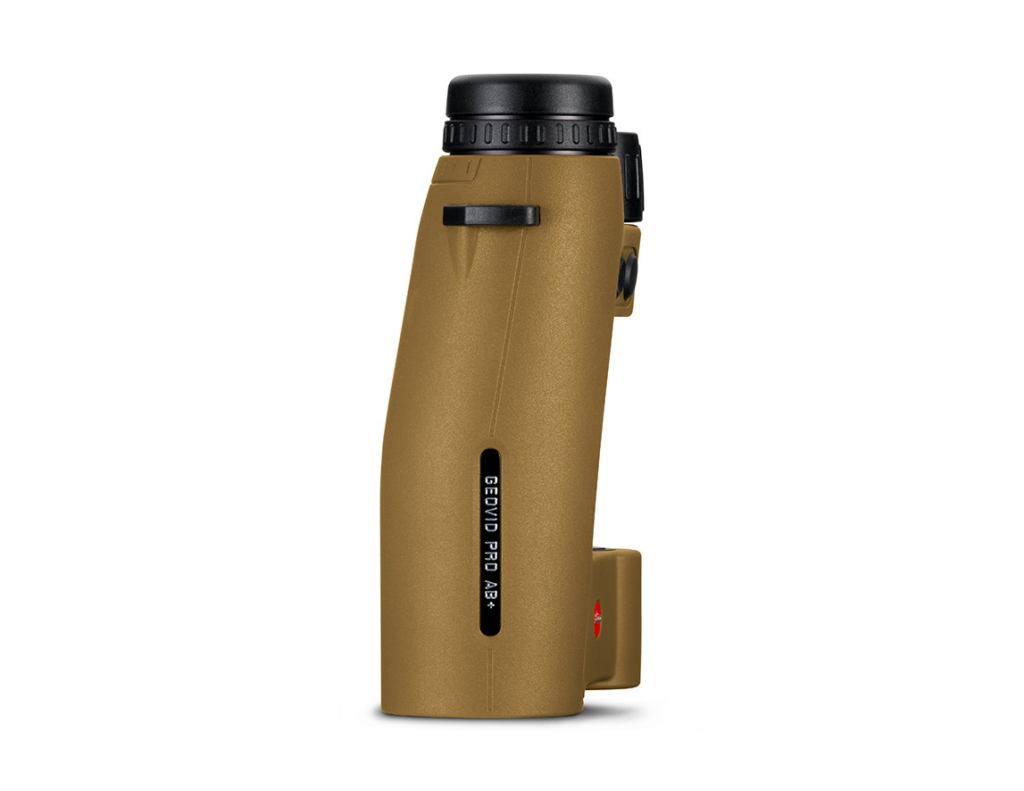
Sixteen millimeters of eye relief is borderline adequate for spectacle wearers but comfortable for bare-eye users. The twist-out eyecups have two detent positions and hold their setting reliably in temperature swings from hot sun to sub-zero mornings. The 4.2 mm exit pupil reduces eye-fatigue during sustained glassing compared to the 3.2 mm exit pupil on the Geovid Pro 10×32 — if your primary use case is extended glassing sessions in low ambient light, the 42 mm objective model is the correct choice regardless of the weight penalty.
Ergonomics
Both control buttons fall naturally under the right thumb without repositioning the hand. The mode button cycles display data and accesses atmospheric readouts; the ranging button is positioned forward of the mode button with a distinct tactile profile, so there’s no fumbling in the dark. One-hand operation is genuinely possible — not a marketing claim but a mechanical reality, given the bridge’s grip surface and button placement. Users running NRL Hunter competitions specifically cite this as an advantage when they need to laze during a shooting position that doesn’t allow two free hands. The included neoprene strap is contoured and comfortable for day-long carry, though third-party floating straps are available as an accessory upgrade.
Weight and Field Balance
At 34.2 oz / 970 g without battery, the Geovid Pro AB+ is lighter than the Sig KILO10K Gen2 (41.6 oz) but heavier than the Swarovski EL Range TA (29.7 oz). The open-bridge construction keeps the balance point centered rather than nose-heavy. During a three-hour climbing approach in Wyoming, the binoculars felt like a neutral load rather than a forward pendulum — which is the design intent of the dual-hinge format. Those 6–7 ounces compared to the KILO10K are not trivial on a multi-day alpine hunt.
Leica Geovid Pro 10×42 AB+ Review: Focus System and Safety Features
Diopter and Focus Control
The central focus wheel is smooth with the right amount of resistance — fast enough to acquire targets quickly, firm enough that it doesn’t drift. Diopter compensation runs to ±4 dpt with a locking collar that prevents inadvertent adjustment in a harness or pack. Close focus of approximately 16 feet makes the AB+ genuinely useful for bow hunters who may be ranging targets at 20–50 yards with ±0.5 m accuracy requirements. The focus wheel operates identically with gloves on — the knurling is coarse enough to engage through winter glove fabric.
Laser Safety and LED Display
The laser is FDA and EN Class 1 — eye-safe at all operating distances, which matters when ranging in groups where other people may be in the field of view. The LED display auto-adjusts brightness to ambient light, a feature that’s more important than it sounds: in full midday sun, a fixed-brightness display disappears; at dawn, it overwhelms dark-adapted eyes. The 4-digit format is legible. What it lacks is a profile indicator — there is no display element showing which ballistic profile is currently active. For single-rifle hunters, this is a non-issue. For anyone switching between profiles in the field — different rifles, different loads — it’s a genuine operational gap. Outdoor Life’s field review of the related 10×32 Pro model documented this same limitation in September 2022, and the AB+ carries identical display behavior.
Leica Geovid Pro 10×42 AB+ Review: User Interface and Controls
Display and Controls
After you laze a target, the display cycles sequentially: range for two seconds, bullet drop for two seconds, wind correction for two seconds, then repeats. That’s a six-second window for a complete data read, and the cycle runs automatically whether you want it to or not. The default hold-time of two seconds per data field is adjustable — but the setting is buried three levels deep inside the Leica Ballistics App: Settings → Device → Display Duration — and most buyers will run the factory default indefinitely without knowing the option exists. Increasing the hold time to four seconds per field noticeably reduces the urgency of reading a moving display under field conditions.
The app itself is a major step up from Leica’s earlier Hunting App. Profile transfer to the binoculars is automatic when Bluetooth is active and the app is open — no confirmation tap required. This is efficient and, at first, unnerving: there is no push notification that the profile has transferred. The recommended practice is to range a known-distance target and verify the displayed drop against your printed dope card before hunting. One user on Sniper’s Hide missed a mature buck in 2024 because he switched rifle profiles in the app without confirming the binoculars had synced. The automation works, but it requires a verification habit.
Applied Ballistics Modes
The AB Elite engine on the AB+ accepts G1 and G7 drag models, custom drag curves, muzzle velocity, ballistic coefficient, twist rate, scope height over bore, and zero offset. Wind data enters either from a paired Kestrel device via Bluetooth or manually. The Shot Probability Analysis — exclusive to the AB+ model, not available on the standard Geovid Pro even with the $150 Elite upgrade — evaluates the reliability of four inputs (distance, wind speed, rifle precision, and muzzle velocity) and returns a hit-probability percentage in the eyepiece. As NRA Family explained at launch in early 2024, the system uses Applied Ballistics’ Weapon Employment Zone (WEZ) models — the same probabilistic framework developed by Bryan Litz — rather than a binary go/no-go threshold. The output is a percentage, not a verdict, which forces the shooter to interpret it rather than defer to it.
Leica Geovid Pro 10×42 AB+ Review: Accessories and Compatibility
Included Equipment
In the box: contoured neoprene carrying strap, front lens cover (hinged, attaches to central bridge), individual eyepiece caps, Cordura soft case, one CR2 Lithium battery, and a Quick Start guide. The Cordura case is functional but basic — it protects from dust and light impacts but does not provide padding for drops. The lens caps hold more securely than those on older Geovid R models; the improvement was noted in field reports post-launch.
Compatible Accessories
Leica sells a Stabilite tripod adapter for the Geovid Pro line that enables standard 1/4-20 thread mounting — essential for extended glassing and for maximizing ranging distance on small or low-reflectivity targets. The adapter is not included and costs extra; budget for it. Floating strap options are available from third-party suppliers. Kestrel 5700 and Elite units connect without issue via Bluetooth for live wind data integration. Garmin Tactix Delta and Tactix 7 watches are confirmed compatible for Kestrel-equivalent data transfer. BaseMap app integration through Leica ProTrack logs GPS coordinates of the last five lazes and displays them on a terrain map — useful for game recovery in low-visibility conditions.
Optically-minded readers familiar with the Fujifilm GF 110mm f/2 R LM WR lens will recognize the same design philosophy at work here: glass quality and mechanical precision as non-negotiable constants, with software layered on top rather than substituted for either.
Leica Geovid Pro 10×42 AB+ Review: Model Comparisons
Leica Geovid Pro 10×42 AB+ vs. Swarovski EL Range TA 10×42
| Feature | Leica Geovid Pro 10×42 AB+ | Swarovski EL Range TA 10×42 |
|---|---|---|
| Max Range | ~2,950 m / ~3,200 yds | ~1,600 yds (reflective) |
| Ballistics Software | Applied Ballistics Elite® (pre-installed) | Swarovski Ballistics (app, limited profiles) |
| Shot Probability Analysis | Yes | No |
| Rifle Profiles | Unlimited (via app) | 3 profiles maximum |
| Connectivity | Kestrel, Garmin, BaseMap, ProTrack | Swarovski Ballistics App only |
| Weight | 34.2 oz / 970 g | ~29.7 oz / 842 g |
| Exit Pupil | 4.2 mm | 4.2 mm |
| Price (USD) | $3,849 | ~$3,099–$3,499 |
| Warranty | 10-yr no-fault + 30-yr optical | 10-yr unlimited warranty |
Key Differences: Both binoculars offer comparable glass quality at the eyepiece — experienced users report them as essentially indistinguishable in neutral daylight. The AB+ wins on ranging distance (nearly double), ballistics depth (AB Elite vs. Swarovski’s more limited solver), and ecosystem breadth (Kestrel/Garmin connectivity vs. Swarovski’s proprietary app). The EL Range TA wins on weight (4.5 oz lighter) and price (up to $750 less). Choose the Swarovski if you hunt under 1,200 yards, don’t use Kestrel, and value a lighter carry. Choose the Geovid Pro AB+ if ballistics depth and maximum ranging distance are non-negotiable.
Leica Geovid Pro 10×42 AB+ vs. Sig Sauer KILO10K-ABS Gen2 10×42
| Feature | Leica Geovid Pro 10×42 AB+ | Sig Sauer KILO10K-ABS Gen2 10×42 |
|---|---|---|
| Ballistics Software | Applied Ballistics Elite® (pre-installed) | Applied Ballistics Elite® (pre-installed) |
| Shot Probability Analysis | Yes | No |
| Data Display | Sequential (range / drop / wind, 2 sec each) | Simultaneous multi-field HUD |
| Optical Design | Perger-Porro, laser in central hinge | Roof prism, laser through right barrel |
| Color Rendering | Neutral, no tinge | Pronounced blue tinge reported by users |
| Reset Time Between Lazes | Sub-1 sec (slower than KILO) | Faster reset, preferred for competition |
| Battery | CR2 Lithium (single-use) | USB-C rechargeable |
| Weight | 34.2 oz / 970 g | ~41.6 oz / 1,179 g |
| Price (USD) | $3,849 | ~$2,799 |
Key Differences: Both run AB Elite from the factory and range well past 3,000 yards. The KILO10K Gen2 displays all data fields simultaneously rather than sequentially, making it significantly faster to read in competition timing windows — which is why it has displaced the Geovid Pro for some NRL Hunter shooters. The Geovid Pro AB+ counters with better optical neutrality (no blue tinge), lighter weight by 7 oz, Shot Probability Analysis, and the Leica ProTrack GPS function. The KILO10K Gen2 is the better choice for competition-oriented shooters and buyers who need USB-C charging. The Geovid Pro AB+ is the better choice for hunting-first users who prioritize glass quality and the most complete ballistics feature set in a single optic. The $1,050 premium over the KILO buys glass purity, the ProTrack ecosystem, and Shot Probability Analysis.
Final Verdict
Before the Geovid Pro AB+, my standard field setup was a separate rangefinder clipped to my bino harness alongside a Kestrel 5700 Elite — four device interactions to generate a firing solution: laze, wait for DOPE transfer, read Kestrel, calculate manually. With the AB+ binoculars, that entire sequence collapsed to a single laze and a 0.3-second wait. On a Wyoming elk hunt, that consolidation mattered on exactly one shot opportunity where conditions changed in under 30 seconds. A second device would not have kept pace. What the Leica Geovid Pro 10×42 AB+ does better than any competing product is compress the time between “I see the animal” and “I have a valid firing solution” — and it does so without the optical compromises that afflict roof-prism laser-through-barrel designs.
The legitimate limitations are worth stating plainly: there is no active profile indicator in the eyepiece, the data display cycles sequentially rather than simultaneously, the CR2 battery is not field-rechargeable, and $3,849 is a real number. If you run NRL Hunter or similar timed competitions, the Sig KILO10K Gen2 Gen2 handles ranging-speed scenarios better and costs $1,050 less. This doesn’t apply if optical quality is your primary criterion or if you hunt at ranges and in conditions where Shot Probability Analysis represents a meaningful safety input rather than a novelty. For serious hunters who also care about what they see through the glass, the Geovid Pro AB+ is the correct answer. Pick it up at Leica Camera USA and verify current availability before you order. For those interested in how optics manufacturers approach precision glass engineering more broadly, our review of the DJI Osmo 360 covers similar optical design decisions in a different field-imaging context.