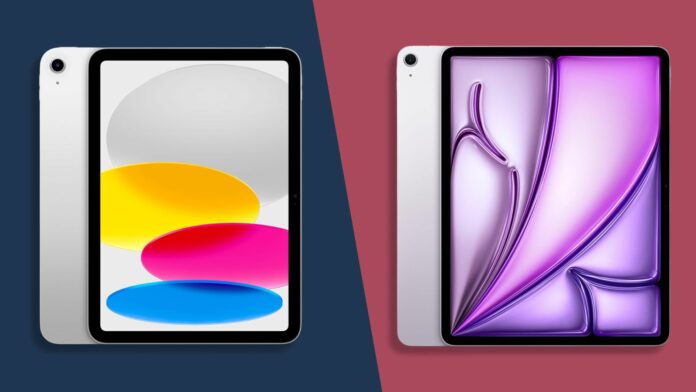
When shopping for a new iPad, the choice can be difficult. Apple’s tablet line has grown in recent years and now includes six models under four different names (some models have different screen size options).
Of course, many iPad buyers will choose the cheaper models in the range to avoid spending more. The high-end iPad Pro’s hardware is great, but its high price and powerful hardware might be a bit too much for some users.
Once one of the most high-end devices in Apple’s lineup, the standard iPad has taken on the role of Apple’s more affordable tablet, with a chipset borrowed from the iPhone 15, an 11-inch display, and a variety of cool colors to choose from.
The next step up is the iPad Air, which is a hybrid of the iPad and iPad Pro. It uses the Apple Silicon M3 chipset, supports Apple Intelligence, and is available in 11-inch and 13-inch sizes.
For many buyers, choosing between the iPad and iPad Air will be a difficult decision. Read on to get detailed first-hand information that will help you make the right decision when buying a tablet.
Comment. Some of the iPad Air images in this comparison are taken from the previous generation M2 model. The design is similar to the current-generation M3.
iPad vs. iPad Air: Specs Comparison
This guide covers the iPad and iPad Air in detail, but if you just want an overview of the basic features, check out this handy data sheet.
We’ll go over the key features and capabilities of the iPad and iPad Air later in this guide, but if you want a quick spec comparison, check out the table below.
iPad and iPad Air: pricing and availability
Since we’re talking about Apple here, availability of iPad and iPad Air models isn’t an issue. All types of Apple products are widely sold in Western and global markets.
In terms of price, the base price of the 128GB model of iPad is US$349/£329/AU$599. With starting prices so low, you can find great deals during seasonal sales at third-party retailers, which is why we often offer sales on base model iPads.
The 11-inch iPad Air is quite expensive, starting at $599 / £599 / AU$999 for 128GB of storage. That rises to $799 / £799 / AU$1,349 for the 13-inch model with the same 128GB of internal storage.
The base iPad is cheap and by far the best tablet you can buy in your price range. Since the price of the 11-inch iPad Air is quite high, it’s a good idea to know where you can take advantage of its unique features, including Apple Pencil Pro compatibility and Apple Intelligence support. However, the 13-inch iPad Air is very affordable for such a large tablet, and much cheaper than the 13-inch iPad Pro, which starts at $1,299 / £1,299 / AU$2,199.
iPad and iPad Air: Design and Presentation
Both the base iPad and the 13-inch iPad Air follow Apple’s latest all-screen iPad design language: a unibody aluminum body, flat edges, no home button, and black borders around the 10:7 aspect ratio screen. The 13-inch iPad Air has a similar design, but is slightly larger and has a more square aspect ratio of 4:3.
As you can see in the image below, all three tablets have the same 12MP rear camera, with the smaller camera located in the upper left corner of the back panel. Aside from the color, the two 11-inch models look almost identical. Base iPad models come in bright colors like silver, pink, blue, and yellow, while the iPad Air comes in more subdued colors like space gray, blue, starlight, and purple.
All three models can attach the Apple Pencil to the right side of the tablet, but supported Apple Pencil models vary by model (see the Performance section for more information).
In terms of display, the base iPad and 11-inch iPad Air have the same display. Both feature 11-inch panels with a resolution of 1640 x 2360 pixels and a maximum brightness of 500 nits.
However, the iPad Air has a laminated display, with no noticeable gap between the glass and the LCD panel underneath. This makes drawing and scrolling feel more visually relevant to the screen.
The 13-inch iPad Air has a display resolution of 2048 x 2732 pixels and a brightness of 500 nits. All three monitors have the same 60Hz refresh rate and the same 264ppi pixel density. Requires iPad Pro with Apple ProMotion 120Hz display.
The iPad Air leads the display by a wide margin with its laminated screen, but there’s not much difference between the two. Considering the Air is a 13-inch model, it’s no surprise that it also has a size advantage.
iPad and iPad Air: Camera
The camera systems on the iPad and iPad Air models are nearly identical. As far as I can tell, all three cameras have identical rear cameras, with 12MP sensors, f/1.8 lenses, and video recording capabilities up to 4K at 60fps.
All three devices feature 12-megapixel selfie cameras, but the base iPad has a slightly different aperture. The iPad Air has an f/2.0 selfie lens, while the base iPad has an f/2.4 lens.
This means that selfies on the iPad Air should be slightly brighter than those on the base iPad. They both support 1080p recording at 60 frames per second and Apple’s Center Stage feature, which keeps video calls within the frame.
This means that the photo and video features on the iPad and iPad Air are very similar, and you don’t have to think too much when deciding which one to choose.
iPad and iPad Air: Performance
The iPad and iPad Air clearly stand out in terms of performance. This category covers key considerations for whether you should upgrade to the larger 13-inch iPad Air display.
First is the software. Both the iPad and iPad Air run iPadOS 26 and thus receive the same updates to Windows, file management, and background tasks. A more powerful iPad Air will be able to open more windows simultaneously.
The base iPad model is powered by the A16 chipset, which is the mobile system-on-chip also found in the iPhone 15. It comes with 6GB RAM and 128GB, 256GB or 512GB storage, depending on the configuration.
The iPad Air comes in two sizes, but has the same internal specs except for battery capacity. It’s powered by the M3 chipset, the desktop-class chipset also found in the previous-generation MacBook and the current-generation iMac. This is probably the biggest upgrade over the standard iPad, allowing the iPad Air to handle serious multitasking, multimedia workloads, and intensive gaming.
iPad Air also comes with 8GB of RAM, which helps with multitasking and allows the tablet to run Apple Intelligence tools and processes. Depending on configuration, it comes with 128GB, 256GB, 512GB or 1TB storage capacity. The 1TB capacity option does increase the price, but that may be a deciding factor for those with a lot of photos, videos, or apps for local storage.
iPad and iPad Air also vary in compatibility with third-party accessories, which offer similar but different experiences.
Standard iPad compatible with Apple Magic Keyboard Folio. The Magic Keyboard Folio is a two-piece accessory: a stand case and a detachable keyboard.
iPad Air is compatible with the creatively named iPad Air Magic Keyboard. It’s a single device that folds into a paper box and has an adjustable viewing angle.
As far as the Apple Pencil is concerned, the iPad is compatible with the Apple Pencil, which has a USB-C port and charges via a wired connection. iPad Air is compatible with Apple Pencil or Apple Pencil Pro with USB-C, charges by plugging into the side of iPad, and supports a variety of gestures and functions.
There is no doubt that the iPad Air is a tablet with better performance and better accessories than the base model. However, keep in mind that both the iPad Air’s Magic Keyboard and Apple Pencil Pro are more expensive than their base models, and considering the iPad Air’s higher starting price, upgrading can be a pretty pricey proposition.
iPad and iPad Air: Battery
iPads are known for their long battery life, and there’s no significant difference in battery capacity or measured battery life between the base iPad model and the 11-inch iPad Air. The 13-inch iPad Air is better than both devices in some ways, but that’s to be expected from a larger device.
Apple doesn’t reveal the exact battery capacity of its products, so you’ll have to rely on third-party sources. according to phone squareThe standard iPad battery capacity is 7698mAh.
according to GSM areaThe 11-inch iPad Air comes with a 7606 mAh battery. The 13-inch model has a capacity of up to 9705mAh.,
In Future Labs’ own testing, the base model iPad lasted 11 hours and 25 minutes, while the 11-inch iPad Air lasted just over 9 hours. This may be because the iPad Air’s more powerful M3 chipset requires more power. Both devices have almost identical displays.
As for the 13-inch iPad Air, we haven’t tested the battery life of the next-generation model, but according to our review of the 13-inch iPad Air (2024), the 2024 version with the M2 chipset lasted about 11 hours and 30 minutes.
All of these tablets have long battery life, but the base iPad model was the winner in our tests. This may be due to the lower power consumption of the A16 chipset or other hardware requirements.
Of course, battery life will vary based on your activity and settings like screen brightness, so these test numbers may not tell you the whole story. It’s worth noting that the M3 iPad Air chip tends to sweat less during intensive tasks like video editing, which may impact overall battery life.
iPad vs. iPad Air: Verdict
Apple has announced higher prices for the iPad and iPad Air. With its low price, fairly powerful chipset, and great display, the iPad is a great choice for everyday users, families, and even students and professionals.
Thanks to the M3 chipset, the performance of the 11-inch iPad Air has been significantly improved. It’s also an obvious choice for AI fans thanks to its Apple Intelligence compatibility and ample RAM.
It also supports better (but more expensive) third-party accessories. Otherwise, the two tablets are very similar, with almost identical designs and displays.
Of course, the 13-inch iPad Air is Apple’s cheapest big tablet, making it the obvious choice for those who want a truly big screen. Aside from a larger screen and battery, it’s essentially the same tablet as the 11-inch model.
Overall, you can’t beat the base model iPad in terms of value for money, and the 13-inch iPad is indeed very competitively priced. The 11-inch iPad is stylish and powerful, which is probably why Apple sells it so expensively. However, the faster M3 chipset helps mitigate this issue to an extent.
If you need to save money, choose the basic model. If you need performance, choose the 11-inch Air. If you want performance and a larger screen, choose the 13-inch Air.
Which iPad will you choose? Let us know in the comments below.
You may also like
- Tablet deals for October 2025
- Is the rumored iPad Pro M5 worth buying? A new report adds confusion to an important update.
- If the Honor MagicPad 3 didn’t have a fatal flaw, it would be an iPad Air killer
