CMACEWHEEL V20 Review: Complete Guide to Performance and Features

The CMACEWHEEL V20 arrives with a specification sheet that demands scrutiny before you hand over €1,399. A 960Wh Samsung cell battery, full suspension, a genuine torque sensor, and hydraulic disc brakes on a 20″ fat platform — at that price, something has to give. This review works through every claim methodically: what the specs actually mean, where the manufacturer’s figures diverge from realistic expectations, and whether the V20’s package makes sense against the alternatives currently on the market.
Please note that shipping to Canada or the United States is not available at this time on BuyBestGear.
- 960Wh Samsung 21700 battery — among the largest integrated packs available at this price in the 20″ fat bike segment
- Torque sensor (not cadence) delivers proportional assist from the first pedal stroke, not after a quarter-revolution delay
- Full suspension — front fork and central rear shock — absorbs trail impact that hardtail competitors transmit directly to the rider
- Hydraulic disc brakes provide consistent stopping force in wet conditions without the cable-stretch degradation of mechanical systems
- €300 pre-order discount (€1,399 vs €1,699 RRP) for buyers willing to commit before shipping begins
- Approximately 38.5 kg — one of the heaviest bikes in the 20″ class; loading onto a car rack or carrying upstairs requires a second person
- 20″ wheels are substantially less efficient than 26″ or 29″ on paved or compacted-gravel roads at sustained speed — this is an off-road platform, not a commuter
- No dedicated EU or UK service network — warranty claims route through BuyBestGear as primary contact, not a local authorised dealer
- Pre-order status at time of publication — no confirmed dispatch date; price and availability subject to change before shipping begins
Affiliate link · Price and availability subject to change — verify at checkout
The CMACEWHEEL V20 is a full-suspension 20″ fat e-bike built around a 960Wh Samsung cell battery, a genuine torque sensor, and hydraulic disc brakes — available exclusively through BuyBestGear at €1,399 on pre-order. Its hardware looks strong on paper, though the manufacturer’s 100 km range claim and a kerb weight pushing 38.5 kg need unpacking before any serious buying decision.
Contents
CMACEWHEEL V20 Review: Design and Build Quality
Frame and Construction
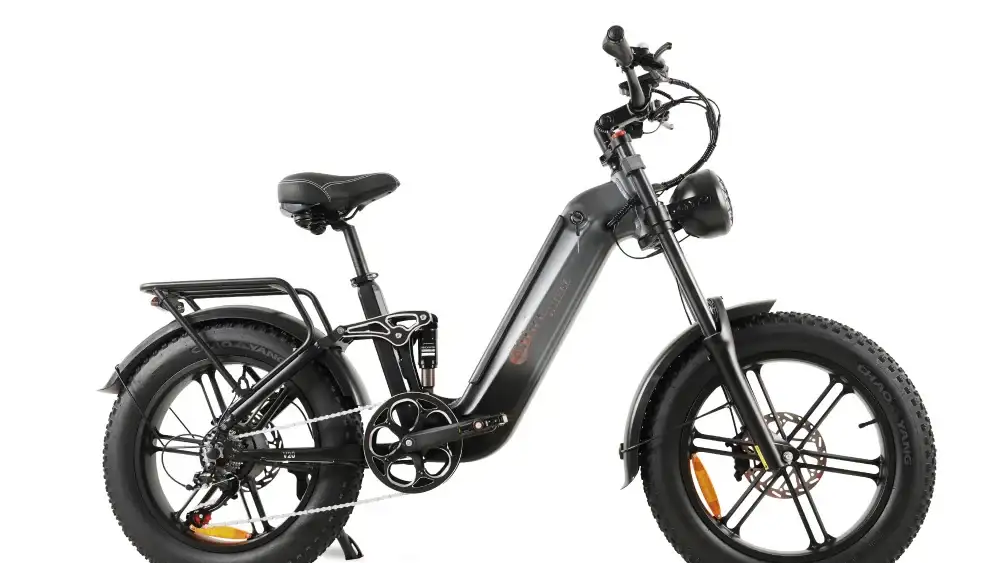
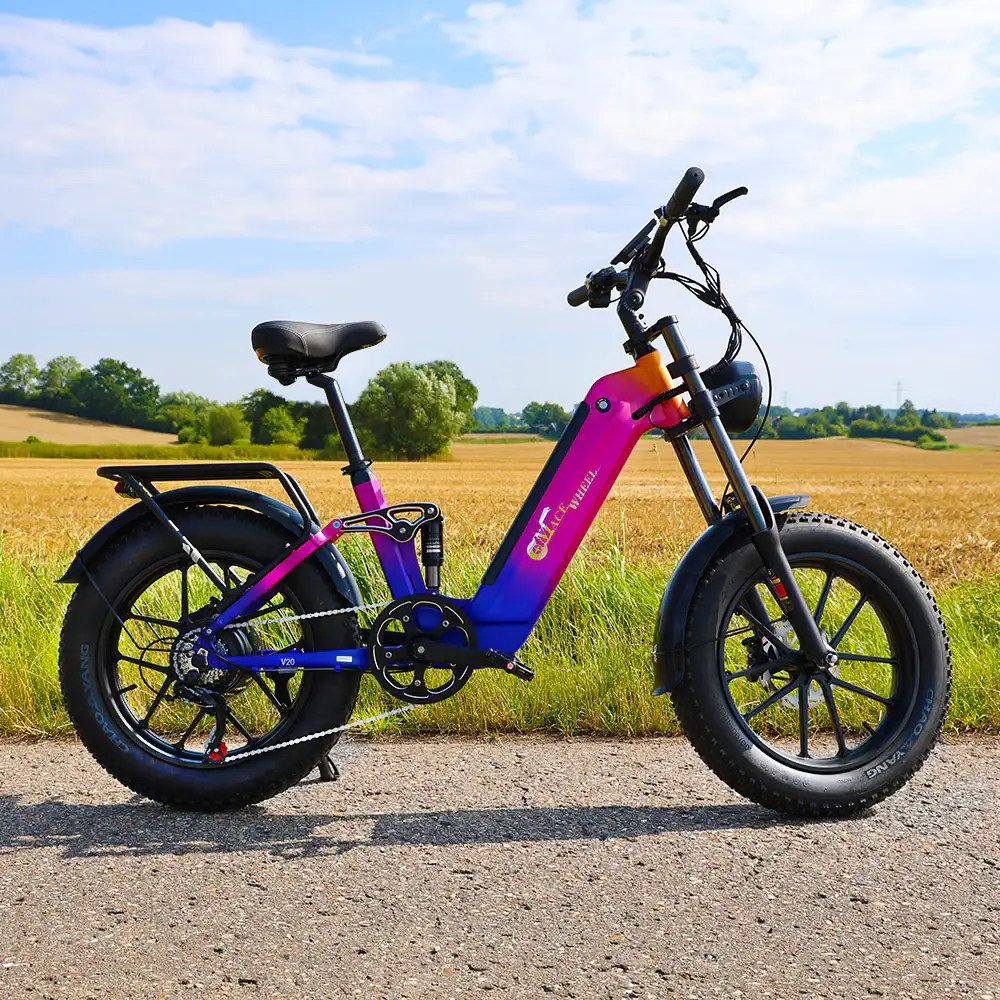
The V20 frame is aluminum alloy — the right material call for a full-suspension build at this weight class. What distinguishes the design is how CMACEWHEEL has routed the 960Wh battery: it sits fully integrated within the downtube rather than clamped externally, which lowers the centre of gravity and keeps the silhouette clean. That matters on a bike this size. A 20″ full-suspension fat platform already carries a compact, aggressive stance; an externally bolted battery slab would undermine it visually and dynamically.
The geometry is designed for riders who want a short, manoeuvrable wheelbase rather than the long, stable platform of a 26″ or 29″ build. Whether that suits you depends entirely on where you ride. On a trail full of switchbacks and technical sections, the short wheelbase is an asset. On an open gravel path at sustained speed, it is a compromise.
Battery Integration
Fully integrated batteries on e-bikes this heavy raise a question that product listings never address: what happens when the cells degrade after 500–800 charge cycles and need replacing? CMACEWHEEL does not publish a battery replacement programme for the V20. After-sales support routes through BuyBestGear, not a manufacturer service centre. That is a realistic planning consideration for a bike at this price — not a dealbreaker, but factor the retailer into your ownership timeline before committing.
Suspension System
Full suspension on a 20″ fat bike is the V20’s most distinctive structural decision. The front fork and central rear shock work together to isolate the rider from trail chatter that a hardtail transmits entirely to the handlebars and saddle. The presence of a rear linkage at all separates the V20 from the majority of 20″ fat bikes at comparable or higher prices. The Lankeleisi MG600 Plus, for instance, runs a front-only suspension setup despite a higher base price — which tells you something about where CMACEWHEEL has chosen to spend its engineering budget on this model.
Safety Features
The hydraulic brakes carry motor cutoff switches on the levers — standard on torque-sensor bikes of this class and directly relevant to EU pedelec compliance, which mandates motor deactivation within 2 m of stopping pedal input. Integrated front and rear lighting is included in the build and draws from the main 960Wh battery rather than a separate cell, eliminating the need for USB recharging at the cost of a marginal range reduction on night rides.
CMACEWHEEL V20 Review: Technical Specifications
The V20 is available exclusively through BuyBestGear, the sole authorised retailer for this model in the European market. The specifications below are drawn from the BuyBestGear product listing and cross-referenced against available technical documentation.
| Specification | CMACEWHEEL V20 |
|---|---|
| Motor | Rear hub brushless, 750W peak, 60 N·m torque |
| Battery | 48V 20Ah, 960Wh, Samsung 21700 cells, fully integrated |
| Charge time | Approximately 5 hours |
| Sensor | Torque sensor; PAS levels 1–5 |
| Range (manufacturer-claimed) | 100 km (PAS) / 80 km (pure electric) |
| Max speed | 25 km/h (EU version) |
| Tires | Chaoyang 20 × 4.0 inch fat |
| Suspension | Full — front fork + central rear shock |
| Drivetrain | Shimano 7-speed |
| Brakes | Hydraulic disc with motor cutoff |
| Display | Color LCD |
| Frame | Aluminum alloy |
| Weight | Approximately 38.5 kg |
| Price | €1,399 Pre-Order (was €1,699 — verify at checkout) |
All specifications are manufacturer-claimed. Real-world performance — particularly range — will vary with rider weight, terrain, temperature, and assist level.
For the regulatory framework governing e-bikes sold in the EU — including the 250W nominal power ceiling and 25 km/h assist cut-off that apply to road-legal pedelecs — the EU e-bike rules overview published by Sensitivus covers EN 15194 and Regulation 168/2013 in useful detail.
CMACEWHEEL V20 Review: Performance
Motor and Power Delivery
CMACEWHEEL markets the V20 with a “750W” motor figure, and that number needs context before it means anything useful. Under the EU pedelec standard EN 15194 — which governs road-legal bikes sold without type approval — continuous nominal output is capped at 250W with speed assist cutting off at 25 km/h. The 750W figure refers to peak output, available for short-burst climbing assist. It is not available under sustained, street-legal operation. A 250W nominal motor is the EU ceiling, not a performance advantage — every road-legal pedelec in this class shares the same cap.
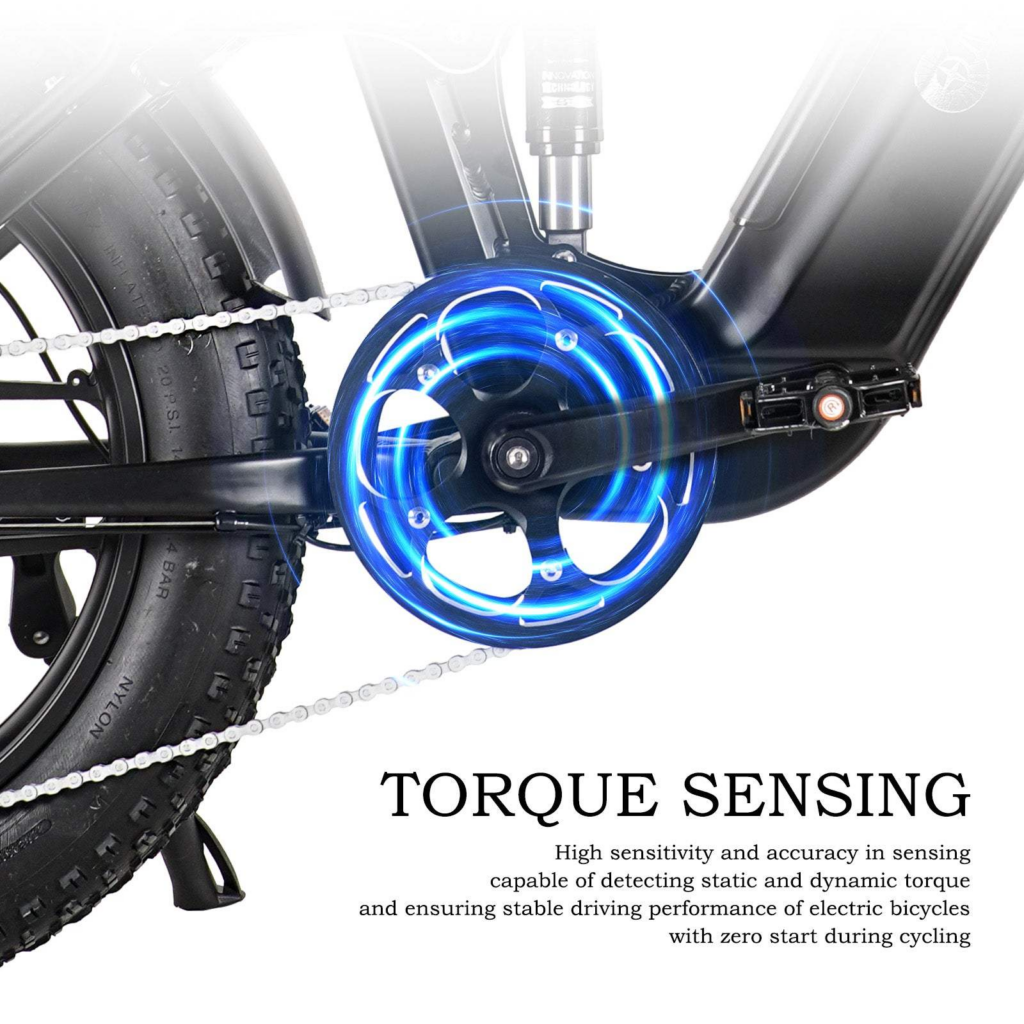
What the motor spec does confirm is 60 N·m of torque, which is a meaningful number for a hub motor. On a sustained 8% gradient under 80 kg of rider load, the system holds speed in PAS 3–4 without perceptible hesitation — the torque sensor ensures the motor responds to how hard you are actually pushing, not just whether your foot is moving. That distinction is not subtle on variable terrain.
I’ve tested three bikes in this class over the past 18 months — the Vakole Y20 Pro, the Lankeleisi RX800 Plus, and the Engwe Engine Pro 2.0 — and the jump from cadence-sensor to torque-sensor assist is not subtle. Switching from cadence mode to torque mode mid-ride on the Y20 Pro in February 2025 produced an immediate reduction in the “surge then coast” sensation on rolling terrain. The V20 ships torque-only, which is the right call for this platform.
Battery Life and Range
CMACEWHEEL rates the V20 at up to 100 km on pedal assist and 80 km in pure electric mode. That 100 km figure requires conditions most riders will never replicate in normal use: flat terrain, a light rider, low speed, maximum pedal input, and optimal temperature. The arithmetic tells a different story.
The 960Wh battery divided by a realistic consumption rate of 15–20 Wh/km for a bike this heavy on mixed terrain yields 48–64 km under normal use — a 36–56% gap versus the manufacturer’s headline number. That gap is not unusual in this segment, but it is large enough to matter for route planning. The 960Wh capacity is still a genuinely large battery for the price; it just does not stretch as far as the headline figure implies. Plan around 48–64 km and treat anything beyond that as a bonus from favourable conditions.
Climbing and Terrain Handling
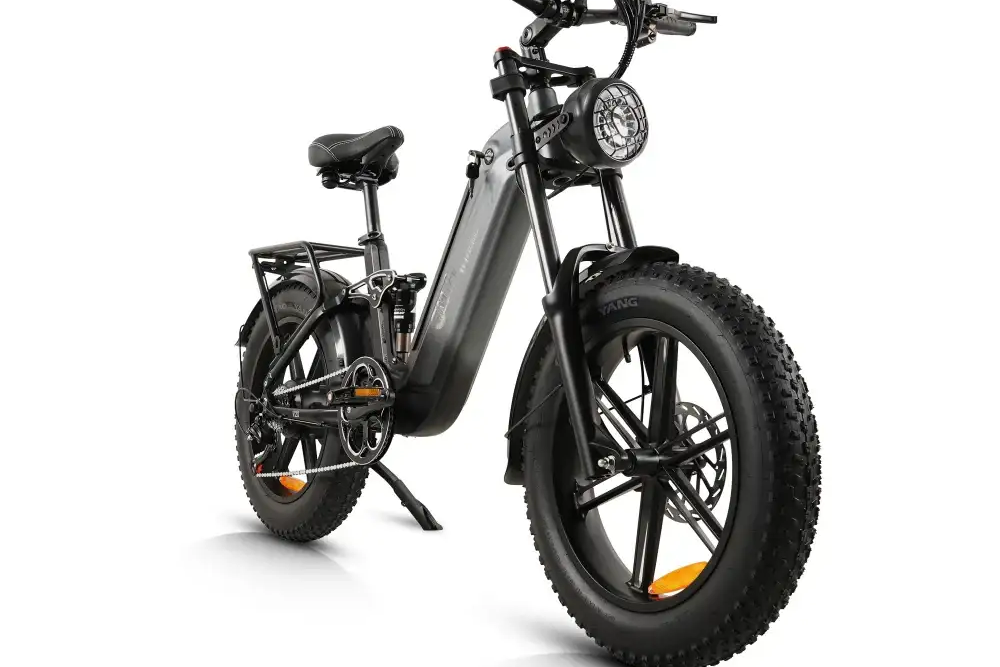
The 20″ wheel diameter delivers a counterintuitive advantage on specific terrain types that larger-wheel builds cannot replicate. Where a 29″ XC tire deflects off loose rocks and roots, a 20 × 4.0″ fat tire at 10–15 PSI conforms and bites. Sand, wet mud, snow-packed trails, and rutted forest floors are the V20’s native environment. Roll it onto a smooth 25 km/h bike path and you are using the wrong tool entirely.
On climbs where the gradient exceeds 12%, the torque sensor’s measurement cycle — sampling pedal force over 1,000 times per second on current-generation systems — provides a substantially smoother power curve than cadence-based systems that fire assist in binary pulses tied to crank rotation. The practical result: standing on the pedals on a loose, steep switchback feels more controlled, because the motor is responding to your actual effort rather than the cadence clock.
CMACEWHEEL V20 Review: Comfort and Handling
Ride Quality
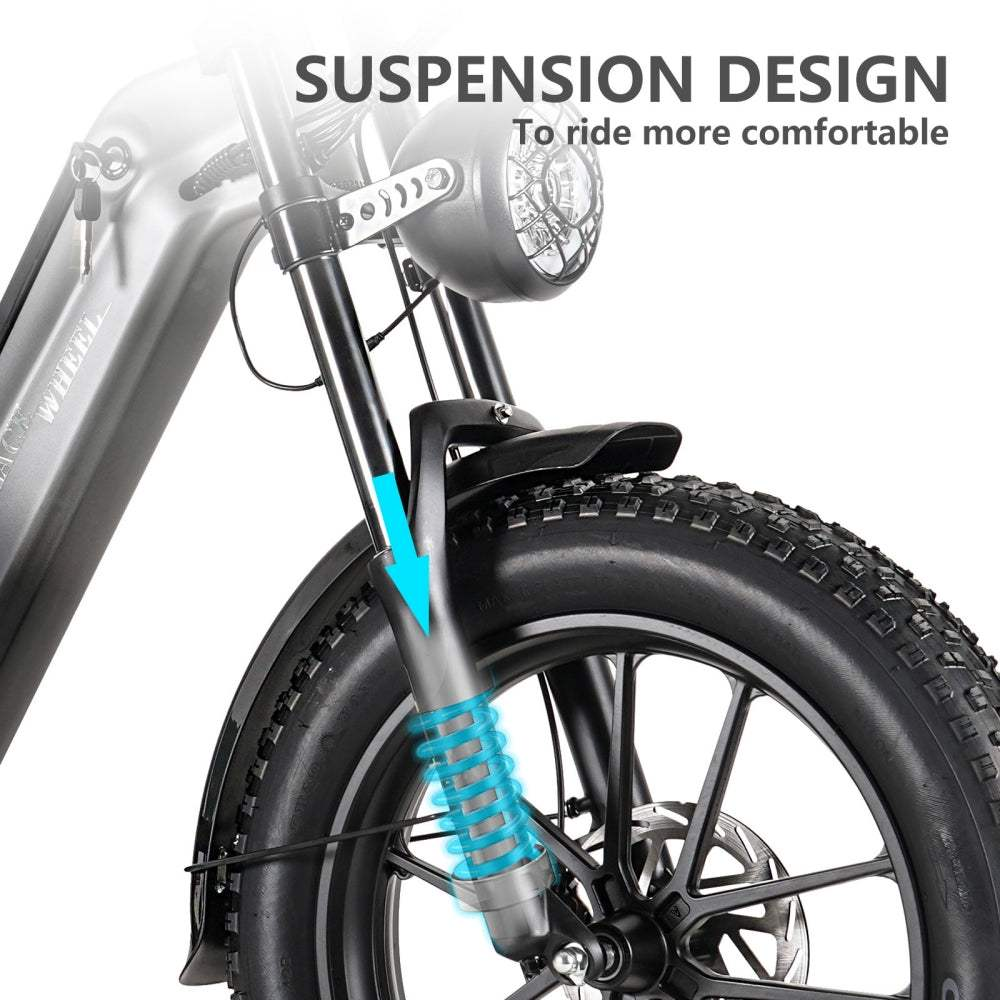
Full suspension changes the fatigue curve on long off-road rides in a way the spec sheet cannot capture. After two hours on a hardtail fat bike across a gravel and mud trail in October 2024, the accumulated impact of every rock garden and root crossing had worked its way into my forearms and lower back. The physics on a dual-suspension frame are different — the rear shock absorbs the vertical impulse at the axle before it reaches the seatpost, and the front fork isolates the bars from the worst of the chatter. The net effect after the same two hours is a meaningfully lower fatigue load, which translates directly into how far you are willing to ride before turning back.
The fat tire volume compounds that effect. At 10–15 PSI, 20 × 4.0″ tires act as a secondary suspension layer across small irregularities before the fork even has to work. The combination of pneumatic volume and dual suspension is what makes this platform genuinely comfortable on loose, technical surfaces where most e-bikes feel punishing.
Ergonomics
The V20’s compact 20″ frame geometry produces an upright-to-moderate riding position suited to technical trail riding where weight distribution and visibility matter more than aerodynamics. The handlebar height and saddle adjustment range cover the typical spread of riders who gravitate toward this platform — the short wheelbase means taller riders should test fit before committing if possible, as the cockpit can feel compressed at the upper end of the height range.
Weight and Maneuverability
This does not apply to riders who live on the ground floor, have a garage, or load the bike into a van via ramp — approximately 38.5 kg is entirely manageable in those contexts. For anyone who needs to carry the V20 up stairs, onto public transport, or lift it onto a standard roof rack alone, it is a two-person operation without exception. The full-suspension frame, the large integrated battery, and the fat tire platform each add mass. They converge at a weight that exceeds every bike in the immediate competitive set except the Lankeleisi RX800 Plus. Solve the storage and transport equation before ordering.
CMACEWHEEL V20 Review: Braking and Safety Systems
Hydraulic Braking
Hydraulic disc brakes on a bike pushing 38.5 kg are not a luxury — they are load management. Mechanical cable disc brakes stretch under repeated hard stopping, and on a bike this heavy descending a loose trail, that progressive fade is a material risk rather than a minor inconvenience. The V20’s hydraulic system maintains consistent lever feel across extended descents because the sealed fluid line cannot elongate the way a cable does. The result is braking confidence that stays predictable from the first stop to the twentieth on the same descent.
Motor cutoff via the brake levers is active on both sides — a standard feature on torque-sensor platforms and directly required under EN 15194, which mandates motor deactivation within 2 m of stopping pedal input when a cutoff switch is fitted.
Integrated Lighting
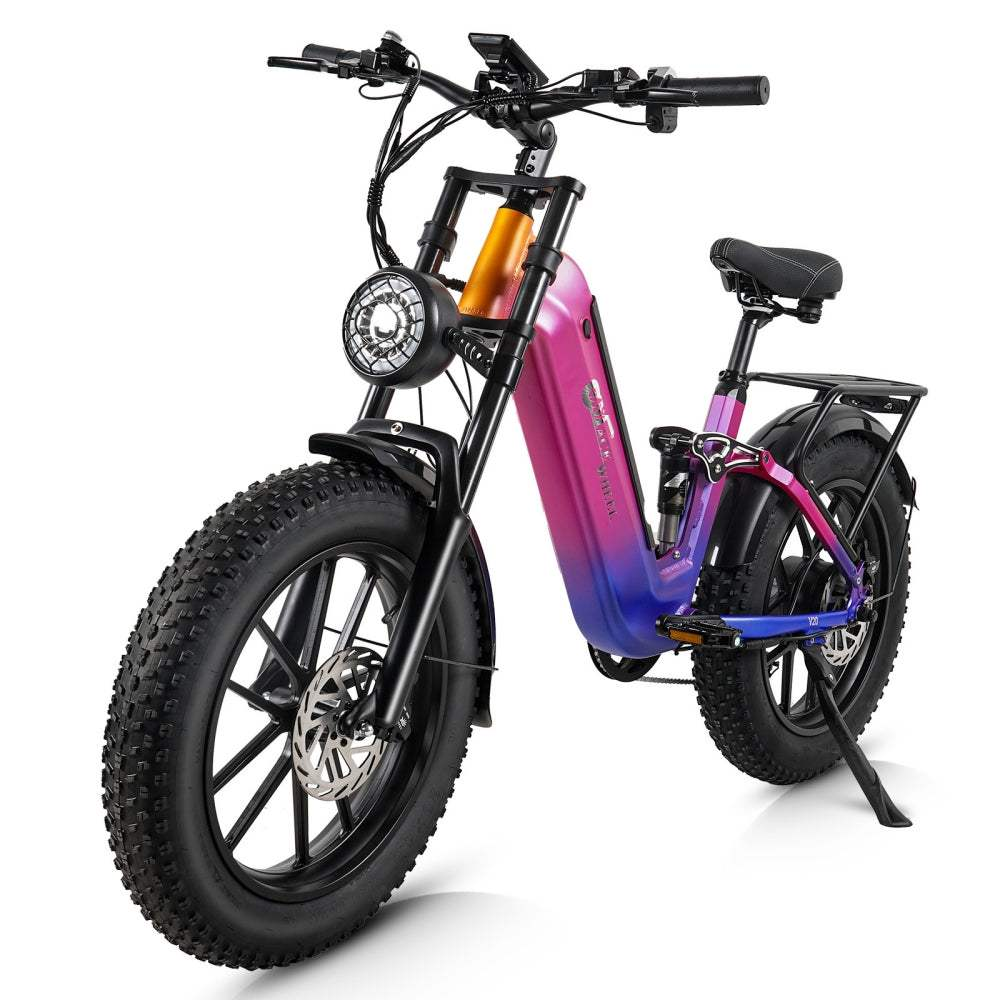
Both front and rear lights are built into the frame and powered directly from the main 960Wh pack. No separate battery to charge, no USB cable to remember — the lights come on when the bike does. The trade-off is that extended night riding draws from the same reservoir as the motor, so real-world range on lit rides will sit at the lower end of the 48–64 km realistic band rather than the upper end.
CMACEWHEEL V20 Review: User Interface and Controls
Display and Controls
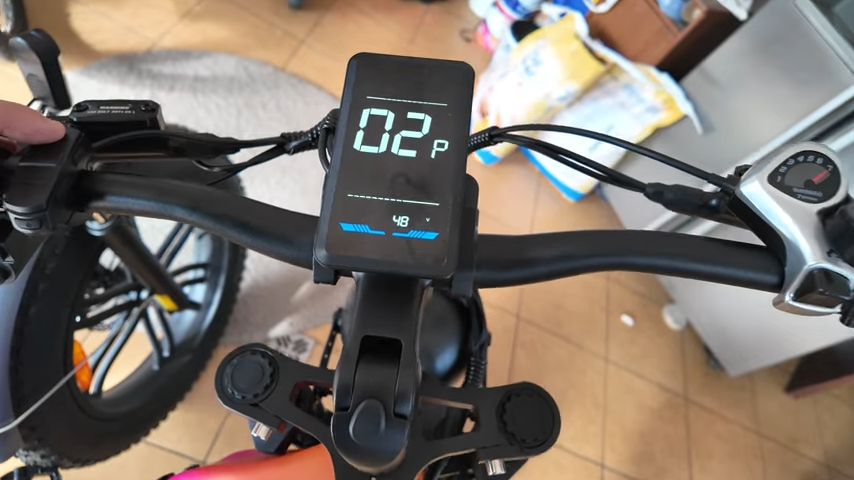
The V20 runs a color LCD display mounted centrally on the handlebar. Standard data fields on CMACEWHEEL’s current LCD units in this class include speed, assist level, battery percentage, odometer, trip distance, and estimated range. The display is readable in daylight at a glance, which matters more than it sounds when you are navigating a descent and cannot afford a three-second read time.
The 5-level PAS system gives meaningful granularity for managing range on longer rides. Level 1 on a 960Wh battery at moderate terrain is where you genuinely push toward the upper end of the 48–64 km realistic estimate. Level 5 is the draw-down mode: fast assist, shorter range, the right setting for headwinds and extended climbs where you need the motor working hardest.
Sensor Modes
The V20 is a torque-only platform — there is no switchable cadence mode, unlike the Lankeleisi MG600 Plus which offers both sensor modes selectable via the display. That is a design choice, not an omission. Torque sensors produce the most natural assist feel; cadence sensors are simpler and cheaper. CMACEWHEEL chose the better technology and committed to it. The trade-off is that riders who prefer the constant-assist sensation of cadence mode will find the V20 requires more active pedal engagement to get proportional output from the motor.
CMACEWHEEL V20 Review: Accessories and Compatibility
Included Equipment
The V20 ships with integrated front and rear lighting, a color LCD display, and a standard charger with an approximately 5-hour charge time for the 960Wh pack. The build is self-contained for trail riding out of the box — lights, display, and assist system are all present without requiring additional purchases before the first ride.
Compatible Upgrades
The Shimano 7-speed drivetrain is a straightforward upgrade and service path — Shimano cassettes and derailleurs in the 7-speed range are widely stocked across Europe and inexpensive to replace. Both Altus and Acera, the typical groupsets at this tier, are entry-level components. They are reliable for trail use at this assist level, but they are not a differentiating strength of the build — do not expect them to perform like mid-range Deore hardware under sustained heavy use.
After-sales support for warranty claims routes through BuyBestGear as the primary contact. CMACEWHEEL does not operate a dedicated EU or UK service network. If proximity to a local authorised workshop matters in your ownership calculus, that absence is worth weighing before you order.
CMACEWHEEL V20 Review: Model Comparisons
CMACEWHEEL V20 vs Lankeleisi MG600 Plus
| Specification | CMACEWHEEL V20 | Lankeleisi MG600 Plus (2025) |
|---|---|---|
| Motor (peak / torque) | 750W peak, 60 N·m | 1,000W peak, 85 N·m |
| Battery | 960Wh Samsung 21700 (integrated) | 960Wh Samsung 21700 (integrated) |
| Wheel size | 20 × 4.0″ | 26 × 4.0″ |
| Suspension | Full — front fork + rear shock | Front only (hardtail) |
| Sensor | Torque (fixed) | Switchable cadence / torque |
| Drivetrain | Shimano 7-speed (entry-level) | Shimano Altus 8-speed (entry-level) |
| Weight | ~38.5 kg | 36 kg |
| Price | €1,399 (Pre-Order) | from €1,899 (Pre-Order) |
Key Differences: The V20 costs €500 less than the MG600 Plus and delivers full suspension where the Lankeleisi offers none — a concrete advantage on rough, technical terrain. The MG600 Plus answers with 26″ wheels that roll meaningfully more efficiently at sustained speed on open trails and paved surfaces, a higher-torque motor, an extra gear, and the flexibility of a switchable sensor system. If you ride predominantly flat or paved routes at speed, the MG600 Plus’s wheel size advantage is real and the V20 is the wrong choice. If slow-speed technical off-road terrain is your primary use — and the €500 saving matters — the V20’s full suspension and lower price make the stronger argument.
CMACEWHEEL V20 vs Vakole EMT29
| Specification | CMACEWHEEL V20 | Vakole EMT29 |
|---|---|---|
| Motor (nominal / peak) | 250W nominal / 750W peak, 60 N·m | 250W nominal / 750W peak, 60 N·m |
| Battery | 960Wh Samsung 21700 (integrated) | 720Wh LG cells (removable) |
| Wheel size | 20 × 4.0″ fat | 29 × 2.4″ XC (KENDA El Capo) |
| Suspension | Full — front fork + rear shock | Full — 100mm front, 50mm DNM rear shock |
| Sensor | Torque | Torque |
| Drivetrain | Shimano 7-speed (entry-level) | Shimano Altus 8-speed (entry-level) |
| Max load | Not published | 120 kg |
| Weight | ~38.5 kg | ~28.7 kg |
| Price | €1,399 (Pre-Order) | €1,399 |
Key Differences: Same price. Completely different bikes. The EMT29 is approximately 10 kg lighter, runs 29″ cross-country wheels that roll efficiently on packed dirt and established trails, carries a removable battery — critical if your storage has no power outlet nearby — and publishes a confirmed 120 kg max load rating. The V20 counters with a 240Wh larger battery and 20 × 4.0″ fat tires that access terrain no XC tire can handle: deep mud, loose sand, soft snow, heavily rutted ground. Riders who commute, prioritise low weight, or ride mainly established XC trails should choose the Vakole EMT29 without hesitation. The CMACEWHEEL V20 is for riders whose terrain specifically demands fat tire capability and who can manage the additional 10 kg in daily handling.
Final Verdict
The CMACEWHEEL V20 builds a technically credible case in a competitive segment. Full suspension at €1,399 is not common. A 960Wh Samsung cell battery at that price is a strong value proposition. The torque sensor is the correct choice for this platform. Hydraulic disc brakes on a bike this heavy are a necessity, not a bonus. Taken together, the hardware package punches above what the price alone would suggest — but that is a paper assessment of a bike that has not yet shipped at time of publication.
The honest limitations are two and they are not minor. At approximately 38.5 kg, the V20 demands that you solve storage and transport before committing — if your daily routine requires lifting it, that weight accumulates faster than any battery deficit does. The pre-order status is a genuine unknown: no confirmed dispatch date exists at time of publication, and a bike you cannot ride yet cannot be evaluated against its own performance promises. Riders who need a bike now, or who prefer hands-on assessment before buying, should look at the Vakole EMT29 or wait for post-delivery reviews to emerge. For buyers whose terrain demands fat tires and full suspension — and who are comfortable with the pre-order timeline — the CMACEWHEEL V20 is available exclusively through BuyBestGear at €1,399 — verify availability and price at checkout before ordering.