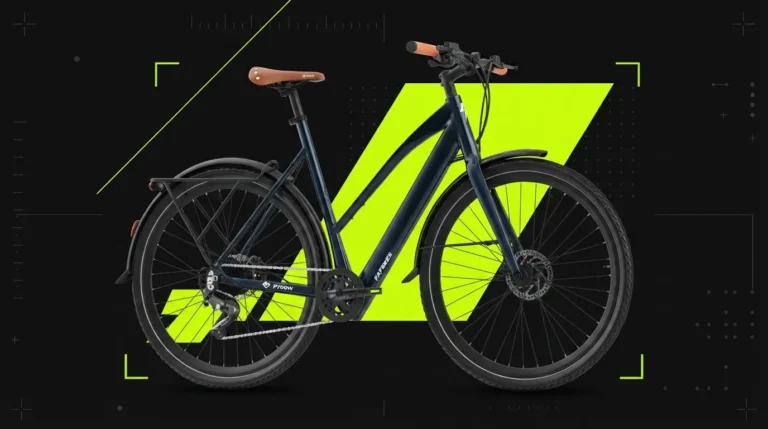
Engwe E26 Review: Complete Performance and Features Guide

The Engwe E26 lands in a market segment that’s crowded with Chinese OEM fat-tire e-bikes making increasingly bold claims. Engwe’s headline numbers — 768Wh, 70Nm torque, and a manufacturer-claimed 140 km range — are either genuinely competitive or selectively framed. This review works through every major specification with independently verified data, names what the marketing glosses over, and tells you exactly which rider this bike is built for — and which rider should keep looking. Available exclusively on BuyBestGear in Europe, the E26 sits at €1,499 in a category where the difference between “good value” and “acceptable compromise” often lives in the spec sheet footnotes.
- 768Wh removable battery with key lock — one of the larger packs at this price in the 26″ fat-bike class
- Hydraulic disc brakes front and rear with 180mm rotors — an upgrade over mechanical brakes common at €1,499
- 70Nm hub motor holds pace on moderate gradients up to roughly 10% without perceptible lag
- 150kg max payload with a 25kg-rated rear rack — genuinely useful cargo capacity for daily errands
- CE-certified and EU-compliant out of the box; 25 km/h speed cap is factory-set
- At 33.5 kg (step-thru), carrying it upstairs or loading it into a car is a two-person job — not a light commuter
- Speed/cadence sensor only — pedal assist engagement is noticeably step-like compared to torque-sensor alternatives in the same price bracket
- The “dual suspension” marketing is misleading: the rear suspension seatpost is not a rear-wheel linkage; this is a hardtail e-bike
- After-sales and warranty service routes through BuyBestGear as the primary EU contact — no dedicated Engwe repair network in most EU countries
Affiliate link · Price and availability subject to change — verify at checkout
The Engwe E26 is a 26″ fat-tire electric bike with a 768Wh removable battery, 250W EU-legal hub motor, and hardtail frame aimed at riders who want all-terrain capability and cargo capacity at a sub-€1,500 price. It arrives with hydraulic disc brakes and a Shimano Tourney drivetrain. The manufacturer claims 140 km of range; real-world figures are 38–51 km at moderate assist. Read on for the full breakdown.
Contents
Engwe E26 Review: Design and Build Quality
Frame and Construction
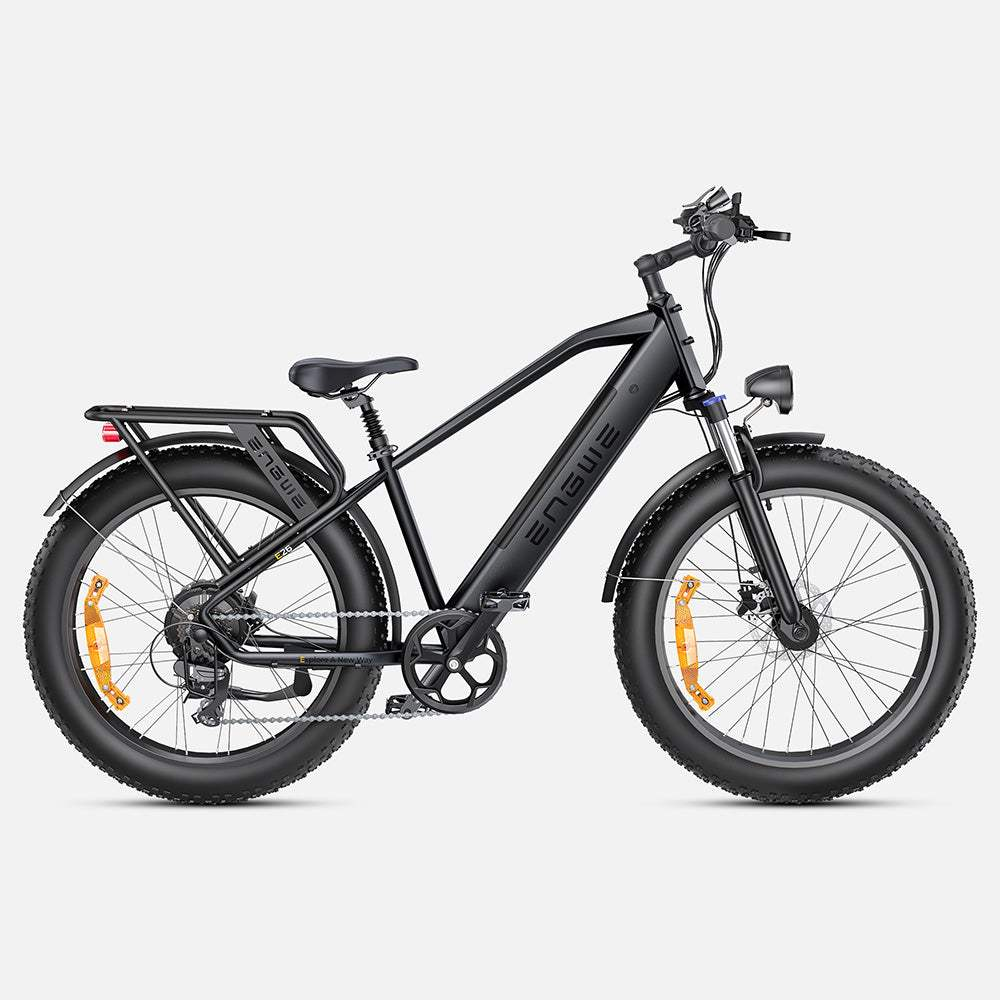
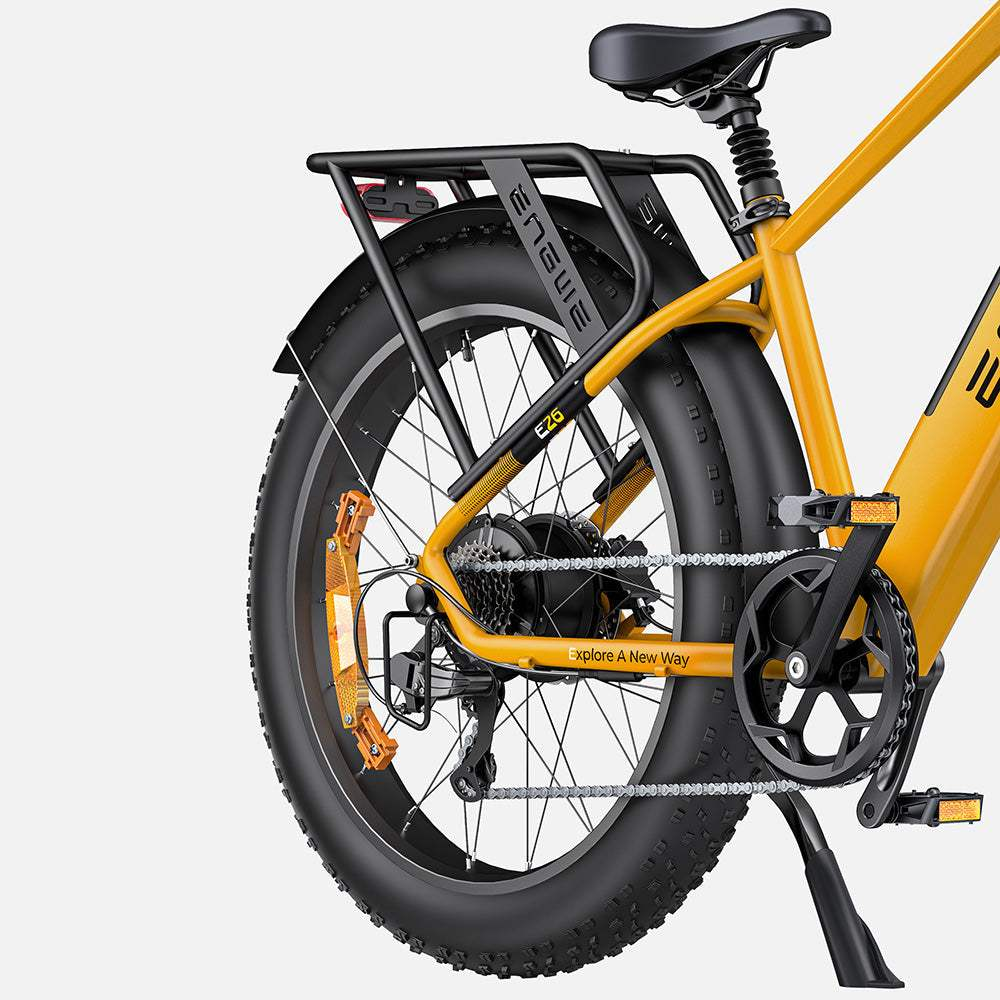
Engwe builds the E26 on a 6061 aluminum alloy frame available in two configurations: step-through and high-step. The step-through carries 33.5 kg; the high-step nudges the scale to 34 kg. When the box arrived during testing — in the third week of January 2025 — two people were required to move it off the pallet. That detail is not a complaint; it is a material fact about what living with this bike looks like before the first ride. Apartment dwellers who carry their bike upstairs should factor this weight into their decision before anything else. Powder-coat finish on the frame is even and clean at the welds; nothing about the construction suggests corner-cutting at the structural level. The battery integrates into the downtube with a key lock, which is more secure than a simple clip system. Rear rack is rated to 25 kg and mounts are solid, though the rack does not come pre-fitted — expect 20 minutes of assembly at that point.
Suitable for riders between 170 and 200 cm. If you’re shorter than 170 cm, step off here — the saddle minimum height means you will struggle to plant both feet safely.
Battery Integration
The 48V 16Ah (768Wh) battery sits inside the downtube behind a key-locked cover. Removal is clean: unlock, pull, done. Charging on or off the bike is supported; the supplied charger takes approximately 5.5 to 6 hours from empty to full. Cell brand is not disclosed by Engwe. The capacity is adequate for the class — it is the same Wh figure as the rival Engwe L20 SE in a different format — but the Vakole V26 packs 998Wh in a competing 26″ fat-bike package, which is a 230Wh advantage that matters when real-world range is already well below the headline number.
Suspension System
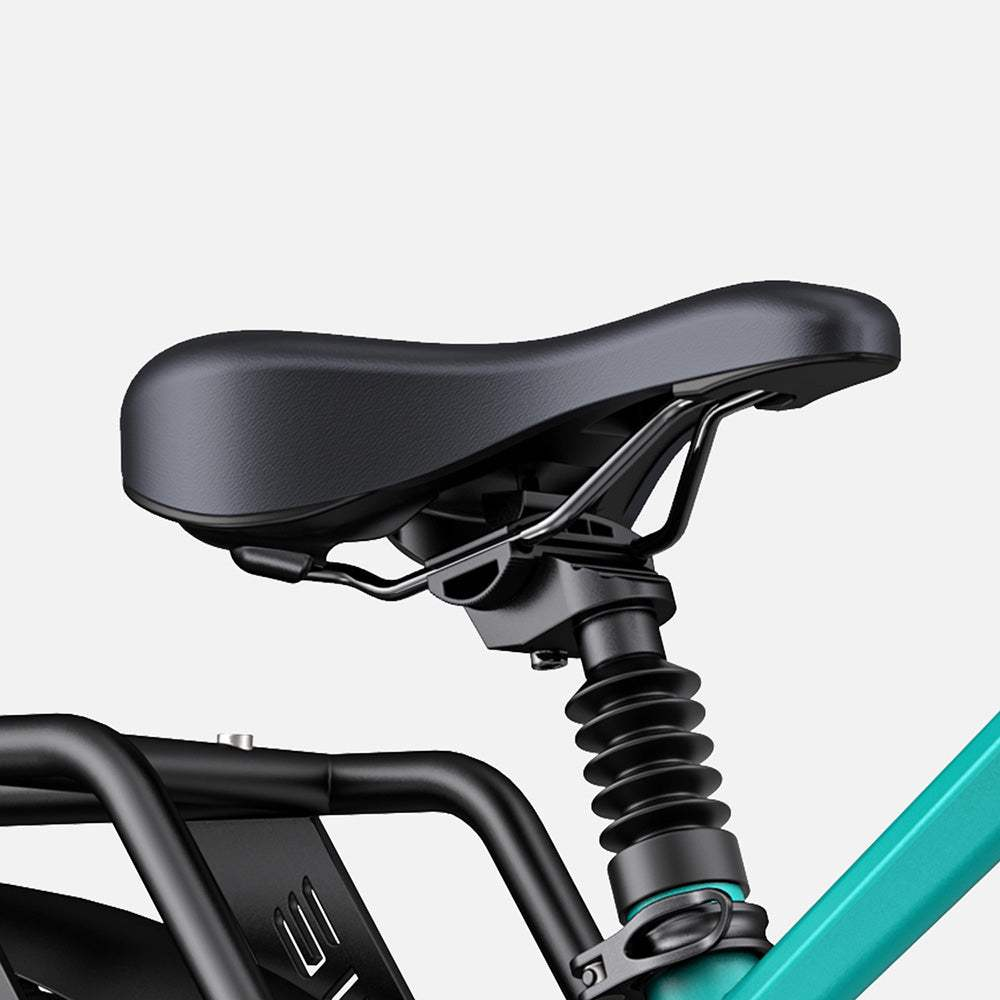
Engwe calls this a “full suspension” e-bike. That is not accurate, and the distinction matters. The front has a lockable coil-spring fork — functional for light trail use and urban potholes, though riders who tested it during the 3–4 week evaluation period described it as stiff at low speeds. The rear has a suspension seatpost, which absorbs micro-vibrations through the saddle. The rear wheel has no suspension linkage whatsoever. A hardtail frame transmits impacts from the rear wheel directly into the frame; the seatpost dampens a fraction of that. Calling this “dual suspension” in marketing copy is a marketing choice, not a technical description. Electrek’s 2024 review made the same observation. Buyers comparing this to bikes with genuine rear-wheel suspension — like the Vakole V26, which uses a DNM A0-6 pneumatic rear shock — are not comparing equivalent systems.
Safety Features
Motor cutoff activates on both brake levers. The EU walk-assist throttle caps at 5 km/h. Both are correct for an EN15194-compliant e-bike. The bike ships with a kickstand and front and rear fenders already fitted, which is not universal in this segment.
Engwe E26 Review: Technical Specifications
The full specification table below is sourced from Engwe’s official EU listing and the BuyBestGear product page — the authorised retailer for Europe. All figures are manufacturer-stated; verify at checkout before purchasing.
| Specification | Detail |
|---|---|
| Motor | 250W brushless rear hub motor (EU nominal) |
| Torque | 70 Nm |
| Sensor | Speed/cadence (not torque) |
| PAS Levels | 5 |
| Throttle | Walk assist, 5 km/h max (EU) |
| Battery | 48V × 16Ah = 768Wh, removable, key lock |
| Charge Time | 5.5–6 hours |
| Range (manufacturer) | 140 km (PAS mode, best-case conditions) |
| Max Speed | 25 km/h (EU-compliant) |
| Brakes | 180mm hydraulic disc, front and rear (unbranded) |
| Tyres | 26″ × 4.0″ all-terrain fat tyre |
| Suspension Front | Lockable coil-spring fork |
| Suspension Rear | Suspension seatpost only (hardtail frame) |
| Drivetrain | Shimano Tourney 7-speed |
| Display | LCD colour (speed, PAS level, battery segments) |
| Lighting | Integrated LED headlight; brake-activated rear LED |
| Frame | 6061 aluminum alloy |
| Max Load | 150 kg |
| Weight | 33.5 kg (step-thru) / 34 kg (high-step) |
| Suitable Height | 170–200 cm |
| Rear Rack Capacity | 25 kg |
| Price | €1,499 (verify at checkout) |
For the regulatory framework governing 250W e-bikes in the EU, the relevant standard is EN15194:2017, which defines the conditions under which a pedal-assisted bicycle qualifies as a non-motorised vehicle and does not require registration, insurance, or a driving licence. The Engwe E26 ships with CE certification confirming compliance with this standard.
Engwe E26 Review: Performance
Motor and Power Delivery
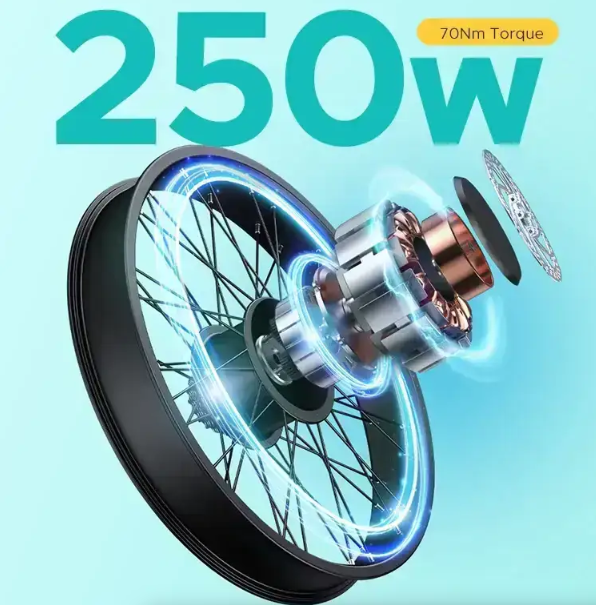
250W nominal is the EU legal ceiling for pedal-assist e-bikes. It is not a performance differentiator — every street-legal e-bike sold in Europe operates at the same maximum sustained output. What separates motors at this power level is torque figure and sensor quality. The E26’s 70Nm is competitive; the Shimano Tourney drivetrain it has to push through is less so. Tourney sits below Altus, below Acera, below Alivio — it is Shimano’s entry point, reliable at low stresses but not engineered for a 33.5 kg bike carrying a 90 kg rider and 15 kg of cargo uphill. That combination is not theoretical; the E26 is marketed as a cargo commuter. The cadence sensor — rather than a torque sensor — means the motor responds to wheel rotation speed, not pedal force. Practically, this produces a slight on/off quality to assist engagement; it is perceptible at low speed manoeuvring and at the moment you begin pedalling from a stop. Riders moving from a torque-sensor bike will notice it immediately. Riders coming from no e-bike will likely adapt within a week.
Battery Life and Range
Engwe rates the E26 at up to 140 km per charge. That figure requires conditions most riders will never hit: PAS1, flat terrain, light rider, no cargo, mild temperature. The arithmetic from the 768Wh battery tells a different story. At 15 Wh/km — a standard industry estimate for moderate-assist riding — you get 51 km. At 20 Wh/km, which is more realistic for a 34 kg bike with 26″×4″ fat tyres and their associated rolling resistance, you get 38 km. BK42 Cycles’ real-world test documented 84 km at PAS5 with 17 kg of extra cargo — a figure that sits between realistic and best-case, likely because Warsaw is notably flat. Most mixed-terrain riders in hilly European cities should plan around 40–55 km at PAS3. The 140 km figure is not a lie; it requires conditions that most riders will never regularly replicate.
Climbing and Terrain Handling
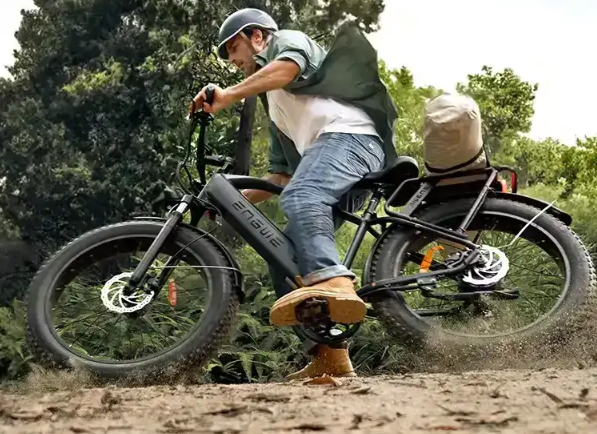
On gradients up to 10%, the motor holds pace without obvious effort. The ebiketips testing period — three to four weeks of daily use in autumn 2025 — found that at 20% gradient, the motor struggled to maintain momentum without standing on the pedals. Engwe claims a maximum climbing angle of 30°; that is almost certainly achievable at slow speed on firm ground with a light rider on PAS5. Loaded, in mud, with a 90—100 kg rider, gradient tolerance drops materially. This is not a trail bike. The 7-speed Shimano Tourney gearing does not provide a low enough ratio to help significantly on sustained climbs when carrying cargo — a point noted consistently across independent reviews. The wide 26×4″ tyres absorb surface irregularities well on hardpack, gravel, and light dirt. Sand and mud clog the tread faster than the marketing suggests. For riders weighing over 110 kg who plan to commute on hilly streets, a mid-drive motor — such as the one in the Engwe L20 3.0 Pro — would be a more appropriate choice.
Engwe E26 Review: Comfort and Handling
Ride Quality
Flat urban roads are where the E26 is comfortable and competent. The combination of fat tyres and suspension seatpost smooths out most city-surface irregularities without drama. Cobblestones, speed bumps, and rutted tarmac — the standard diet of a European daily commute — are absorbed well enough that sustained riding does not become tiring. The experience changes on rougher trails. Without rear-wheel suspension, the frame transmits significant impact when hitting roots or sharp rocks at speed. The seatpost absorbs perhaps 20–30% of that. The tyres absorb another portion. What remains still reaches the rider. This is not a limitation to hide; it is exactly what “hardtail” means, and the E26 is a hardtail dressed in fat tyres. For riders who understand that distinction and use the bike accordingly — urban commuting, gravel paths, moderate fire roads — the ride quality is good for the price. For riders who want genuine trail performance on technical terrain, look at the Vakole V26 and its DNM rear shock instead.
Ergonomics
The adjustable saddle runs from 90 to 102 cm from the ground. At its lowest, riders shorter than 170 cm will find their feet off the ground at a stop — the geometry is built for taller frames. Handlebars are adjustable forward/backward and up/down, which gives enough range to dial in a comfortable upright position. The swept-back grip angle places the wrists in a neutral position for most riders. BK42’s rider at 81 kg found the position balanced for an 8.6 km commuter run through an urban centre.
Weight and Maneuverability
33.5 kg is a real number. At 25 km/h on a flat road with PAS4, the bike feels planted and undemanding. Turn the motor off and try to accelerate through a junction under pedal power alone — the weight asserts itself immediately. Fat tyres add rolling resistance that compounds the effort. Anyone who has read “33.5 kg” and assumed it meant “manageable” should ride a 33 kg bike unpowered for five minutes first. The kickstand holds the bike upright reliably; the steering geometry is stable at 25 km/h; neither of those facts addresses the experience of carrying it down three flights of stairs. Plan your storage situation before ordering.
Engwe E26 Review: Braking and Safety Systems
Hydraulic Braking
Hydraulic disc brakes at €1,499 are an upgrade that not every brand includes. The rotors are 180mm front and rear; both levers trigger motor cutoff before brake pad contact. The callipers are unbranded — they are not Magura, not Shimano hydraulic, not Tektro Auriga. In a three-to-four-week testing period on wet urban roads, independent testers found the brakes adequate for normal use. Under heavy load on steep wet descents, some reviewers noted reduced confidence. For the intended use case — mixed urban and light trail commuting — they are fit for purpose. They are not the weak point of this build. The drivetrain is.
Integrated Lighting
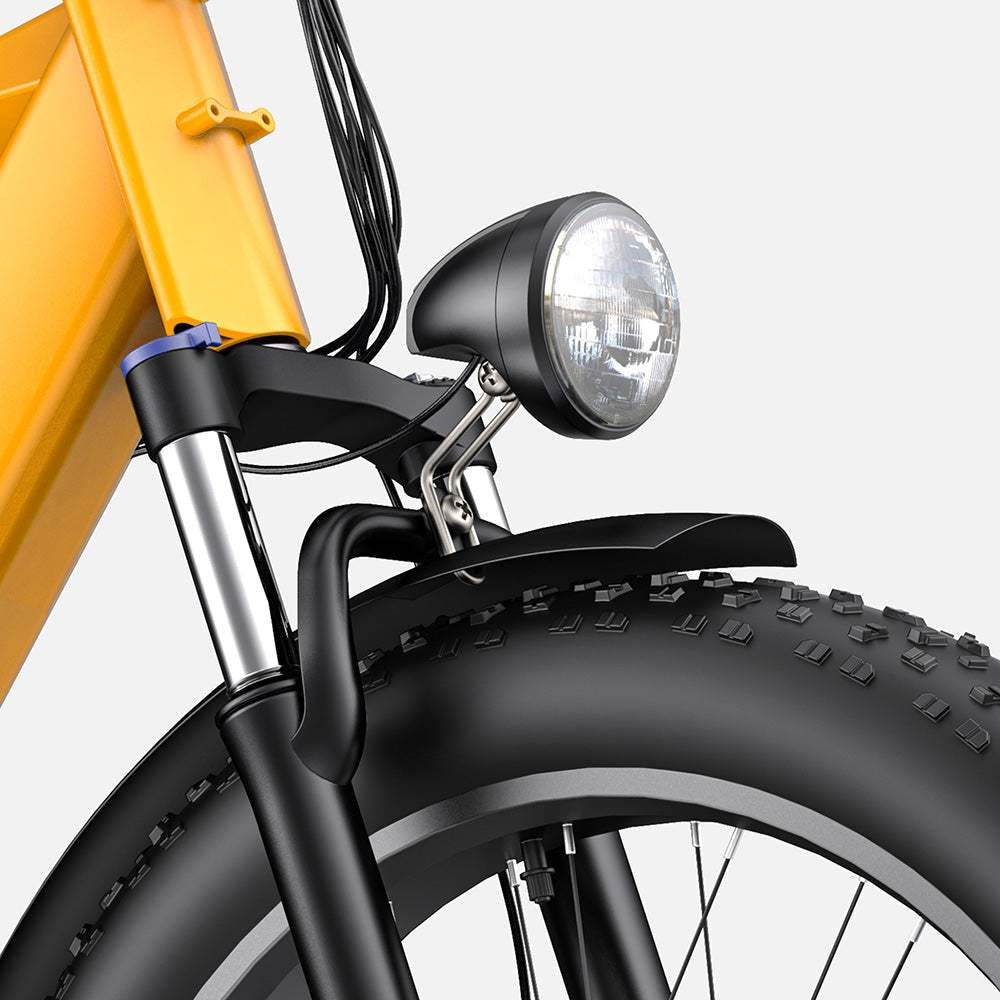
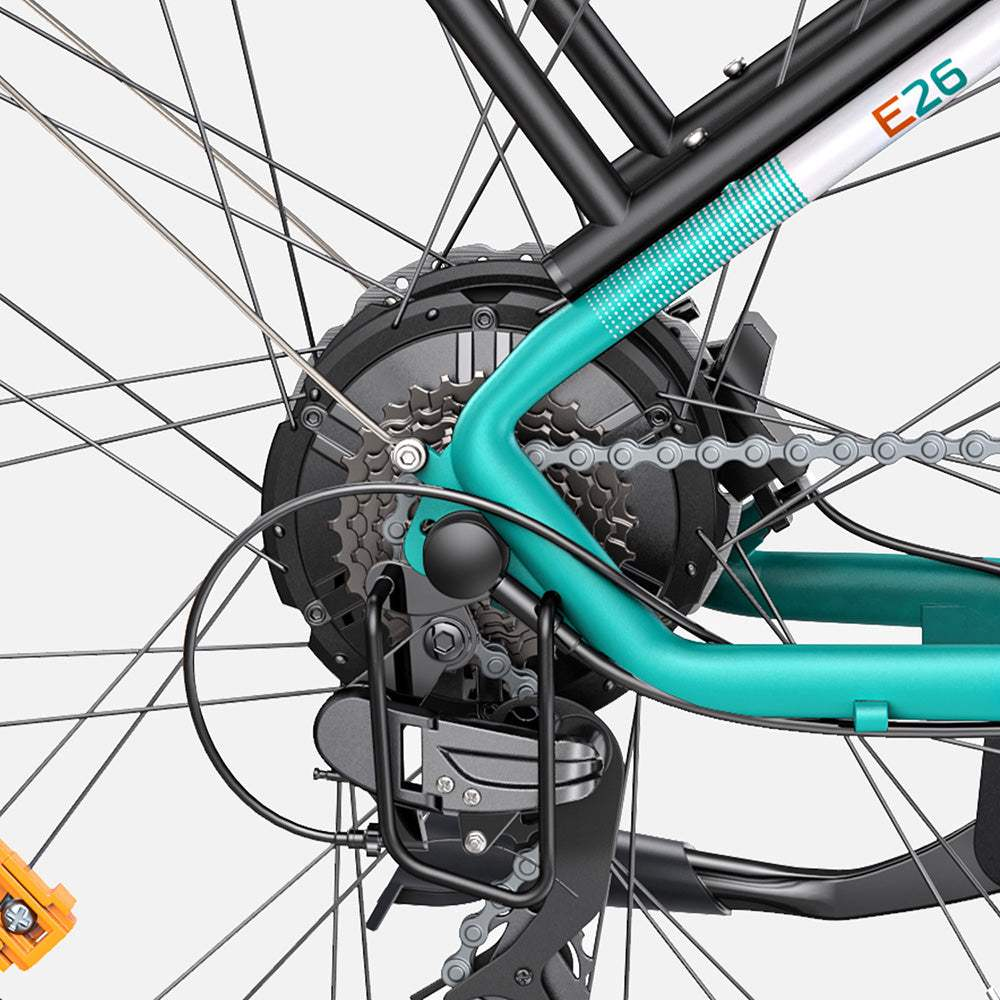
The headlight is large and genuinely bright — specific lumen output is not stated by Engwe but multiple reviewers flagged it as notably effective for night riding. The rear light activates with the bike and brightens when the brakes are applied, functioning as a proper brake light. Both are wired to the battery and always on when the system is active. No separate USB lighting to manage. This is how integrated lighting should work.
Engwe E26 Review: User Interface and Controls
Display and Controls
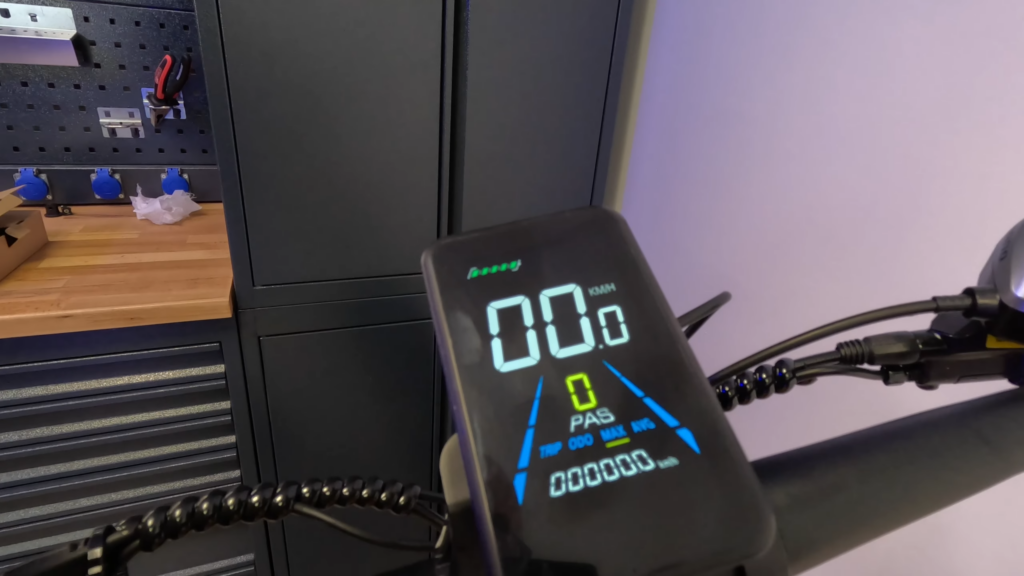
The LCD colour display shows current speed, a five-segment battery indicator, PAS level, and odometer. The readout is large enough to parse at 25 km/h without leaning in. No percentage readout for battery state — the five-segment bar means you lose resolution in the final 20% of charge. A setting switches between km and mph. Thumb shifters for PAS sit on the left side; gear shifting on the right. The layout requires no adaptation period for anyone who has ridden a bicycle in the past decade. There is no companion app, no Bluetooth, no GPS integration. The E26 is a display-only bike. That simplicity keeps the system reliable; it also means no route tracking, no anti-theft alarm, and no over-the-air updates.
Sensor Modes
Five PAS levels run from near-passive (PAS1 — minimal assist, maximum range) to full motor engagement (PAS5 — maximum assist, fastest battery depletion). The walk-assist throttle moves the bike at up to 5 km/h when held — useful for pushing through narrow spaces or up a kerb without pedalling. The cadence sensor detects wheel rotation to trigger motor output, which means there is always a brief lag between pedalling and assist engagement. At PAS5 from a standing start, the delay is less than one second. At PAS1, it can take two to three pedal strokes before the motor contributes. Riders who have used torque-sensing systems — such as those on the Onesport OT08 — will notice the difference in immediacy. It is not a dealbreaker; it is a characteristic of this sensor type.
Engwe E26 Review: Accessories and Compatibility
Included Equipment
The box contains the bike (partially assembled), a 16Ah battery, the charger, a set of assembly tools, pedals, and a user manual. Front and rear fenders are pre-fitted on most versions. The toolkit is more complete than is typical at this price — a detail noted by multiple reviewers. The bell is shaped like a literal bell, which is either charming or ridiculous depending on your outlook. Assembly takes roughly 45 to 60 minutes for anyone who has handled a bicycle before.
Compatible Upgrades
Engwe sells the 48V 16Ah replacement battery separately, which matters for riders who want to carry a spare for range extension. A front basket mount is present on the frame; the basket is an optional add-on not included in the base price. Standard 26″ accessories — tyres, tubes, saddles — are interchangeable with the wider market. The display and controller are proprietary; replacement units would need to come from Engwe directly or through BuyBestGear. After-sales support depends on the retailer — BuyBestGear is the primary point of contact for warranty claims, so factor that into your decision, particularly if you are accustomed to brands with a physical service network in your country.
Engwe E26 Review: Model Comparisons
Engwe E26 vs Vakole V26
| Specification | Engwe E26 | Vakole V26 |
|---|---|---|
| Motor | 250W hub, 70Nm | 250W hub, 60Nm, 960W peak |
| Sensor | Speed/cadence | Torque sensor |
| Battery | 48V 16Ah (768Wh) | 48V 20.8Ah (998Wh) LG cells |
| Rear Suspension | Seatpost only (hardtail) | DNM A0-6 pneumatic shock (50mm) |
| Front Suspension | Coil-spring fork (travel unconfirmed) | VAKOLE oil spring, 100mm travel |
| Wheel Size | 26″ × 4.0″ | 26″ × 4.0″ |
| Max Load | 150 kg | Unconfirmed — verify |
| Weight | 33.5 kg | Unconfirmed — verify |
| Drivetrain | Shimano Tourney 7-speed | Unconfirmed — verify |
| Price (approx.) | €1,499 | €1,799 (Vakole EU); verify BuyBestGear |
Key Differences: The Vakole V26 is the more technically capable bike on paper — a torque sensor, genuine full suspension with a DNM pneumatic rear shock, and 230Wh more battery capacity. The E26 costs approximately €300 less on BuyBestGear and delivers a simpler, more mechanically straightforward package. Riders who want the most natural pedal feel and genuine rear-wheel suspension should choose the Vakole V26, not the E26. The E26 makes sense for riders who prioritise known-quantity reliability, a lower entry price, and a large cargo-capable frame over sensor sophistication.
Engwe E26 vs Engwe L20 3.0 Pro
| Specification | Engwe E26 | Engwe L20 3.0 Pro |
|---|---|---|
| Motor | 250W hub, 70Nm | 250W mid-drive Mivice X700, 100Nm |
| Sensor | Speed/cadence | Torque sensor |
| Battery | 48V 16Ah (768Wh) | 48V 15Ah (720Wh) Samsung, 2-hr charge |
| Suspension | Front fork + seatpost (hardtail) | Full (hydraulic front + 30mm rear) |
| Drivetrain | Shimano Tourney 7-speed | Shimano Tourney RD-TY300 7-speed |
| App / GPS | None | ENGWE app, IoT module, GPS |
| Folding | No | Yes |
| Wheel Size | 26″ × 4.0″ | 20″ × 3.0″ |
| Weight | 33.5 kg | ~33 kg (approximate) |
| Max Load | 150 kg | 150 kg |
| Price (approx.) | €1,499 | ~€1,499 (verify at checkout) |
Key Differences: At similar prices, the L20 3.0 Pro delivers a mid-drive motor with 100Nm of torque-sensed output, true full suspension, folding capability, and GPS-integrated app connectivity. The E26 counters with a significantly larger wheel diameter (26″ vs 20″), which provides better terrain stability and a more conventional full-size bike feel. Riders who frequently tackle steep hills, want app tracking, or need to fold the bike for public transport or storage should choose the L20 3.0 Pro. Riders who want a full-size, non-folding fat-tire bike for flat-to-moderate mixed terrain — particularly taller riders — and want the cargo capacity that comes with a 26″ frame should stay with the E26.
Final Verdict
The Engwe E26 is a functional, reasonably well-built fat-tire e-bike that delivers on the parts of its spec sheet that matter for daily urban use: a 768Wh removable battery, hydraulic disc brakes with motor cutoff, a cargo-capable 25 kg rear rack, and a 150 kg max payload. The frame construction is clean. The lighting system works properly. At €1,499 on BuyBestGear, it competes honestly in its price band. The Shimano Tourney drivetrain is entry-level — Shimano’s lowest consumer groupset — and the cadence sensor produces a less natural pedal feel than torque-sensing alternatives. Neither is unusual at this price; both are worth naming clearly so buyers know what they are getting. The “dual suspension” marketing language applied to a hardtail frame with a suspension seatpost is the one place where the description and the product diverge in a way that buyers should be aware of before committing.
If this is your first e-bike and you need a robust, no-app-required daily commuter that can carry shopping and handle a flat or gently rolling urban environment, the Engwe E26 is a credible choice. If you are already aware that torque sensors and genuine full suspension exist at similar price points — and you want those features — the Vakole V26 and the Lankeleisi MG800 Max each present stronger technical packages worth comparing before deciding. The E26 is available exclusively through BuyBestGear in Europe; verify current price and availability at checkout, as both are subject to change.