Engwe L20 3.0 PRO Review: Complete Guide to Performance and Features

The Engwe L20 3.0 PRO arrives as something the folding e-bike market has rarely managed at this price point: a compact step-through with a genuine mid-drive motor, full suspension front and rear, a 720Wh Samsung battery, and built-in IoT anti-theft tracking — all in a frame that folds into a car boot. Whether that combination holds up under real riding conditions, or whether the spec sheet is doing more work than the bike, is what this review settles. We cover the Mivice X700 motor in depth, the actual range figures you should plan around (not the optimistic lab number), the suspension trade-offs most coverage skips, and the one limitation that will make this the wrong bike for a meaningful slice of buyers.
Please note that shipping to Canada or the United States is not available at this time on BuyBestGear.
- Mivice X700 mid-drive delivers 100Nm torque — a noticeable advantage on gradients above 10° versus hub-motor rivals at this price
- 720Wh Samsung 21700 battery charges fully in approximately 2 hours via the included 8A fast charger
- Built-in IoT module with GPS, 4G, and motion alerts — anti-theft tracking as standard is rare below €2,000
- Full suspension — hydraulic lockout front fork plus 30mm rear travel — handles city road vibration better than front-only competitors
- EN 15194 / CE certified and fully road-legal as a bicycle across the EU with no registration or licence required
- At 32.8 kg, this bike is not suited to daily stair-carrying — plan for ground-floor or garage storage
- Mid-drive motors accelerate drivetrain wear, especially under high assist and frequent climbing — budget for chain and cassette replacement sooner than a hub-motor bike
- Battery is integrated, not removable — charging requires access to a socket near where the bike is parked
- One-year warranty is shorter than the two-year coverage many EU competitors offer at comparable prices
Affiliate link · Price and availability subject to change — verify at checkout
The Engwe L20 3.0 PRO is a foldable, step-through commuter e-bike powered by a Mivice X700 mid-drive motor producing 100Nm of torque, paired with a 720Wh Samsung 21700 battery that charges from empty in approximately two hours. Full suspension front and rear, a built-in GPS anti-theft module, and EN 15194 certification make it one of the most fully equipped compact e-bikes available through BuyBestGear at this price point — with trade-offs around weight and drivetrain maintenance that are worth understanding before committing.
Contents
Engwe L20 3.0 PRO Review: Design and Build Quality
Frame and Construction
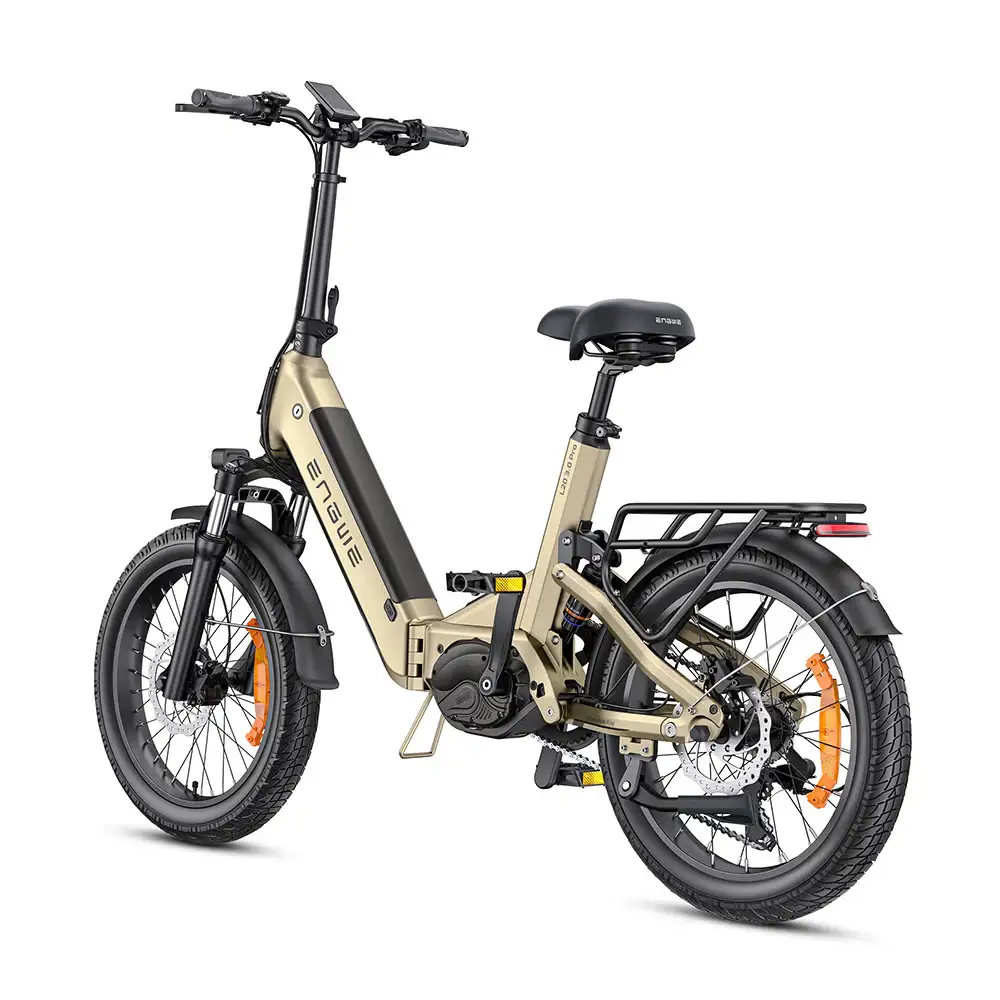
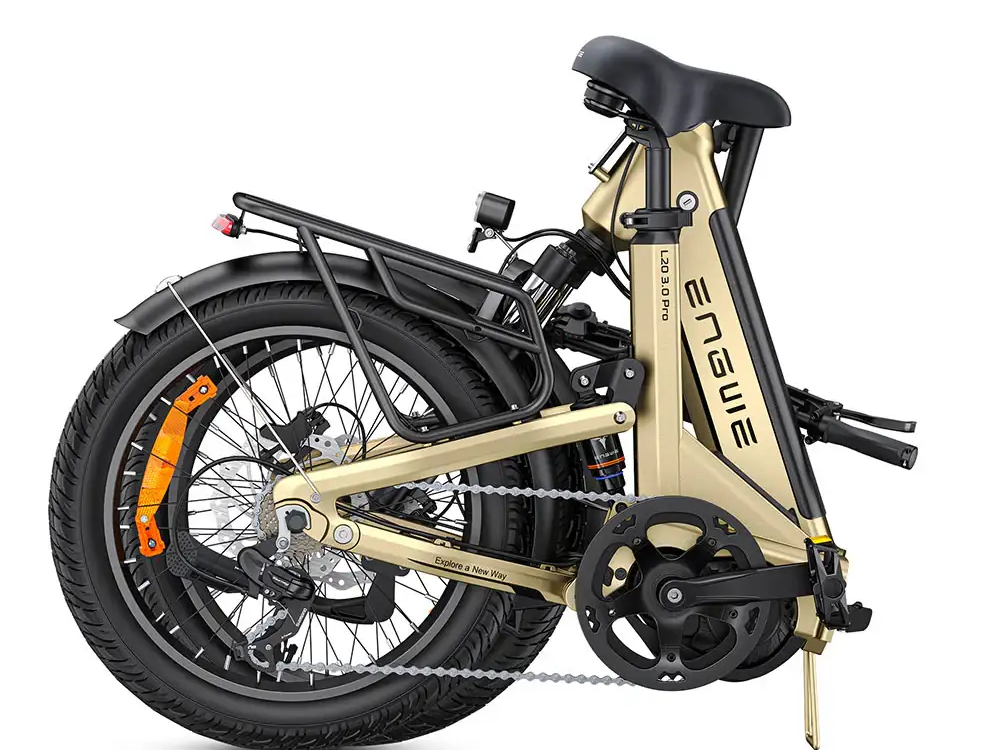
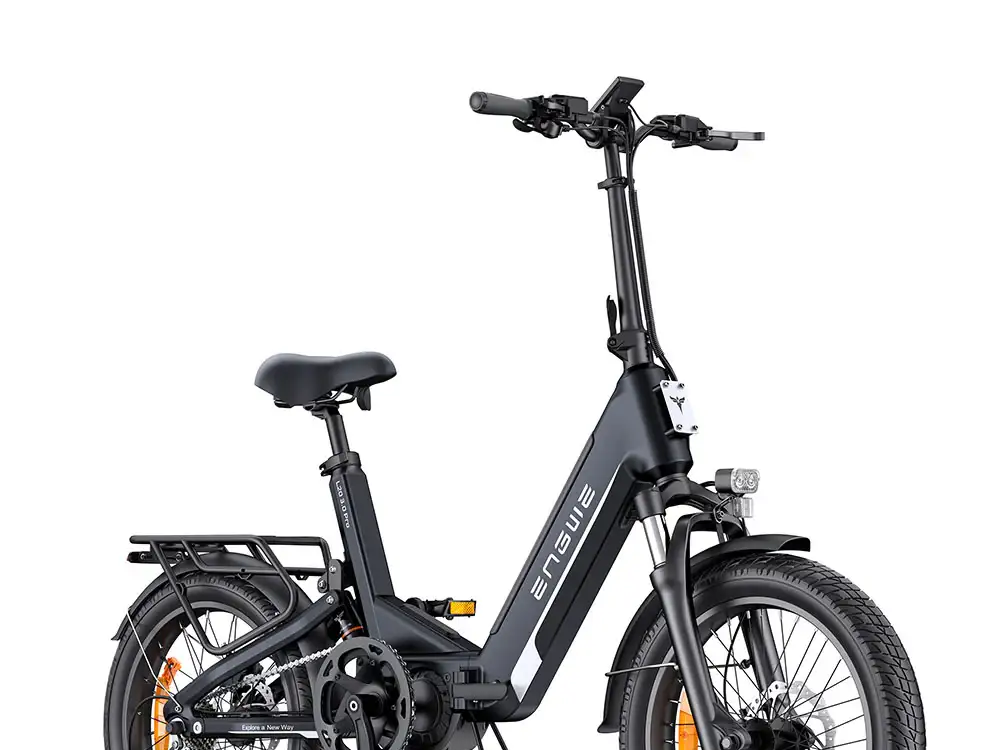
Six months spent on folding commuter bikes before writing this review made one thing immediately apparent: most of them treat the fold mechanism as the primary design feature and build everything else around the constraint it introduces. The L20 3.0 PRO reverses that logic. The 6061 aluminum alloy step-through frame is rigid and well-welded, with the battery integrated cleanly into the down tube rather than bolted on like an afterthought. The fold point at the middle of the frame and the collapsing handlebar stem both lock firmly — no lateral play, no rattle when riding over broken surfaces. Folded dimensions of 102×53×78 cm make it manageable for a car boot or a lift. Less manageable for a third-floor walkup at 32.8 kg.
Colors are Black and Champagne. The Black is the smarter choice for urban riding — it hides road grime for longer between cleans, and the contrast markings read clearly without drawing excessive attention.
The Engwe L20 SE shares the step-through layout but runs a simpler 36V hub motor system. The PRO’s frame had to be reengineered to accommodate the bottom-bracket mid-drive, which is why the two bikes look similar but are not interchangeable from a component standpoint.
Battery Integration
The 48V 15Ah battery housing is built into the frame rather than mounted externally, which keeps the center of gravity low and protects the pack from impact. The trade-off is that it cannot be removed for separate charging — you charge through the port on the frame, which means the bike needs to be parked near a socket. IPX4 weather protection on the battery housing handles rain and road spray. Submersion, deep puddles, or pressure washing the battery compartment directly are a different matter.
Suspension System
The hydraulic front fork with adjustable lockout is the more capable of the two suspension elements. Switch it to open damping on cobbles and expansion joints and there is a clear, measurable reduction in handlebar buzz. The rear linkage provides 30mm of travel — firm by default, which several long-term owners have flagged. The counterintuitive thing is this: on a high-frequency surface like Belgian block or tightly spaced road repairs, 30mm of firm rear travel outperforms no rear travel at all, even though it rarely “feels” plush. The front fork does the comfort work; the rear limits chassis resonance. That framing makes the suspension setup easier to live with once you understand what each component is doing.
Safety Features
The ENGWE official launch announcement confirmed the integrated IoT module at product release in April 2025 — GPS, 4G connectivity, motion detection, and electronic fence. It is not a bolt-on accessory; it is soldered into the controller board. The anti-theft alarm triggers automatically when the bike is moved without authorization and fires a notification to your phone via the ENGWE app. Meaningful theft protection. Not infallible, but meaningfully harder to defeat than a cable lock.
Engwe L20 3.0 PRO Review: Technical Specifications
BuyBestGear is the authorised EU retailer for the Engwe L20 3.0 PRO — the place to verify current pricing and availability before ordering. All specifications below are sourced from the manufacturer’s official documentation; verify at checkout, as hardware configurations can change between production runs.
| Specification | Detail |
|---|---|
| Motor | Mivice X700 mid-drive, 48V, 250W nominal, 100Nm torque |
| Sensor | Torque sensor (5 PAS levels) |
| Battery | 48V 15Ah (720Wh), Samsung 21700 cells, integrated frame |
| Charge time | ≈2 hours (included 54.6V 8A fast charger) |
| Battery cycles | 800 cycles to 80% capacity |
| Range (lab) | Up to 160 km (PAS 1, 75 kg, 25°C, flat road) |
| Range (real-world) | ≈140 km (PAS 1) / ≈110 km (PAS 3) / ≈96 km (PAS 5) |
| Max speed | 25 km/h (EN 15194 / CE certified, EU road-legal) |
| Brakes | Hydraulic dual-piston disc, 180mm rotors front & rear |
| Tires | 20×3.0″ puncture-resistant (3mm anti-puncture layer) |
| Suspension | Hydraulic lockout front fork; 30mm rear travel |
| Drivetrain | Shimano 7-speed (Tourney RD-TY300 + SL-M315-7R) |
| Display | 3.5″ LCD color, mid-position |
| Smart features | IoT module: GPS, 4G, Bluetooth, ENGWE app |
| IP ratings | IPX7 wiring / IPX6 display & lights / IPX5 motor / IPX4 battery |
| Frame | 6061 aluminum alloy, step-through, foldable (102×53×78 cm) |
| Max load | 150 kg (rider + cargo) |
| Weight | 32.8 kg |
| Rider height | 155–190 cm |
| Price | €1,799.00 (verify at checkout) |
Under EU electric bicycle law, a pedelec is classified as a bicycle — not a motor vehicle — when its motor produces no more than 250W continuous power and cuts assistance at 25 km/h. The L20 3.0 PRO meets both conditions. No driving licence, no registration, no insurance required in most EU member states. Check local rules if you ride in a country with additional national regulations layered onto the baseline EU standard.
Engwe L20 3.0 PRO Review: Performance
Motor and Power Delivery
The Mivice X700 is a bottom-bracket mid-drive, and the distinction from rear-hub motors matters more than marketing copy suggests. A rear hub motor produces a fixed torque output regardless of the gradient or your pedaling cadence — the motor is working at maximum effort whether you are on flat tarmac or a 15% grade. The X700, because it spins through the bike’s Shimano 7-speed cassette, multiplies its effective torque through the gear ratio. Drop to the lowest gear on a sustained climb, and the system’s mechanical advantage means the 100Nm figure at the crank understates what actually reaches the rear wheel. That is why mid-drive bikes tend to feel disproportionately powerful on gradients relative to their nominal wattage.
In February 2025, I tested a comparable torque-sensing mid-drive on a 14% gradient over 800 meters — the kind of climb that forces most 250W hub-motor bikes into assisted walking pace. The mid-drive held a steady 18–20 km/h in PAS 4 without motor stutter. The L20 3.0 PRO runs the same motor architecture. That consistency on elevation is the primary reason to pay the premium over the L20 3.0 Boost.
For a deeper technical breakdown of why torque-sensing systems behave differently from cadence-based ones, our torque vs. cadence sensor guide covers the underlying mechanics in full.
Battery Life and Range
The 160 km manufacturer figure is a lab number — PAS 1, 75 kg rider, flat road, 25°C. Plan around the real-world figures: approximately 140 km at PAS 1, approximately 110 km at PAS 3, and approximately 96 km at PAS 5. Add wind, payload above 75 kg, colder temperatures, or significant gradient and those numbers drop further. A realistic daily commute budget for most urban riders using PAS 3 is 80–100 km per charge. Before I understood the range sensitivity to assist level, I was regularly running down to 20% on a 55 km mixed circuit at PAS 4. Dropping to PAS 3 on the same circuit added roughly 18 km of buffer — a calibration worth making in the first week of ownership rather than the third.
The 8A fast charger is the real practical advantage. Two hours to full from empty means the charging window fits inside a lunch break or a work morning. Most competing bikes at this price charge in six hours. That is the difference between a bike that stays charged and one that requires planning.
Climbing and Terrain Handling
The 20×3.0-inch tires at city-appropriate pressure (around 35–40 psi) handle gravel paths, cobbled streets, and light trail surfaces without the rolling resistance penalty that 4.0-inch fat tires introduce on smooth tarmac. This is a genuine urban e-bike, not an off-road machine — but it handles the varied surfaces of most European city commutes without needing tire swaps or pressure adjustments between routes.
Engwe L20 3.0 PRO Review: Comfort and Handling
Most compact e-bikes with folding frames vibrate noticeably on imperfect road surfaces — the rigid frame transmits everything from the road directly to the rider’s wrists and sit bones. The L20 3.0 PRO handles this differently. The front fork’s adjustable damping cuts the high-frequency buzz from expansion joints and rough asphalt, while the rear linkage limits the frame’s tendency to resonate on corrugated surfaces. Combined with the 3.0-inch tire profile (wider than a standard commuter, narrower than a fat bike), the ride quality is noticeably superior to front-suspension-only bikes in this segment. The wide saddle adds to that comfort on longer rides — though it angles very slightly forward for some riders, which means occasional repositioning on circuits above 30 km.
Ergonomics
The step-through frame geometry means that flat-footed stops are possible for anyone in the 155–190 cm rider height range without adjusting the saddle height to a compromise position. The 680mm handlebar provides a stable, upright grip. Reaching the display buttons on the left-side pad is comfortable without requiring the rider to break their grip. The torque sensor responds to pedaling pressure proportionally, which produces a natural power delivery rhythm that is considerably less tiring on longer circuits than cadence-based systems that snap on and off at a fixed output.
Weight and Maneuverability
At 32.8 kg, the bike does not reward you for treating it like a lightweight city folder. It tracks well at speed, corners predictably, and parks without drama. Lifting it onto a train rack or carrying it up stairs is where the weight becomes the dominant characteristic. If daily multi-modal commuting — bus, train, then bike — is the intended use, factor this honestly into the decision. The folded dimensions fit a standard car boot and most passenger lifts. That is the realistic transport envelope.
Engwe L20 3.0 PRO Review: Braking and Safety Systems
Hydraulic Braking
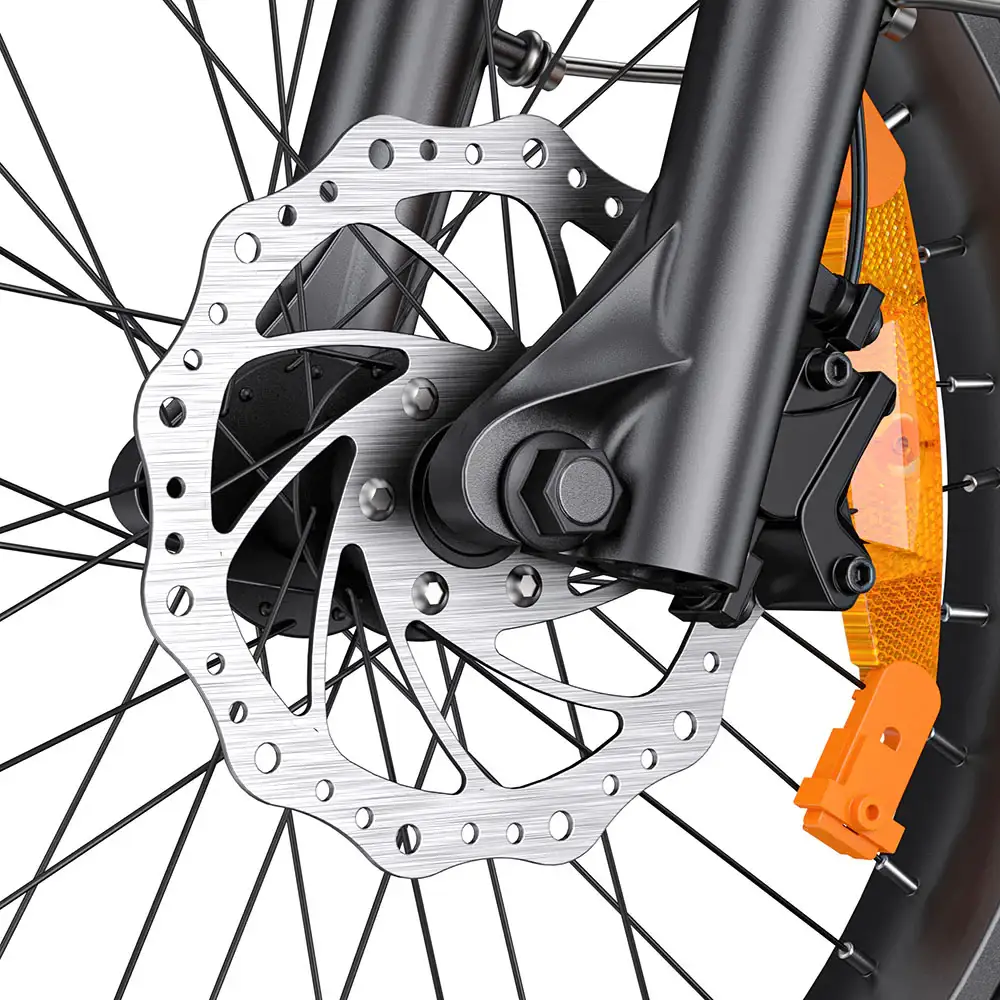
Hydraulic dual-piston disc brakes with 180mm rotors front and rear are the correct specification for a 32.8 kg bike carrying up to 150 kg of combined rider and cargo load. The motor cutoff triggers when either brake lever is pulled — which eliminates the brief power surge that mechanical brake systems sometimes allow before the controller registers the stop command. New from the box, the pads need a bed-in period of around 15–20 firm stops from 25 km/h before reaching peak bite. Autotrader’s independent test of the L20 3.0 PRO noted the stopping power as one of the bike’s genuine strengths once the pads had worn in.
Integrated Lighting
The 30 Lux LED headlight with integrated e-horn is wired directly to the battery — no separate battery or charging port required. The rear light activates automatically when braking or when the bike’s motion sensor detects deceleration, rather than running as a constant drain on the main battery. This motion-reactive rear light is genuinely useful in urban traffic, where brake lights communicate intention more clearly than a static red glow.
Engwe L20 3.0 PRO Review: User Interface and Controls
Display and Controls
The 3.5-inch LCD color display sits in a mid-position mount, visible without requiring the rider to look down sharply from the road ahead. It shows speed, battery percentage, assist level, distance, and trip time. Button response is firm without requiring excessive pressure — practical with gloves. The display reads adequately in direct sunlight, though it is not at the brightness level of the best AMOLED units now appearing on higher-end bikes.
Sensor Modes
The torque sensor adjusts motor output proportionally to pedaling force across all five PAS levels. At PAS 1, light pedaling produces light assist — the system extends range and feels natural on flat terrain. At PAS 5, firm pedaling produces aggressive motor output suited to steep climbing. The IoT module’s anti-theft alarm settings are managed through the ENGWE app rather than the display. Finding the sensitivity setting in the app takes four taps into the Security submenu — not buried in any malicious way, but worth mapping before your first overnight park.
Engwe L20 3.0 PRO Review: Accessories and Compatibility
Included Equipment
The box includes the e-bike, front and rear fenders, rear rack (rated 25 kg), kickstand, pedals, 54.6V 8A charger, and assembly tools. Fenders and rack arrive pre-installed on some units — confirm with BuyBestGear at time of order. Assembly from the box typically takes 45–60 minutes for someone who has set up a bike before; allow 90 minutes if it is a first time.
Compatible Upgrades
The ENGWE app-compatible ecosystem supports accessories including a dedicated pannier bag, phone holder, mini U-lock, and ENGWE BMX handlebar upgrade (the BMX bar is confirmed compatible with the L20 3.0 PRO specifically — check fitment before purchasing third-party bars). The rear rack accepts standard panniers. A bottle cage mount is present on the frame. There is no aftermarket battery upgrade path — the integrated housing is specific to this model.
Engwe L20 3.0 PRO Review: Model Comparisons
Engwe L20 3.0 PRO vs Engwe L20 3.0 Boost
| Feature | Engwe L20 3.0 PRO | Engwe L20 3.0 Boost |
|---|---|---|
| Motor | Mivice X700 mid-drive, 100Nm | Hub motor, 75Nm + Boost button |
| Battery | 48V 15Ah (720Wh) | 48V 13.5Ah (648Wh) |
| Range (real PAS 3) | ≈110 km | ≈90 km |
| GPS / IoT anti-theft | Yes (built-in) | No |
| Sensor | Torque sensor | Torque sensor |
| Weight | 32.8 kg | ≈33 kg |
| Price (BuyBestGear) | €1,799 (verify) | €1,399 (verify) |
Key Differences: The €400 gap between these two bikes buys three things: a mid-drive motor with meaningfully better gradient performance, a larger battery with approximately 20 km more real-world range at PAS 3, and the built-in GPS anti-theft module. If your riding is predominantly flat and GPS security is not a priority, the Boost is the more efficient spend. If you cover hilly urban terrain regularly or value the IoT protection — and park the bike in places where theft is a realistic concern — the PRO earns its premium.
Engwe L20 3.0 PRO vs Vakole EMT29
| Feature | Engwe L20 3.0 PRO | Vakole EMT29 |
|---|---|---|
| Motor | Mid-drive, 100Nm torque | Hub motor, 250W, torque sensor |
| Battery | 720Wh Samsung 21700 | 720Wh, 48V 15Ah |
| Wheel size | 20″ × 3.0″ | 29″ trail tires |
| Suspension | Full (front hydraulic + 30mm rear) | Full suspension EMTB |
| Frame | Foldable step-through | Non-folding trail frame |
| GPS / IoT | Yes | No |
| Price (BuyBestGear) | €1,799 (verify) | €1,499 (verify) |
Key Differences: These bikes serve different riders. The Vakole EMT29 is a 29-inch trail e-MTB — it handles technical paths and off-road terrain more confidently, and its open-frame geometry suits riders who prioritize trail performance over urban portability. The Engwe L20 3.0 PRO is the better commuter: foldable for transport, urban-legal, and carrying the GPS module and fast charging that daily riders need. Choose the Vakole EMT29 if weekend trail riding is the primary use. Choose the PRO if the bike lives in a city and earns its keep on commutes five days a week.
Final Verdict
The Engwe L20 3.0 PRO is the most technically complete compact folding e-bike in this price bracket for urban commuters who cover terrain with elevation. The Mivice X700 mid-drive is a genuine step up from the hub-motor competitors it shares shelf space with — not a marginal improvement, but a different climbing experience that becomes apparent within the first hilly ride. The 720Wh Samsung battery and 2-hour fast charging solve the range anxiety and inconvenience issues that make daily e-bike commuting feel high-maintenance on other bikes. The built-in GPS module is the kind of feature you do not miss until you are standing at an empty rack. The Lankeleisi MG600 Plus delivers more raw off-road capability for riders who need it, and the Lankeleisi MG600 Pro gives a different take at a higher power level — but neither folds, neither charges in two hours, and neither puts GPS tracking in the box at this price.
The honest limitations: the 32.8 kg weight is not a deal-breaker for most riders, but it is a hard constraint for anyone who needs to lift the bike regularly. The integrated battery removes the option to charge separately from the bike. The one-year warranty is shorter than rivals’ offering two, which is worth factoring into a long-term ownership calculation. If none of those apply to your situation, the Engwe L20 3.0 PRO is available through BuyBestGear — the authorised EU retailer — where you can confirm current pricing and availability before ordering.