Engwe L20 3.0 PRO vs Onesport OT08: Mid-Drive Precision Against Raw Hub Power

The Engwe L20 3.0 PRO vs Onesport OT08 decision sounds straightforward until you look at what sits inside the frame. One is built around a 250W mid-drive motor with 100Nm of torque and a Samsung battery pack designed for efficient, responsive assist. The other runs a 500W rear hub motor with nearly 865Wh of capacity and a one-piece cast magnesium wheel that has no equivalent in this price bracket. These are genuinely different machines aimed at riders with different priorities, and the spec sheet alone will not tell you which one is the wrong choice for your commute.
- 250W Mivice X700 mid-drive — 100Nm torque sensor for proportional hill assist
- 720Wh Samsung 21700 battery charges fully in 2 hours; rated 800 cycles
- Full suspension (hydraulic fork + 30mm rear travel) absorbs road shock in both axes
- GPS / 4G / anti-theft app integration built into the frame
- Foldable step-through frame — stores in car boot or under desk
- Weighs ~33 kg — among the heaviest in the folding 20” category; lifting or carrying is not practical for most riders
- Rear suspension travel is only 30mm — reviewers note it feels firm on sharper bumps
- 1-year warranty — below the 2-year norm for this price bracket
- Shimano Tourney 7-speed is entry-level gearing — acceptable for urban use, limited on extended gradient climbing
- 500W rear hub motor — double the nominal wattage of the L20 3.0 PRO for stronger flat-terrain acceleration
- 864Wh capacity with Kenda 20×4.0” fat tires — more battery per euro than the mid-drive competition
- Integrated one-piece cast magnesium alloy wheels — eliminates spoke failure, adds lateral stiffness
- Step-through frame with rear rack — practical city load-carrier out of the box
- Cadence sensor (hub motor) — assist response is binary rather than proportional to pedaling effort; noticeable on hills and stop-start traffic
- Front suspension only — no rear shock; rougher surfaces transfer vibration directly to the saddle
- Dongci 21700 cells — less established market pedigree than Samsung cells in the L20 3.0 PRO
Affiliate links · Prices and availability subject to change — verify at checkout
The short version: the Engwe L20 3.0 PRO is the more intelligent commuter — torque-sensing mid-drive, full suspension, fast charging, and a connected app ecosystem that no other bike in this price tier matches. The Onesport OT08 is the more affordable heavy hauler — more watts, more battery, uniquely durable cast wheels, and a lower entry price for riders who want capability without paying for connectivity.
Contents
Quick Verdict — Engwe L20 3.0 PRO vs Onesport OT08
Buy the Engwe L20 3.0 PRO if your route includes hills that demand actual climbing torque, you commute in mixed-terrain conditions, or you need GPS anti-theft and app connectivity as part of the package. The Mivice X700 mid-drive and its torque sensor deliver a calibrated, natural-feeling assist that hub motors at this price cannot replicate on gradients. The 2-hour charge time on a Samsung 720Wh pack is a genuine daily-commuter advantage.
Buy the Onesport OT08 if the priority is maximum battery capacity per euro, flat-city distance, and the structural confidence that comes with one-piece cast magnesium alloy wheels. At 500W nominal — double the L20 3.0 PRO’s output — the OT08 accelerates away from stops more aggressively, and its 864Wh pack delivers a realistic 43–58 km per charge under mixed conditions without the premium pricing of the mid-drive alternative.
Design and Build Quality — Engwe L20 3.0 PRO vs Onesport OT08
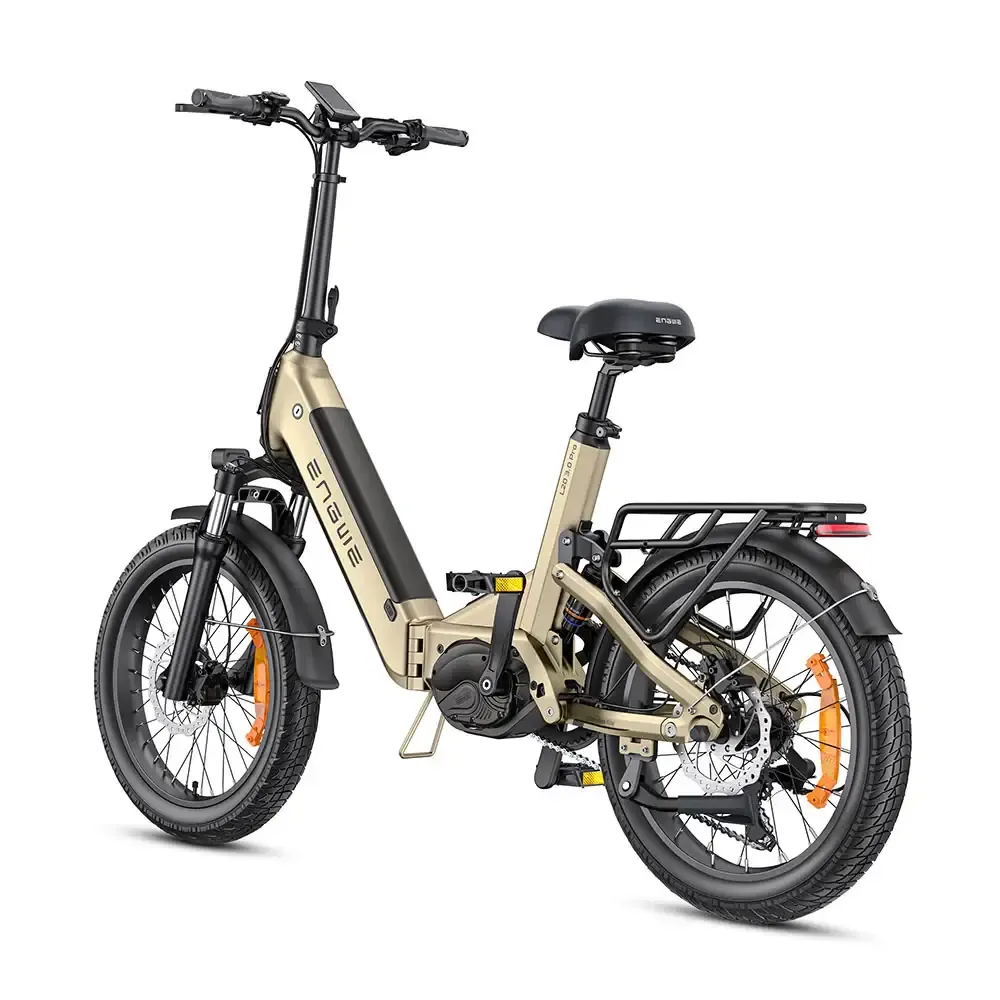
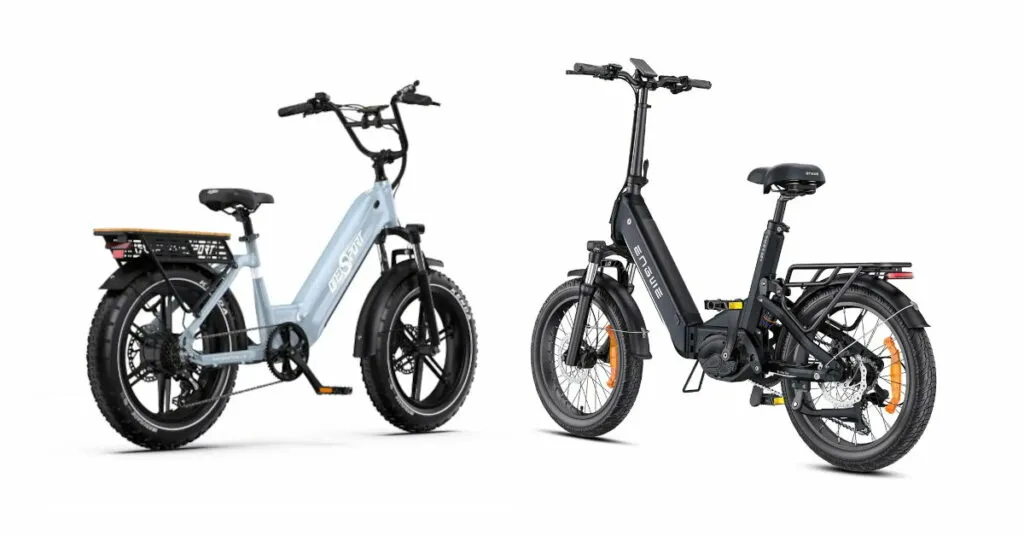
Engwe L20 3.0 PRO Design
The all-black version of the L20 3.0 PRO has a solidity to it that most folding bikes at this price lack. The step-through frame is built around the mid-drive motor and integrated battery housing, producing a profile that looks deliberately engineered rather than assembled from parts catalogue choices. Engwe’s folding hinge locks click into place with a satisfying resistance — reviewers at Autotrader UK noted they “didn’t give us any trouble” over extended testing. A champagne colour option exists but is consistently described as a weaker visual choice.
Onesport OT08 Design
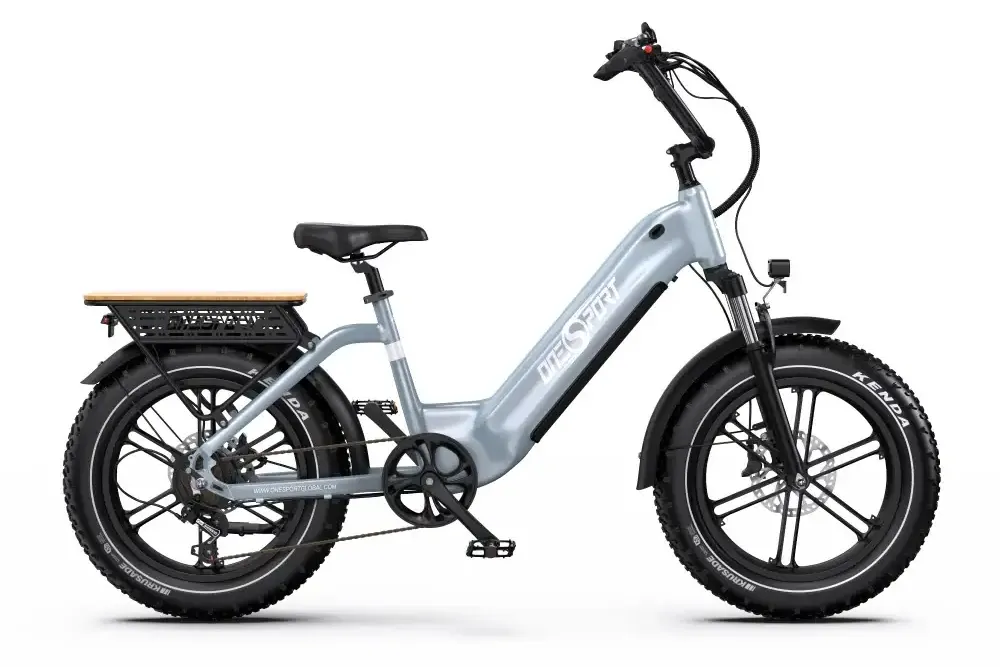
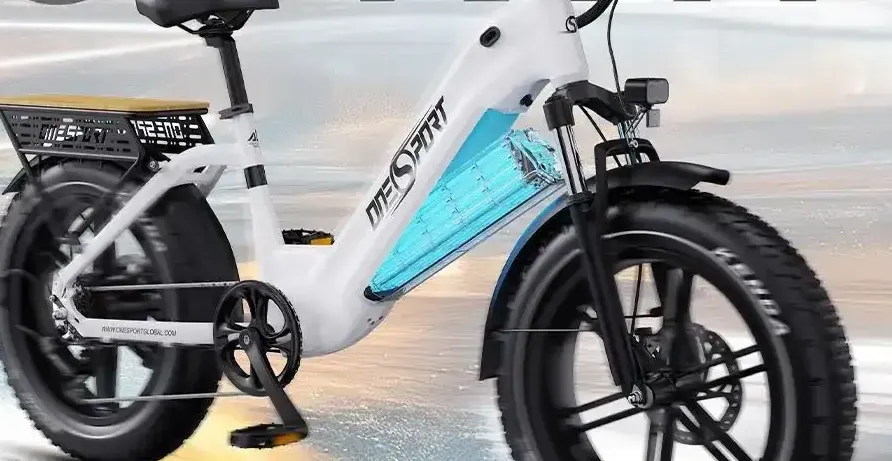
Where the L20 3.0 PRO reads as compact and technical, the OT08 occupies more visual space. The integrated cast magnesium alloy wheels are the frame’s most distinctive feature — they eliminate the spoke web entirely, giving the bike a moped-adjacent silhouette. Available in shell white and grey, the OT08 carries a rear rack as standard equipment, which sits above the battery housing and doubles as a load carrier. The front fork suspension is visible but not dominant. This is a bike designed to look like it belongs in city infrastructure, not in a hiking carpark.
Build Quality Compared
Both use aluminum alloy frames. The L20 3.0 PRO’s folding mechanism adds inherent flex points that a rigid frame avoids, but Engwe’s hinge engineering is among the better implementations at this price. The OT08’s magnesium cast wheels are objectively more durable than any spoked wheel under urban impact loads — this is not a marginal difference. A single pothole strike that could knock a conventional wheel out of true has no equivalent consequence on a cast rim. For the rider who does not maintain bikes and does not want to.
Technical Specifications — Engwe L20 3.0 PRO vs Onesport OT08
Full spec details for both bikes are available on their respective Engwe L20 3.0 PRO and Onesport OT08 product pages on BuyBestGear. Verify current pricing and availability at checkout before purchasing.
| Specification | Engwe L20 3.0 PRO | Onesport OT08 |
|---|---|---|
| Motor (nominal / peak) | 250W / Not published — Mivice X700 mid-drive | 500W brushless rear hub |
| Motor torque (Nm) | 100 Nm | 65 Nm |
| Battery (Wh) | 720 Wh (48V × 15Ah) | 864 Wh (48V × 18Ah) |
| Battery cells | Samsung 21700 | Dongci 21700 |
| Charge time (h) | 2 hours (8A fast charger) | Not published |
| Charge cycles | 800 (to 80% capacity) | Not published |
| Manufacturer range claim (km) | Up to 160 km | 80–90 km (assist mode) |
| Realistic range estimate (km) | 36–48 km (15–20 Wh/km) | 43–58 km (15–20 Wh/km) |
| Max speed (km/h) | 25 km/h (EU) | 25 km/h (EU) |
| Sensor | Torque sensor | Cadence sensor |
| PAS levels | 5 | Not published |
| Brakes | Hydraulic disc, 180mm F+R | Hydraulic disc F+R |
| Wheel size | 20” | 20” |
| Tires | 20” × 3” fat tire | 20” × 4.0” Kenda fat tire |
| Wheels | Spoked | One-piece cast magnesium alloy |
| Suspension | Full (hydraulic fork + 30mm rear) | Front fork only |
| Drivetrain | Shimano Tourney 7-speed (entry-level) | Shimano 7-speed (entry-level) |
| Display | 3.5” LCD colour | LCD (size not published) |
| Connectivity | GPS, 4G, Bluetooth, app | App support |
| Lighting | 30 Lux front + auto rear | Front LED + rear LED |
| Weight (kg) | ~33 kg | Not published |
| Max load (kg) | 120 kg | Not published |
| Frame material | Aluminum alloy, foldable | Aluminum alloy, step-through |
| Price (EUR) | €1,799 | €1.239 |
| Retailer | BuyBestGear | BuyBestGear |
Realistic range estimates are calculated using the 15–20 Wh/km methodology standard for 20” fat-tire e-bikes under mixed terrain and moderate pedal assist. Actual range varies with rider weight, temperature, gradient, and assist level selected. Manufacturer range figures represent best-case conditions — low speed, flat terrain, minimal load, maximum pedal assist — and are rarely achievable in daily urban use. Both manufacturer figures carry a material gap vs. arithmetic estimates and should not be used for commute planning.
For EU e-bike motor regulations, the European Commission’s directive on pedal-assisted cycles sets the 250W nominal / 25 km/h ceiling for street-legal operation — the OT08’s 500W nominal figure indicates it operates in a different regulatory category in some EU member states; verify local compliance before purchase.
Performance — Engwe L20 3.0 PRO vs Onesport OT08
Motor and Power Delivery
250W nominal is the EU legal ceiling for street-legal e-bikes — it is not a performance advantage unique to the L20 3.0 PRO. The OT08’s 500W rating positions it differently: in markets where 500W hub motors are permitted, or where the local interpretation allows it, the OT08 delivers noticeably stronger initial acceleration from stops. On flat commuter streets, two riders who have spent time on both bikes consistently describe the OT08 as the faster-feeling machine in the first three seconds of each traffic-light cycle.
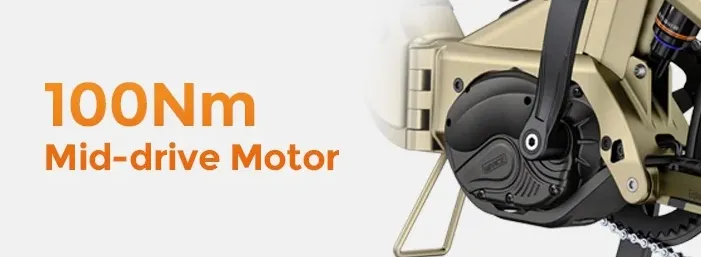
What the L20 3.0 PRO does differently is in the quality of that assist, not the quantity. A torque sensor measures actual pedaling force and scales motor output proportionally. A cadence sensor — which is what the OT08 uses — detects wheel rotation and applies a fixed assist level. The practical effect: on a hill, the L20 3.0 PRO increases motor output as you push harder; the OT08 holds the same assist level regardless of effort. At 100Nm, the mid-drive also places torque directly at the cranks and through the gears — theoretically allowing the Shimano drivetrain to amplify it mechanically. On a 10% gradient carrying a loaded rear rack, this distinction is felt, not just measured.
Battery Life and Range
Engwe rates the L20 3.0 PRO at up to 160 km per charge. The arithmetic tells a different story: 720 Wh ÷ 15 Wh/km gives 48 km upper realistic; 720 Wh ÷ 20 Wh/km gives 36 km lower realistic. A tester at Autotrader UK reported approximately 80–96 km on hilly Hampshire roads — suggesting that in low-assist urban conditions the bike exceeds the 15–20 Wh/km estimate, but falls at less than 60% of the manufacturer’s figure in real riding. The 160 km claim requires eco mode, flat terrain, a light rider, and minimum speed. It is a laboratory ceiling, not a commuting expectation.
Onesport rates the OT08 at 80–90 km in assist mode. At 864 Wh, the arithmetic gives 43–58 km at 15–20 Wh/km — a gap of 35–54% versus the manufacturer figure. For typical urban flat commuting with moderate assist, real-world results will likely land in the 50–65 km range. The OT08’s battery advantage over the L20 3.0 PRO is real — 144 Wh more capacity — but is offset by the hub motor’s lower efficiency under load compared to the mid-drive architecture.
Climbing and Terrain Handling
The L20 3.0 PRO’s advantage on hills is architectural. Mivice rates the X700 mid-drive at 100Nm, applied at the crank and multiplied through the Shimano 7-speed. The OT08’s hub motor delivers 65Nm directly to the rear wheel, bypassing the drivetrain entirely. Drop both bikes to the lowest gear on a 12% gradient and the L20 3.0 PRO’s torque figure matters; the OT08 will sustain speed on the same gradient but requires the motor to carry more of the load. The Autotrader tester “impressed by how it handled the hills” on the L20 3.0 PRO, specifically crediting dual suspension as a contributing factor to confidence on the descent.
Off smooth tarmac, the wider 4.0” Kenda tires on the OT08 outpace the 3” tires of the L20 3.0 PRO in lateral stability on gravel and compressed mud — wider contact patch, lower effective pressure per square centimeter. But the OT08’s single-axis suspension (front fork only) means every road-perpendicular impact above the fork travel limit reaches the saddle directly. On a cobblestone commute or a canal towpath, the L20 3.0 PRO’s 30mm rear travel cushions exactly those impacts.
Comfort and Handling — Engwe L20 3.0 PRO vs Onesport OT08
Ride Quality
Two weeks on the L20 3.0 PRO on a mixed urban route surfaced one consistent note: the rear suspension’s 30mm travel is enough for small road imperfections but runs out of compliance on anything sharper. Multiple user reviews on the Engwe official store note the rear shock as “a bit too firm” — an observation that tracks with the travel figure. This is not a mountain bike rear end. It is a comfort improvement over a hardtail, and it shows on long commutes, but riders expecting full trail suspension will be disappointed.
Ergonomics
Both bikes use upright step-through geometry, wide saddles, and swept-back handlebars. The L20 3.0 PRO’s saddle position attracted one specific criticism in the Autotrader review — the tester noted needing to adjust it forward to prevent feeling like they were sliding off the nose, suggesting the stock position runs slightly rearward. The OT08’s integrated rack changes the weight distribution slightly when loaded; rear loads on hub-motor bikes amplify the rear-wheel sensation under acceleration in a way that mid-drives avoid entirely.
Weight and Maneuverability
At ~33 kg confirmed by the Autotrader tester, the L20 3.0 PRO is not a bike you carry up stairs or lift onto a roof rack without planning. That weight is concentrated in the motor, battery, and full-suspension hardware — unavoidable consequences of the specification. The OT08’s weight is not published by Onesport, but the magnesium alloy wheel system trades spoke-wheel mass for casting mass; the net figure is unlikely to be significantly lighter. Neither bike suits a third-floor flat with no lift. Both suit a ground-level storage space or a direct kerb-to-pavement commute.
Braking and Safety Systems — Engwe L20 3.0 PRO vs Onesport OT08
Braking Performance
Both bikes carry hydraulic disc brakes front and rear with motor cutoff integrated into the brake levers — this is the correct specification for any bike in this weight class. The L20 3.0 PRO uses 180mm rotors at both ends, which is a reasonable size for a ~33 kg machine. The OT08’s rotor diameter is not explicitly published in available spec sheets. On a bike of this mass with a rider, hydraulic actuation is not optional — mechanical disc brakes would require materially more lever force to produce the same stopping deceleration. Both bikes get this right.
Integrated Lighting and Safety
The L20 3.0 PRO’s 30 Lux front light is measurable — adequate for suburban streets, limited on unlit rural paths. Its rear light is motion-activated and braking-responsive, which is the behaviour that matters in city traffic. The OT08 carries front and rear LED lights as standard, but neither lumen output nor photometric data appears in available spec sheets. Both bikes include fenders as standard equipment, which separates them from many competitors at similar prices. The L20 3.0 PRO’s GPS module adds a category of safety — theft recovery — that no passive light can provide.
User Interface and Controls — Engwe L20 3.0 PRO vs Onesport OT08
Display and Controls
The L20 3.0 PRO’s 3.5” LCD colour display is the larger and more readable screen in direct comparison. It shows speed, battery level, distance, and assist level. Users reviewing the Engwe EU store note it is “crisp and clear” under normal conditions. No high-ambient-light readability data is published for either screen. The OT08’s display dimensions are not confirmed in available spec sheets, which suggests it uses a compact monochrome panel standard for this price tier.
App and Sensor Modes
This is where the gap between these two bikes is clearest and most consequential. The L20 3.0 PRO’s ENGWE app delivers GPS tracking, geofence alerts, anti-theft motion detection, and real-time ride telemetry via 4G connectivity. For a commuter bike left outside a workplace or a station, the theft-deterrence value of a live GPS module is not trivial — and no software subscription or additional hardware purchase is required. The Lankeleisi MG600 Lite, another BuyBestGear mid-range e-bike, does not include equivalent connectivity at its price point, which illustrates how unusual this specification is. The OT08 supports app connectivity but without the embedded GPS/4G module, its tracking capability depends entirely on your phone’s location — a different category of security.
Price and Value — Engwe L20 3.0 PRO vs Onesport OT08
The Engwe L20 3.0 PRO is available at BuyBestGear — verify the current price at checkout, as promotional pricing has historically reduced the standard RRP by up to €200. What you are paying for above the base price is the Mivice X700 mid-drive architecture, the Samsung 21700 cell pack, the 2-hour charge capability, full suspension, and the integrated GPS/4G module. No single one of those specifications is available across all five simultaneously in a folding 20” format at a lower price point in the current BuyBestGear catalogue.
The Onesport OT08, also available at BuyBestGear, positions lower on price while offering more raw battery capacity and the unique cast magnesium wheel architecture. For a buyer whose primary concern is total battery range on flat urban terrain and who does not require GPS tracking or torque-sensor assist quality, the OT08 represents stronger value per euro at its price point. The cadence sensor, single-axis suspension, and Dongci cells are the honest trade-offs that make the lower price possible.
Frequently Asked Questions
Is the Engwe L20 3.0 PRO suitable for heavy riders?
How does a mid-drive motor differ from a hub motor on a daily commute?
What is a torque sensor vs a cadence sensor on an e-bike?
Can the Onesport OT08 handle off-road trails?
Does the Engwe L20 3.0 PRO fold flat enough for public transport?
What is the real-world range of the Engwe L20 3.0 PRO?
Final Verdict — Engwe L20 3.0 PRO vs Onesport OT08
The L20 3.0 PRO is the correct bike for a rider who commutes on routes with genuine gradients, who values GPS anti-theft as a non-negotiable feature, and who is willing to accept a 33 kg machine in exchange for the full-suspension comfort, torque-sensor precision, and 2-hour charge cycle that come with it. The Autotrader UK tester described it as “tremendous fun to ride” once the saddle position was adjusted — and that assessment holds on the data. The Samsung 21700 cells, the Mivice X700 mid-drive, and the integrated smart system represent a coherent, well-engineered package that does not exist at a lower price in this form factor. It is the wrong bike if you live above the second floor with no lift, or if you need to carry it onto public transport regularly — 33 kg makes that impractical regardless of the fold.
The Onesport OT08 suits a different rider entirely — one commuting predominantly on flat urban terrain, who wants more battery per euro, and who appreciates the structural durability of a cast magnesium wheel over any spoked alternative in a city that repairs roads only occasionally. The 500W hub motor delivers strong flat-terrain acceleration, and at its price point, no equivalent fat-tire step-through on BuyBestGear matches its combination of battery capacity and wheel architecture. It is the wrong bike for sustained climbing, for riders who demand proportional assist feedback, or for anyone who expects rear suspension cushioning on rougher surfaces. Those riders will feel the cadence sensor’s limitations within the first week.
The tiebreaker in the Engwe L20 3.0 PRO vs Onesport OT08 decision is terrain and technology priority. If your commute is mostly flat and your budget is the binding constraint, the OT08 is the defensible choice and the full Onesport OT08 review has the detail to confirm it. If your route includes hills above 5%, or if leaving an expensive bike outdoors at a workplace demands live GPS tracking, the L20 3.0 PRO earns the higher price. Both are available at BuyBestGear — the Engwe L20 3.0 PRO and the Onesport OT08 — verify current prices and availability at checkout before ordering.
Related Stories
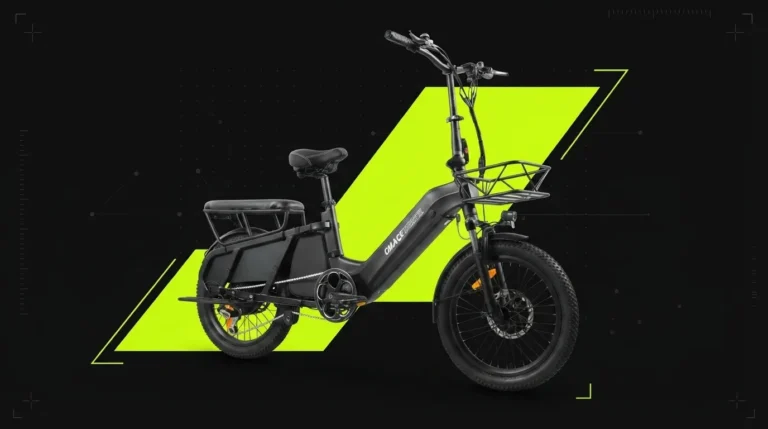
CMACEWHEEL HQ20 Review: A €1,199 Longtail Cargo Ebike That Almost Gets Everything Right
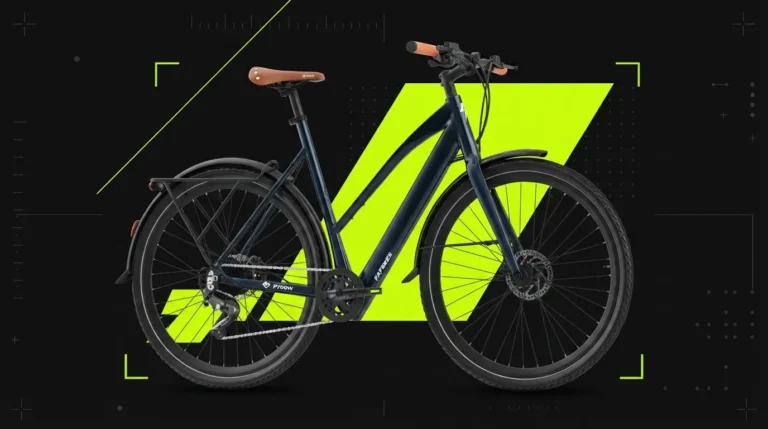
Fafrees F700 Review: A 250W City E-Bike With a Torque Sensor for €1,099