
Gemini 4 Argon Pricing: Dec 1 Cost Calculator for Devs
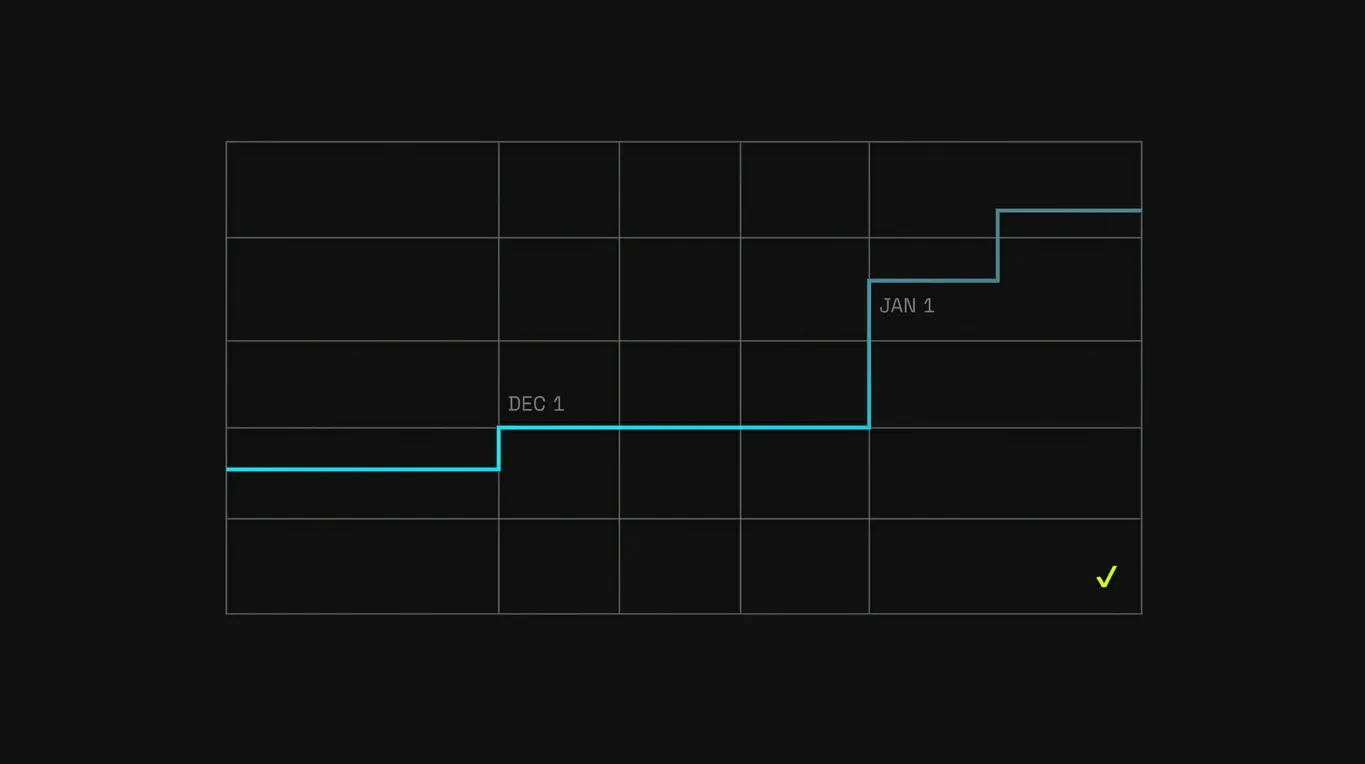
Early-October launch coverage left the end date for Gemini 4 Argon pricing open. Google’s current pricing page now closes that window. Standard is $2 per million input tokens and $10 per million output tokens through November 30, 2026. From December 1, those rates become $4 and $20. That changes forecasts built on the assumption that the launch rate would stick. Gemini 3.8 Flash and Gemini 3.6 Flash have a second price boundary on January 1, 2027. This calculator turns both dates into a budget line using tier-specific token and cache rates. It is a cost model, not a benchmark.
- Argon's launch rate ends on November 30, 2026.
- From December 1, Standard input/output rises from $2/$10 to $4/$20 per million tokens.
- Batch and Flex cost half of Standard; Priority has separate rates.
- Flash rates change on January 1, 2027.
- The calculator models cache share, counts thinking tokens as output and excludes separate tool charges.
What changed and what Google’s page says now
The difference is a date, not a new pricing philosophy. Google’s launch post gave introductory rates of $2 per million input tokens and $10 per million output tokens. It then said $4 and $20 would apply after the introductory period. Its footnote did not set the switch date. The live Gemini API pricing page now lists the introductory rates through November 30, 2026. The higher rates begin December 1.
Google’s release notes mark gemini-4-argon generally available on October 13, 2026. That replaces a vague introductory window with a defined cutover for billing forecasts. Google deprecated gemini-3.7-flash on October 8. Requests using that ID are automatically routed to gemini-3.8-flash. Its introductory price runs through December 31, 2026, so old configuration files may now land on a different model than expected.
The practical implication is straightforward: keep the model ID, pricing tier and effective date beside token volume in your forecast. A model string that still works is not proof that its old pricing assumptions still apply. Google’s release notes are the second reference to check when reviewing older deployments.
Gemini 4 Argon pricing schedule by tier
The rates below are USD per one million tokens. Each input/output pair lists input first and output second; output pricing includes thinking tokens. The four columns show the old and new rate windows for Argon and Gemini 3.8 Flash.
| Spec | Argon to Nov 30 | Argon from Dec 1 | 3.8 Flash to Dec 31 | 3.8 Flash from Jan 1 |
|---|---|---|---|---|
| Standard input / output per 1M | $2.00 / $10.00 | $4.00 / $20.00 | $0.75 / $3.75 | $1.50 / $7.50 |
| Batch/Flex input / output per 1M | $1.00 / $5.00 | $2.00 / $10.00 | $0.375 / $1.875 | $0.75 / $3.75 |
| Priority input / output per 1M | $3.60 / $18.00 | $7.20 / $36.00 | $1.35 / $6.75 | $2.70 / $13.50 |
| Standard cached input per 1M | $0.10 | $0.20 | $0.075 | $0.15 |
| Batch/Flex cached input per 1M | $0.05 | $0.10 | $0.0375 | $0.075 |
| Priority cached input per 1M | $0.18 | $0.36 | $0.135 | $0.27 |
Gemini 3.6 Flash has the same introductory-to-standard input, output and cached-input schedule as Gemini 3.8 Flash on Google’s page. For both Flash models, the listed rates apply through December 31, 2026, then rise on January 1, 2027. The table compares published token prices only; it doesn’t claim that the models behave the same.
Caching and separate tool charges
Caching needs its own line in the spreadsheet. Argon supports implicit caching only; explicit context caching is not supported. Its cache price varies by tier, just as its uncached input price does. However, Flash pricing also lists a separate hourly cache-storage charge, which the calculator below does not include.
Tool charges sit outside these token totals. Google lists 5,000 free Grounding with Google Search requests per month, shared across Gemini 3 and newer models, then $14 per 1,000 search queries. One API request can trigger more than one search query. Add those charges separately rather than burying them in an average token rate.
Calculator logic: API cost after introductory pricing
The calculator treats a month’s traffic as requests multiplied by average token counts. It splits input tokens between uncached and cached shares, then adds output tokens. Google bills thinking tokens as output. Include them in the average output-token figure. You’ll see the impact in the post-intro total.
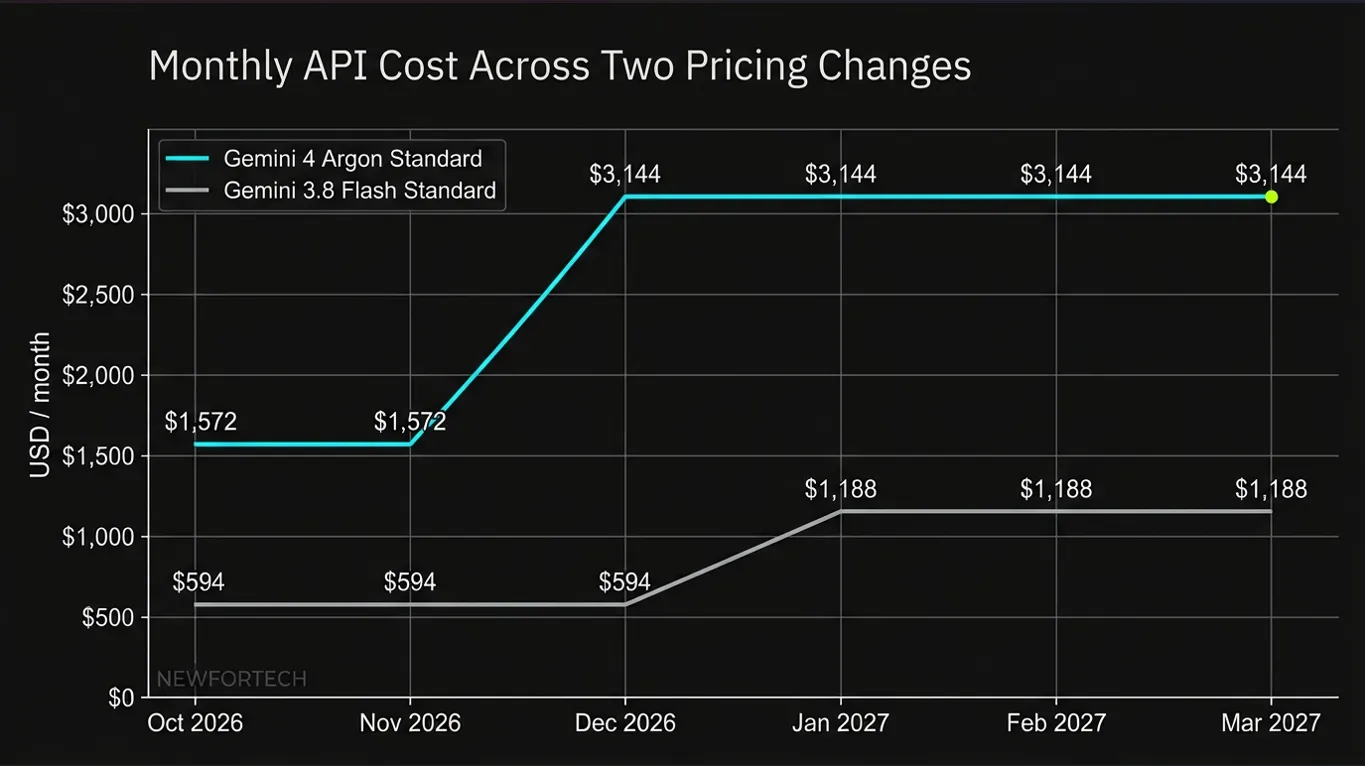
For each request, price uncached input, cached input and output at their respective per-million rates. Multiply that per-request token cost by monthly requests, then divide by 1,000,000. For example, enter cached share as a fraction such as 0.20 or as a percentage such as 20%. The script prints the selected-date cost, intro and post-intro totals, plus the dollar and percentage step. It also prints each month’s estimated cost from October 2026 through March 2027. As a result, you can see both cliffs without changing the workload assumptions.
That is a usable way to model Gemini API cost after introductory pricing without treating today’s invoice as a permanent baseline. Each month’s rate is selected from the first day of its price period: December for Argon and January for Flash. It doesn’t forecast traffic growth, cache-hit behaviour or changes to your prompts.
The script is deliberately standard-library Python. It includes all three model IDs and the four pricing tiers, but estimates token charges only. For Flash, add cache-storage hours where applicable; for any model, add grounding and other separately billed tools from your own usage records.
Worked scenarios from the published rates
These examples are calculations from Google’s published rates, not measurements or benchmark results. Each assumes the specified request volume continues for a full month. Your total changes with request count, input size, output size, cached-input share and tier.
Small developer workflow. At 10,000 requests per month, with 8,000 input tokens and 1,500 output tokens per request, assume 20% of input tokens are billed as cached. Argon Standard comes to $279.60 per month through November 30. From December 1, the same workload costs $559.20, an increase of $279.60.
Queued batch processing. At 100,000 requests, 6,000 input tokens and 2,000 output tokens per request, assume a 50% cached-input share and the Batch tier. Argon costs $1,315 per month at introductory rates, then $2,630 from December. The rate doubles, and so does this fixed-volume token estimate.
Flash service with a like-for-like Argon check. Assume 100,000 requests, 4,000 input tokens, 1,000 output tokens and 30% cached input. Gemini 3.8 Flash Standard costs $594 per month through December 31, then $1,188 from January. For the same traffic, Argon Standard rises from $1,572 to $3,144 in December.
The last example is the cleanest visual check because its request pattern stays fixed while the calendar changes the rate card. It also shows why a monthly total can be compared only when both models use the same workload assumptions. No inference about quality or latency follows from these prices.
Decision rules for a post-intro budget
A forecast should use the rate card active when traffic is billed, not the cheapest month in the current window. So price December Argon traffic at its December rate now, and Flash January traffic at its January rate.
A Gemini 4 Argon vs Gemini 3.8 Flash cost comparison is useful only when workload assumptions match. Hold request count, input/output tokens, cache share and tier constant. In the worked profile, Flash’s post-change token total is lower. That doesn’t establish the right model for every job. The Gemini 3.8 Flash 2027 price is a January budget issue, so use post-intro rates for January forecasts.
Batch and Flex cost half of Standard’s input/output rates for both model families. Priority costs 1.8 times Standard. Keep model, tier and effective date in separate budget columns; a blended “Gemini rate” conceals the variables that set the invoice.
Cache share is an assumption, not a guaranteed hit rate. For instance, use reliable cache telemetry or run low- and high-cache cases. Since output includes thinking tokens, using visible answer length alone can understate billed output.
Finally, Argon isn’t on the Free tier or Google AI Pro. Another model’s free allowance doesn’t transfer to Argon. Grounding and Flash cache storage sit outside this estimator, so budget them separately.
Before Dec 1: what to do this week
First, export a representative month’s requests and calculate average input and output tokens per request. Make sure output includes thinking tokens. Keep cached-input share as a separate input instead of assuming that every repeated prompt will be charged at the cached rate.
Next, run the companion script twice for each workload: once with a date before the cliff and once after it. Compare Standard, Batch, Flex and Priority only if those tiers are actually available to your deployment and relevant to its latency and scheduling requirements. Keep the six-month table in the budget sheet so the January Flash change is not missed.
If you’re moving a workload to Argon, read Google’s migration checklist before changing the model ID. The guide says explicit cache creation and references are not supported on Argon; implicit caching is enabled by default for prompts of at least 4,096 tokens. Update the model ID, check cache assumptions and rerun the forecast before quoting a fixed monthly fee.
Frequently Asked Questions
01 When does Gemini 4 Argon introductory pricing end?
02 Is Gemini 4 Argon available on the free tier?
03 How much does Gemini 4 Argon cost per million tokens?
What to watch next
Keep the effective date attached to every rate in your forecast. After each pricing-page change, rerun the same traffic assumptions and compare the result with observed usage. A budget that records the model ID, tier, cached share and date can be updated without rebuilding the math when the next introductory-price window closes.



Add comment